The Impact of Sleep Quality on Cycling Training Adaptation: The Relationship Between Deep Sleep and Growth Hormone Secretion
Introduction
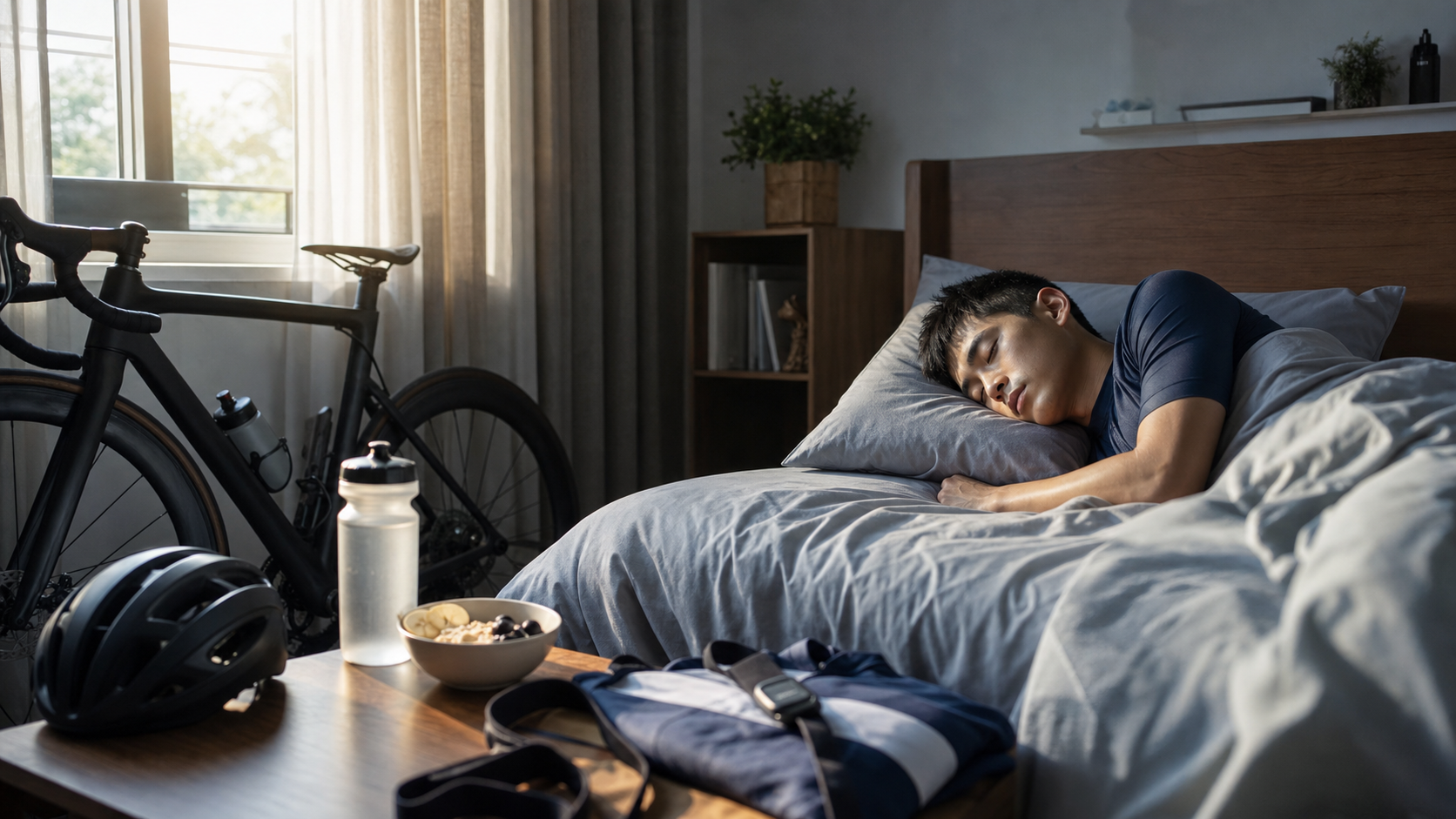
Taiwan’s working professionals often squeeze cycling time into the gaps around their commute—Yangmingshan at 5 a.m., or a trainer workout at 11 p.m. However, no matter how hard you train, if sleep is insufficient, the benefits of training will be greatly diminished. Sleep is not passive waiting; it is an active process of training adaptation, especially the growth hormone secreted during deep sleep (slow-wave sleep), which directly drives muscle repair and supercompensation after each training session.
This article will provide a complete analysis of how to optimize sleep to maximize training results, from sleep architecture and growth hormone mechanisms to common sleep disruptors faced by Taiwanese cyclists.
Sleep Architecture and Athletic Recovery
Normal sleep consists of 4–5 cycles, each approximately 90 minutes, comprising the following stages:
| Sleep Stage | Percentage of Sleep | Main Contribution to Athletic Recovery |
|---|---|---|
| N1 (Light Sleep) | 5–10% | Transition phase, limited recovery benefit |
| N2 (Light Sleep) | 45–55% | Memory consolidation, heart rate reduction |
| N3 (Deep Sleep / SWS) | 15–25% | Growth hormone secretion peak, tissue repair |
| REM (Rapid Eye Movement) | 20–25% | Neuroplasticity, motor skill consolidation |
The most critical insight: Approximately 70–80% of daily growth hormone (GH) secretion is concentrated in the first two deep sleep cycles after falling asleep (approximately 1–3 hours after sleep onset). This means that “sleep timing” is almost as important as “sleep duration.”
Growth Hormone’s Mechanisms in Athletic Recovery
Growth Hormone (GH) plays multiple roles in athletic recovery:
- Promotes muscle protein synthesis: Stimulates IGF-1 (insulin-like growth factor) secretion, activating signaling pathways for muscle repair and hypertrophy
- Accelerates fat breakdown: Increases free fatty acid availability, preserving muscle glycogen
- Enhances bone remodeling: Particularly important for bone maintenance in long-term low-impact aerobic exercise (such as cycling)
- Immune modulation: Supports post-training immune system recovery, reducing the risk of upper respiratory tract infections
Research shows: Sleep deprivation (< 6 hours) can reduce nocturnal GH secretion by 20–30%, while simultaneously elevating cortisol (stress hormone) levels, creating an environment that promotes muscle breakdown.
Specific Effects of Sleep Deprivation on Cycling Performance
Scientific research has quantified the damage of sleep deprivation on athletic performance:
- 5 consecutive days of sleep restriction to 6 hours: Maximum power output decreases by approximately 7–11%
- Single 36-hour sleep deprivation episode: Submaximal endurance time reduced by 30%
- Increased subjective fatigue: RPE (Rating of Perceived Exertion) at the same power output rises by 15–20%
- Delayed reaction time: Affects starting reaction in time trials and decision-making speed on descents
Taiwan’s hot summer nights (especially above 30°C in the Taipei Basin) significantly disrupt deep sleep—when body temperature is too high, the proportion of N3 sleep decreases and GH secretion is reduced.
Common Sleep Disruptors for Taiwanese Cyclists
- Sympathetic nervous system arousal after late-night training: Cortisol remains elevated for 2–3 hours after high-intensity intervals, making it difficult to fall asleep
- Summer heat: When the sleeping environment temperature exceeds 20°C, the proportion of deep sleep drops significantly; it is recommended to use air conditioning to maintain 18–22°C
- Blue light exposure: Checking Strava or Zwift rankings on your phone before bed suppresses melatonin secretion
- Insufficient hydration: Dehydration after long rides affects sleep architecture
- Caffeine before bed: Taiwan’s afternoon tea culture leads many people to consume caffeinated beverages even after 14:00; with a half-life of 5–6 hours, residual caffeine remains in the evening
Practical Strategies for Optimizing Sleep Quality
- Maintain a fixed bedtime: Go to bed at the same time every day to establish a stable circadian rhythm, making deep sleep cycles predictable
- Schedule high-intensity training between 3–6 p.m.: This time window is most favorable for evening recovery after intense exercise and does not interfere with sleep
- Cool-down ritual 60 minutes before bed: A warm bath (not hot), lower the room temperature, and promote the body temperature drop that triggers sleep onset
- Avoid caffeine after late afternoon: Switch to decaffeinated beverages or herbal tea, and watch the caffeine content in energy bars
- Consume a small amount of casein or magnesium before bed: Casein provides a slow release of amino acids to support overnight repair; magnesium helps relax muscles
Application of Sleep Monitoring Tools
Modern wearable devices offer sleep monitoring features commonly used by Taiwanese cyclists:
| Device | Deep Sleep Measurement Accuracy | Additional Features |
|---|---|---|
| Garmin Fenix 7 | Moderate (optical sensing) | Body Battery recovery index |
| Oura Ring | Higher (HRV + temperature) | Can detect pre-illness sleep changes |
| WHOOP 4.0 | Medium-high | Recovery Score + Strain Coach |
| Apple Watch Ultra | Moderate | Integrates with iOS Health App |
The deep sleep estimates from these devices are not medical grade (the gold standard is polysomnography, PSG), but trend tracking and relative comparisons still hold reference value.
Practical Recommendations
- Treat “8 hours of sleep” as part of your training plan, not a luxury—it is a free GH injection
- Record sleep duration and subjective quality in Training Peaks or a diary, and correlate them with next-day training performance
- If life circumstances prevent extending nighttime sleep, schedule a 20–30 minute “power nap” to partially supplement deep sleep benefits
- Sleep investment during deload weeks yields higher returns—supercompensation during deep sleep occurs precisely at this time
Conclusion
Every effort you put into the trainer requires adequate sleep to be converted into genuine fitness gains. Growth hormone silently repairs your muscle fibers, strengthens your heart, and consolidates your cycling skill memory during deep sleep. Taiwanese cyclists are often willing to spend tens of thousands of NT$ on carbon fiber components, yet are unwilling to make adjustments for sleep. In fact, the training benefits gained from optimizing sleep habits far outweigh any equipment upgrade in both value and durability.
Related Reading
- Sleep Science and Athletic Recovery: The Impact of Deep Sleep on Hormone Secretion and Muscle Repair
- Sleep Science for Cyclists: The Critical Role of Deep Sleep in Recovery
- Sleep Optimization for Cyclists: The Most Powerful Recovery Weapon
- Sleep-First Strategies for Long-Distance Cycling Training: Recovery Management for 600km Weekly Training Volume
#公路車 #Fitting 靠人工智慧APP 幫你調整單車
6 年前
CT暗黑廚房) 車友必備 宇宙無敵鮮蚵湯 幫助訓練恢復 天然食補 好市多 超肥鮮蚵 破PR
7 年前
單車 一日北高 ( 雙城 ) 肥宅雙人瘋狂行 紀錄片 REACTO
10 年前
西進武嶺 免費訓練分析服務 Intervals | 練不夠還是練過頭?你哪一種類型選手?AI模型告訴你! | 備戰神器 | 公路車 訓練 | CT Yeh
4 年前
一日北高/長距離團騎 常見問題補充篇 / 組團或跟團的眉角 / 壯車友容易被瘦車友慢性拉爆 / 原來屁股痛可能是這個原因...? / 風場配速法 / 公路車 / CT Yeh
2 年前
大家都在開箱的...單車用藍芽對講耳機真的有幫助嗎? SENA BiKom 20 長距離旅遊 & 海鷗繞圈賽 實際體驗心得 / 公路車 / CT Yeh
9 個月前
單車AI教練!全新 ChatGPT4o 幫你分析訓練成果!排武嶺課表,分析騎車姿勢! 太神了! / 公路車 / CT Yeh / feat. 緯緯
2 年前
摔車後補裝備: 好市多新款單車安全帽& Specialized Romin 北高整路屁股都不痛的坐墊 | 一千元居然有MIPS | CT Yeh | 公路車
4 年前