Swimming for Post-Stroke Rehabilitation: Current Applications of Aquatic Physical Therapy in Taiwanese Hospitals
Introduction
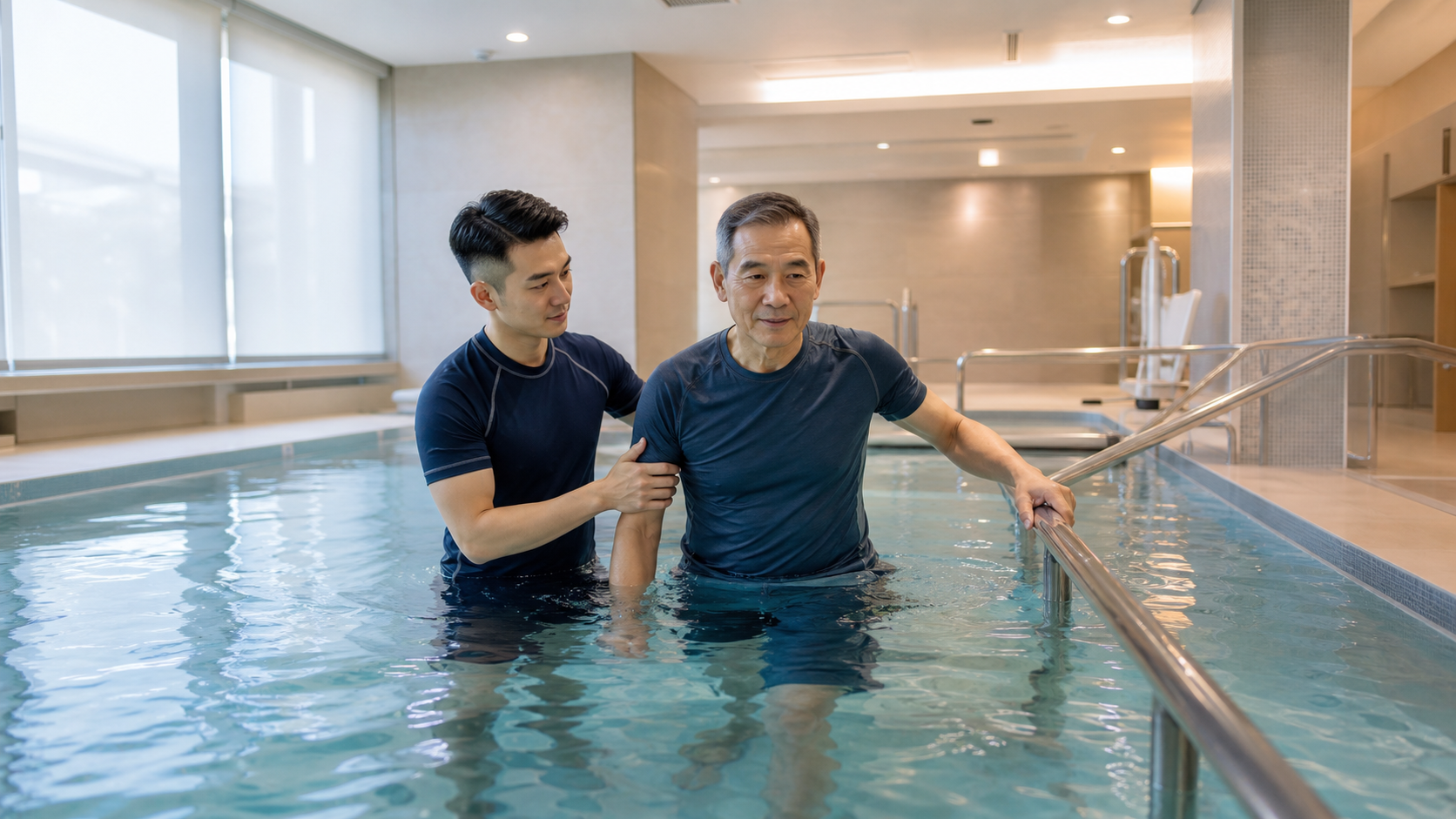
Taiwan sees approximately 30,000 new stroke patients each year, and post-stroke rehabilitation is key to helping patients regain their daily living functions. Traditional land-based physical therapy has a well-established system, but in recent years, aquatic physical therapy (hydrotherapy / aquatic physical therapy) has been gradually introduced at several Taiwanese medical centers, opening a new therapeutic window for stroke rehabilitation. The unique physical properties of the aquatic environment offer therapeutic benefits for common post-stroke conditions such as spasticity, balance disorders, and gait abnormalities that are difficult to achieve with land-based therapy.
Therapeutic Benefits of the Aquatic Environment for Stroke Patients
1. Spasticity Relief
Warm water (35–37°C) reduces the sensitivity of muscle spindles and decreases hyperactive tendon reflexes, effectively alleviating the upper and lower limb spasticity commonly seen after stroke. Multiple studies have shown significant improvements in Modified Ashworth Scale scores following aquatic therapy.
2. A Safe Environment for Gait Training
When walking in water, buoyancy reduces body weight and water resistance slows the speed of falls, allowing patients to practice weight shifting and gait adjustments in a relatively safe environment, thereby establishing neuromuscular patterns for walking on land.
3. Multisensory Stimulation for Balance Training
The instability of the water surface continuously challenges the vestibular and proprioceptive systems, providing rich sensory training that yields better improvements in balance disorders than some static land-based exercises.
4. Assistance with Fine Motor Control of the Upper Limbs
The viscosity of water slows movement speed, making it easier for patients to perceive movement feedback when practicing gripping and stretching with the affected arm in water, which helps reinforce neuroplasticity.
Current Status of Aquatic Physical Therapy in Taiwanese Hospitals
| Hospital | Facility | Features |
|---|---|---|
| National Taiwan University Hospital, Department of Rehabilitation | Aquatic therapy pool (37°C) | Aquatic therapy for neurological disorders, including stroke and spinal cord injury |
| Linkou Chang Gung Memorial Hospital, Department of Rehabilitation | Underwater gait analysis system | Integrated program combining underwater gait analysis with land-based training |
| National Cheng Kung University Hospital, Department of Rehabilitation | Warm water therapy pool | Major referral center for stroke patients in southern Taiwan |
| Hualien Tzu Chi Hospital, Department of Rehabilitation | Hydrotherapy facilities | Primary resource for patients in eastern Taiwan, with strong community connections |
| Changhua Christian Hospital | Aquatic rehabilitation room | Pioneer of aquatic rehabilitation in central Taiwan |
National Health Insurance (NHI) Coverage:
Currently, Taiwan’s NHI has limited coverage for aquatic physical therapy. Inpatient rehabilitation during the acute post-stroke phase may be partially covered, while outpatient aquatic therapy is mostly self-paid (approximately NT$800–2,000 per session). Patients may apply for partial subsidies through a disability handbook or a major illness/injury certificate.
Indications and Contraindications for Post-Stroke Aquatic Therapy
Post-stroke conditions suitable for aquatic therapy:
- Entering the stable phase 3–6 months after onset (not suitable during the acute phase)
- Mild to moderate hemiplegia with basic standing ability
- Those with aquaphobia must first undergo psychological adjustment on land
- No open wounds, urinary catheters, or pressure sores
Contraindications:
- Fever or acute infection
- Severe cardiopulmonary insufficiency
- Uncontrolled history of epilepsy
- Severe incontinence (fecal incontinence)
- Severe swallowing disorders (risk of drowning)
Typical Training Content in Aquatic Stroke Rehabilitation
Therapists design individualized programs based on the patient’s degree of hemiplegia. Common content includes:
- Aquatic standing training: Holding the pool wall with the unaffected hand while practicing weight bearing on the affected lower limb
- Aquatic walking: Walking forward, backward, and sideways, gradually reducing support
- Aquatic half-squats: Improving lower limb strength and bilateral coordination
- Aquatic upper limb exercises: Pushing water boards and practicing grasping objects in water with the affected arm
- Halliwick aquatic therapy: An internationally recognized aquatic neurorehabilitation method; some Taiwanese therapists have obtained certification
Practical Recommendations
- Aquatic therapy for stroke patients must be supervised throughout by a therapist qualified in aquatic physical therapy; never attempt it on your own.
- Family accompaniment can enhance the patient’s sense of security, and some hospitals allow family members to assist at poolside.
- Adequate hydration is essential after aquatic therapy, as the diuretic effect of water pressure may cause dehydration.
- It is recommended to alternate aquatic therapy with land-based physical therapy (e.g., aquatic on Monday, Wednesday, Friday; land-based on Tuesday, Thursday) for optimal synergistic effects.
- Record the Fugl-Meyer assessment or walking speed (10-meter walk test) after each session to track recovery progress.
Conclusion
Aquatic physical therapy in Taiwan’s stroke rehabilitation field is gradually evolving from a “supplementary option” into a “core treatment module.” The physical properties of water provide stroke patients with a safe and effective environment for functional training. With the increasingly well-equipped hydrotherapy facilities and therapist training at Taiwanese medical centers, more and more stroke patients are regaining confidence and hope in their mobility through the water.
Related Reading
- Swimming and Stroke Rehabilitation: The Neuroplastic Benefits of Water Walking and Supported Swimming
- Aquatic Rehabilitation Therapy: A Scientific Approach to Recovery After Orthopedic Surgery Using Swimming
- The Therapeutic Effects of Swimming on Arthritis: Rehabilitation Applications of Aquatic Resistance Training
- The Healing Benefits of Swimming for Arthritis Patients: The Medical Evidence for Low-Impact Aquatic Exercise
水金九不厭五分 10度寒流冷到不願停!feat. 卡卡 / 公路車 / CT Yeh
6 個月前
CT暗黑廚房) 車友必備 宇宙無敵鮮蚵湯 幫助訓練恢復 天然食補 好市多 超肥鮮蚵 破PR
7 年前
白沙屯媽祖進香在家走!UREVO 坡度自調走步機 / 可連接訓練遊戲APP MyWhoosh / 邊看直播邊走起來 / CT Yeh
11 個月前
[防寒衣體驗] 鐵人魂 三鐵 防寒衣試穿會 於松運 深水游泳池 鯨魚池
8 年前
一起升級!海鷗盃LSD團練...JJSC Zone2招待 騎到手抖 / 公路車 / CT Yeh
1 天前
摔車後補裝備: 好市多新款單車安全帽& Specialized Romin 北高整路屁股都不痛的坐墊 | 一千元居然有MIPS | CT Yeh | 公路車
4 年前
[教學] Premiere 影片 手震 修正 教學 防抖 單眼 影像 GoPro 穩定 Video Stabilization
8 年前
近視雷射三個月後悔嗎?單車族/工程師必看,Smart TransPRK 術後血淚史與後遺症全公開 / CT Yeh
4 個月前