Swimming Training for the Visually Impaired: Training Methods and Competition Participation of Taiwanese Visually Impaired Swimmers
Introduction
Taiwan has approximately 60,000 visually impaired people, and swimming is one of the most suitable sports for them—the buoyancy and uniform resistance of water are not diminished by the lack of vision, and once skills are refined, visually impaired swimmers can match or even surpass ordinary swimmers in speed. Taiwanese visually impaired swimmers have repeatedly won medals at the Paralympics, Asian Para Games, and World Para Swimming Championships, backed by a meticulously designed training system and the full support of Taiwan’s disability sports system.
Classification System for Visually Impaired Swimming
International Para Swimming uses a classification system to ensure fair competition:
| Classification Code | Visual Condition | Swim Cap Color (Internationally Standardized) |
|---|---|---|
| S11 | Totally blind or only light perception (visual acuity < 0.03 and visual field < 5°) | Black (opaque goggles required during competition) |
| S12 | Severe visual impairment (visual acuity 0.03–0.1 or visual field < 40°) | Blue |
| S13 | Profound visual impairment (visual acuity 0.1–0.2 or visual field < 60°) | Red |
Tapper System:
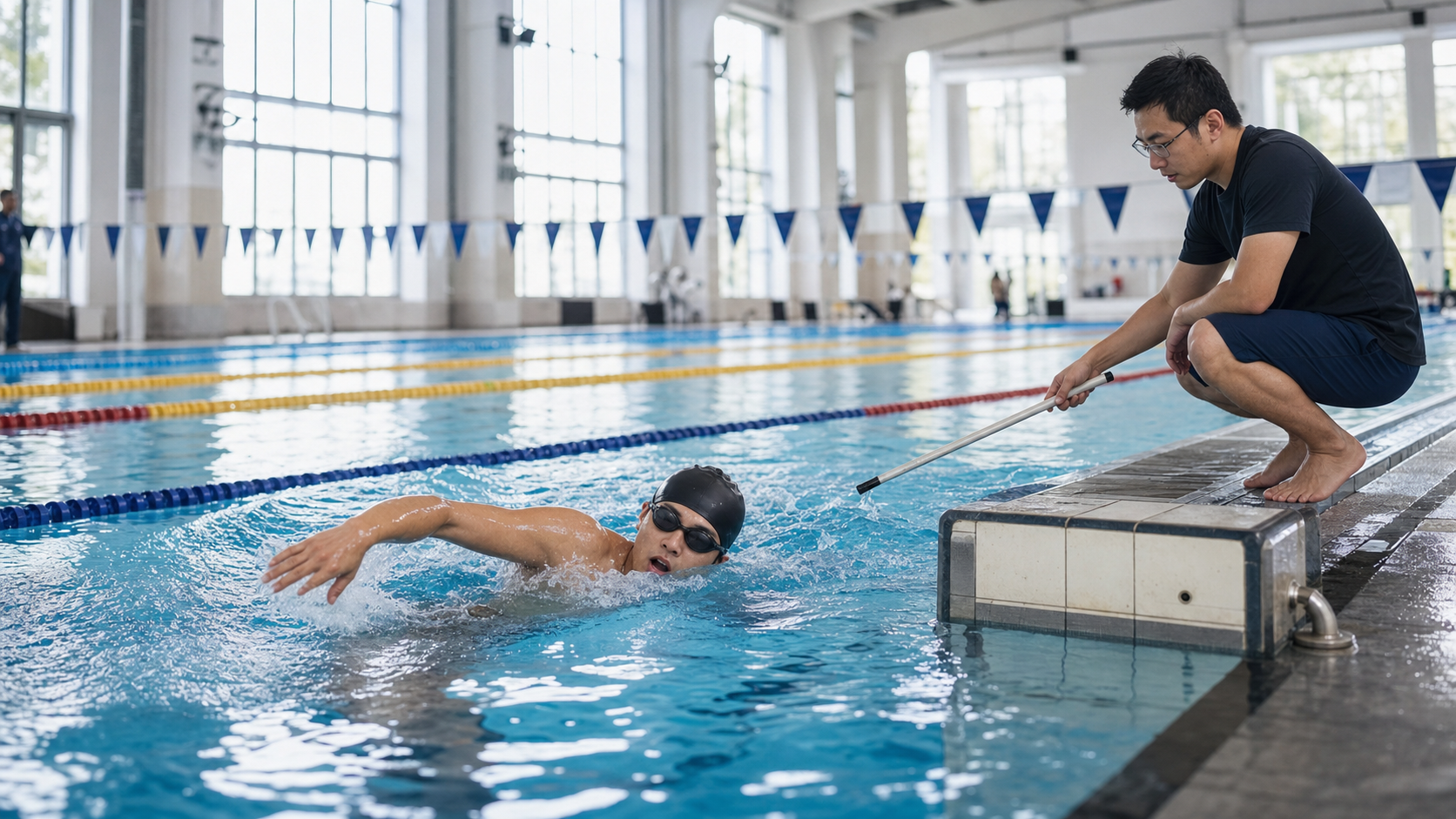
S11 and some S12 swimmers require a “Tapper” during competition, who stands beside the pool end wall and uses a long pole to lightly tap the swimmer’s head or shoulder, signaling an approaching turn wall or finish to prevent head collisions. This system is incorporated into the official rules of the IPC (International Paralympic Committee).
Core Techniques in Visually Impaired Swimming Training
1. Lane Awareness and Swimming in a Straight Line
For totally blind swimmers, maintaining a straight course is the greatest challenge. Training methods include:
- Lane line tactile perception: Lightly touching the lane line during freestyle breathing to correct direction in real time
- Proprioceptive training: Building precise perception of body rotation angles through repeated practice
- Water flow perception: Sensing the directional differences in water flow created by lane lines and pool walls
2. Turn Technique—Wall Perception Without Vision
- Counting method: Memorizing the number of strokes from the last flag (5 meters from the wall) to the turn wall to establish precise spatial distance memory
- Flag tactile cues: S11 swimmers rely on cues from the Tapper, while S12/S13 swimmers can use the tactile feel of the overhead rope holding the lane flags
- Trial-and-error correction: Precisely recording stroke counts after each session to fine-tune personalized distance formulas
3. Stroke Technique Training
Visual demonstration is ineffective when teaching strokes to visually impaired swimmers; alternative methods include:
- Kinesthetic demonstration: Coaches manually guide swimmers’ limbs through complete movement arcs to build muscle memory
- In-water tactile feedback: Coaches touch the swimmer’s hands and elbow positions in the water to correct technique immediately
- Verbal breakdown training: Detailed verbal instructions breaking down each technical element (e.g., “Palm facing backward, elbow held high at 90 degrees, rotate the body 45 degrees to drive the arm forward into extension”)
Taiwan’s Sports Support System for Visually Impaired Swimming
Training Resources:
- Chinese Taipei Visually Impaired Swimming Association: Coordinates the selection, training, and international competition dispatch of visually impaired swimmers
- National Taiwan University of Sport: Houses a Department of Adapted Physical Education, providing sports science support for visually impaired athletes
- County and City Disability Sports Associations: Offer beginner-level visually impaired swimming classes, with some employing specialized visually impaired swimming coaches
- National Sports Training Center (Taichung): Training venue for elite visually impaired swimmers, featuring a standard 50m indoor pool
Competition Opportunities:
| Event | Frequency | Eligibility |
|---|---|---|
| National Visually Impaired Games (Swimming Events) | Every 2 years | Hold a disability certificate and pass classification assessment |
| Taiwan Para Swimming Championships | Annually | Register with the organizing association and compete according to classification |
| Asian Para Swimming Championships | Every 2–4 years | Meet Taiwan national team standards |
| Paralympic Games | Every 4 years | Meet the MQS (Minimum Qualification Standard) |
Recommended Pathway for Visually Impaired Beginners
For visually impaired individuals who are new to swimming or have never swum, the following progressive pathway is recommended:
- Psychological adaptation phase: Standing in shallow water (waist-deep), guided by a coach to experience the buoyancy and temperature of the water (1–2 weeks)
- In-water safety skills: Learning to stand in the water, grip the pool wall, and perform self-protective movements in emergencies (1–2 weeks)
- Basic floating: Front float and back float, without stroking, purely experiencing buoyancy (2–3 weeks)
- Breaststroke introduction: Breaststroke has lower directional control demands (compared to freestyle) and is the easiest first stroke for visually impaired swimmers to learn (4–8 weeks)
- Freestyle breathing training: Combined with lane line tactile practice to maintain a straight course (8–16 weeks)
Practical Advice
- Before your first visit to a pool, contact the pool management in advance to learn about its visually impaired-friendly facilities (such as tactile paving guidance routes and voice guidance systems).
- Some pools in Taipei City and New Taipei City feature “accessible entry platforms” and “visually impaired swimming classes”; contact your local disability sports association for course information.
- If a specialized visually impaired swimming coach is unavailable, general swimming coaches can gain qualifications through the “Visually Impaired Swimming Teaching Workshop” offered by the Taiwan Para Swimming Association before providing instruction.
- Establish a fixed memory of the pool walking route (e.g., “Enter, turn right 10 steps, men’s locker room entrance, after changing walk straight 20 steps into the pool area”) to enhance independence.
- Join visually impaired swimming communities (Facebook, LINE groups) to learn about other visually impaired swimmers’ experiences and competition information.
Conclusion
Swimming is not limited by vision, and the thriving development of visually impaired swimming in Taiwan proves this. A well-established classification system, the Tapper guidance mechanism, and the support system of Taiwan’s disability sports provide visually impaired individuals with a complete pathway from beginner to international competition. Whether it is a beginner’s first time in the water or a para-athlete’s competitive dream, Taiwan’s pools are always open for visually impaired friends.
Related Reading
- Swimming Goggle Prescription: Diopter Configuration and Selection for Myopic Goggles
- The Training Ecosystem of Taiwanese University Swim Teams: The Path from Student Athlete to National Team Member
- Youth Swimming Competitions: The Impact of Team Training Volume on Academics and Balancing Strategies
- Taiwan Swimming Competition Preparation Guide: Pre-Event Preparation for the National Games, University Championships, and International Events
live) 超越北高 之一日北高12小時 策略
7 年前
#KOM 夏季登山王之路 比賽實況 #東進武嶺
7 年前
2025 海鷗團體繞圈賽 網路直播 超激烈裁判長視角 / EIPC 李廷威、Waypoint 等眾多高手競爭 / feat. 卡密兒主持 / 海鷗繞圈賽
9 個月前
近視雷射三個月後悔嗎?單車族/工程師必看,Smart TransPRK 術後血淚史與後遺症全公開 / CT Yeh
4 個月前
Live) 備戰2019彰化經典百K 賽前攻略 (已完賽請看新影片
7 年前
2025南庄山水悠遊行 仙山KOM 網路直播! / 男菁英組A / 女菁英組A
9 個月前
FTL 與 SYB 車隊專訪 西進武嶺 實用攻略分享! 2小時 如何練?!你不知道的眉角!新手準備武嶺必看 EP1 | 實力派女車友 | 精華版 | 公路車 | CTYeh
4 年前
CT 喇低賽) 武嶺牽車 才是王道 西進牽車四小時內秘訣 攝手位置 如何判斷 防抽筋小秘訣
7 年前