Bicycle Island Tour Energy Supply Plan: Precision Carbohydrate Needs and Practical Strategies for 150km Per Day
Introduction
Every year, thousands of people take on the challenge of cycling around Taiwan, one of the most iconic milestones in Taiwan’s cycling culture. However, between those who successfully complete the round-island trip and those who give up midway, the deciding factor is often not just physical fitness, but the quality of the energy supply plan.
“On the afternoon of Day 3, I couldn’t pedal at all—my legs felt like they were filled with cement.” This is a common description shared by many who failed to complete the round-island ride. This phenomenon has a precise name: “muscle glycogen depletion.” It’s not caused by “insufficient training,” but rather by daily carbohydrate intake falling far below expenditure, leading to a cumulative deficit.
This article will help you calculate your daily energy needs and build a supply plan that leverages Taiwan’s rich food resources.
Calculating Daily Energy Needs
Using a standard 10-day round-island trip (approximately 150km per day, average speed 20km/h, including mountain sections) as an example:
| Body Weight | Daily Riding Expenditure (estimated) | Basal Metabolic Expenditure | Total Daily Energy Needs |
|---|---|---|---|
| 55kg | 2,500–3,200 kcal | 1,300 kcal | 3,800–4,500 kcal |
| 65kg | 2,900–3,700 kcal | 1,500 kcal | 4,400–5,200 kcal |
| 75kg | 3,300–4,200 kcal | 1,700 kcal | 5,000–5,900 kcal |
| 85kg | 3,700–4,700 kcal | 1,900 kcal | 5,600–6,600 kcal |
Carbohydrate Needs Calculation:
- Carbohydrate needs for prolonged aerobic riding: body weight × 8–10g/day
- For a 65kg rider: approximately 520–650g of carbohydrates per day
- Converted to calories: 520–650g × 4 kcal/g = 2,080–2,600 kcal from carbohydrates
This figure far exceeds what most people actually consume during a round-island trip. Many riders feel their “legs have no power” after consecutive days of riding because they accumulate a carbohydrate deficit of 200–400 kcal each day, which completely catches up with them by Days 3–4.
Planning Round-Island Supply with Taiwan’s Local Resources
Supply resources along Taiwan’s round-island route are abundant, but they require advance planning:
Northern Section (Taipei→Yilan→Hualien):
- Highest supply density; convenience stores every 3–5km
- Yilan’s local foods (卜肉, 糕渣, 牛舌餅) are rich in carbohydrates and can be actively replenished
- Supply points along the Suhua Highway are relatively scarce; stock up on food before Xiulin
Eastern Section (Hualien→Taitung):
- Along Provincial Highway 11 (coastal route), the distance between tribal village shops can reach 20–30km
- Recommended to do major resupplies in urban areas such as Hualien, Yuli, Chenggong, and Guanshan
- The Rift Valley plain is flat terrain with slightly lower calorie expenditure, making it an easy section for resupply
Southern Section (Taitung→Pingtung→Kaohsiung):
- The Fangliao→Fenggang section has the strongest winds of the entire round-island route; riding against the wind (northbound) consumes enormous energy
- Kaohsiung’s urban area offers the widest variety of food options; this is a good place for a full “carbohydrate loading” session
Western Section (Tainan→Taichung→Taipei):
- The most convenient section for resupply; food is available almost anywhere
- Tainan’s snacks (虱目魚粥, 碗粿, various rice dishes) are excellent long-distance fueling foods
Recommended Daily Meal Framework
Breakfast (60–90 minutes before departure):
- Goal: Replenish 150–200g of carbohydrates (approximately 600–800 kcal)
- Recommended: Rice + egg + tofu, or a combination of bread + soy milk + banana
- Avoid high-fat foods (e.g., dan bing with lots of butter): they are hard to digest while riding
Mid-Ride Fueling (every 30–45 minutes):
- Goal: Consume 60–90g of carbohydrates per hour (240–360 kcal)
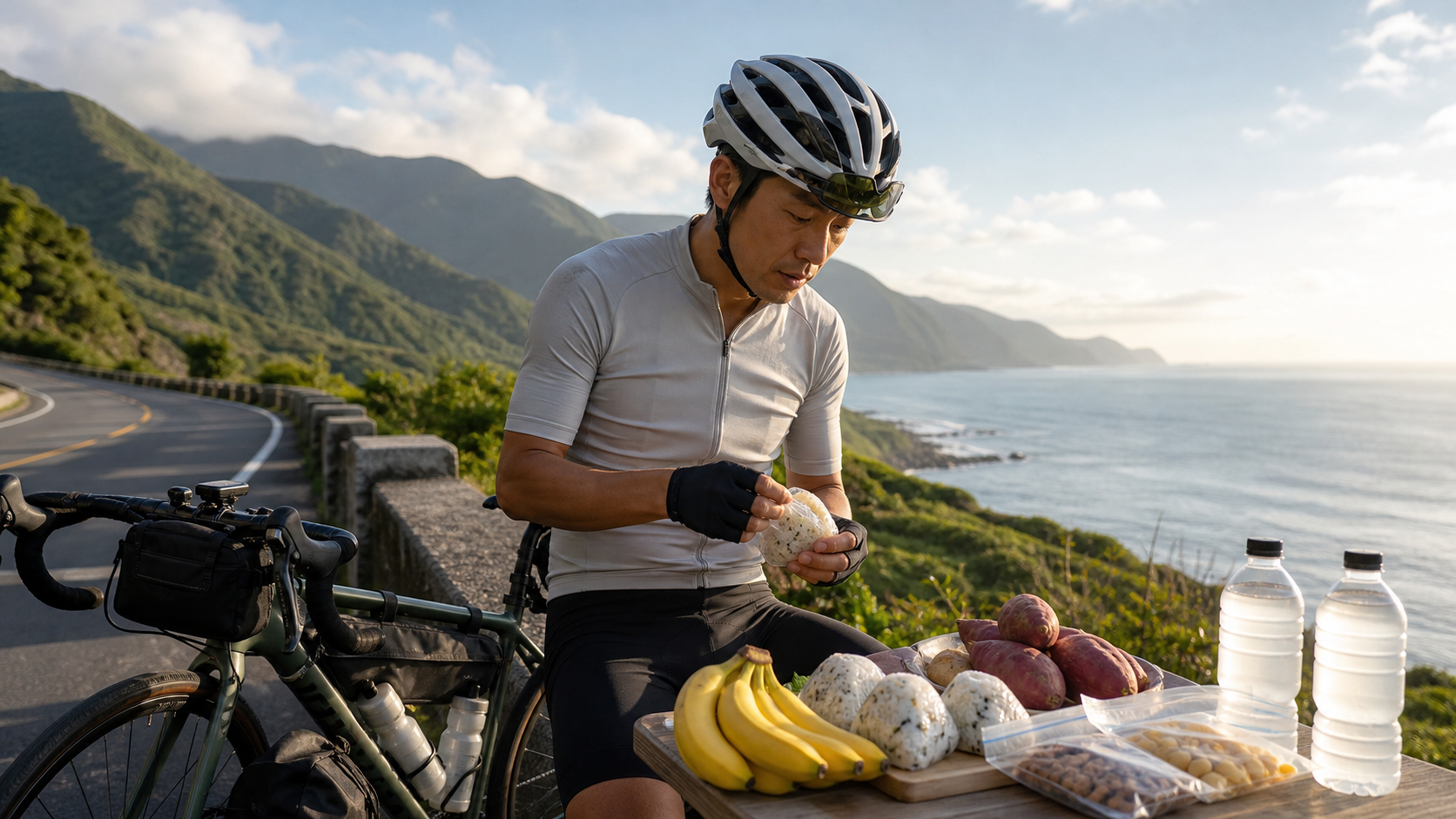
- Recommended: Convenience store rice balls (approximately 45–60g of carbohydrates), bananas, energy bars
Evening Dinner (recovery fueling):
- Goal: Replenish 50–60% of the day’s riding expenditure
- Recommended: White rice (one extra bowl) + meat + vegetables; consider fruit after the meal to replenish fructose
Practical Tips
- The concept of “carbohydrate loading” on consecutive riding days: On Days 1–2 of the round-island trip, deliberately consume 20–30% more carbohydrates than usual to build maximum glycogen stores, creating a buffer against cumulative fatigue
- Recognize the early signs of insufficient energy: Slower thinking, low mood, and legs feeling “heavy” rather than “tired” are usually signs of low glycogen; replenish with fast-acting carbohydrates immediately
- Don’t skip eating just because you’re “not hungry”: Appetite may decrease after prolonged riding, but this is exactly when your body needs energy the most; set fixed fueling times rather than relying on hunger cues
- Recovery fueling before bed: 30–60 minutes before sleep, drink a recovery beverage containing carbohydrates and protein (such as chocolate milk) to significantly improve your condition the next day
Conclusion
The beauty of cycling around Taiwan lies not only in the scenery, but also in the daily dialogue with yourself. A good energy supply plan lets you focus more attention on appreciating the farmland, coastline, and mountain ridges—rather than struggling through fatigue and hunger. Eat scientifically, and you can ride with style.
Related Reading
- Diet Management for Multi-Day Rides: Daily Calorie and Fuel Planning for Round-Island Trips
- Round-Island Fueling Strategies: Daily Calorie Needs Calculation and Convenience Store Resupply Tips
- Round-Island Fueling Strategies: Daily Calorie Needs and the Convenience Store Dependency Culture
- Fueling Plan for a 4-Hour Long Ride: Strategies to Keep Fuel Flowing Throughout
半日 小台灣 極限單車路線挑戰實錄
7 年前
單車 一日北高 ( 雙城 ) 肥宅雙人瘋狂行 紀錄片 REACTO
10 年前
靠單車減肥35公斤 心得分享與整理
7 年前
CT暗黑廚房) 車友必備 宇宙無敵鮮蚵湯 幫助訓練恢復 天然食補 好市多 超肥鮮蚵 破PR
7 年前
大武山後門26%歡樂陡坡!JJSC南台灣單車行Day2 / 被颱風追著跑 / 公路車 / CT Yeh
2 年前
2022 環花東挑戰賽 Day1 全記錄! 4K穿越機美景 x 髮香團 | 廢物伙伴軍團騎聚|花蓮-台東 |公路車 | CT Yeh
4 年前
山道猴出沒!? JJSC屏東單車行 Day1 一直催 / 皮卡丘來了!/ 墾丁 旭海 恆春 社頂 / 公路車 / CT Yeh
2 年前
水金九不厭五分 10度寒流冷到不願停!feat. 卡卡 / 公路車 / CT Yeh
6 個月前