Weather Adaptation for Long-Distance Riding: Practical Strategies for Taiwan's Summer Heat Waves and Southwesterly Flow
Introduction
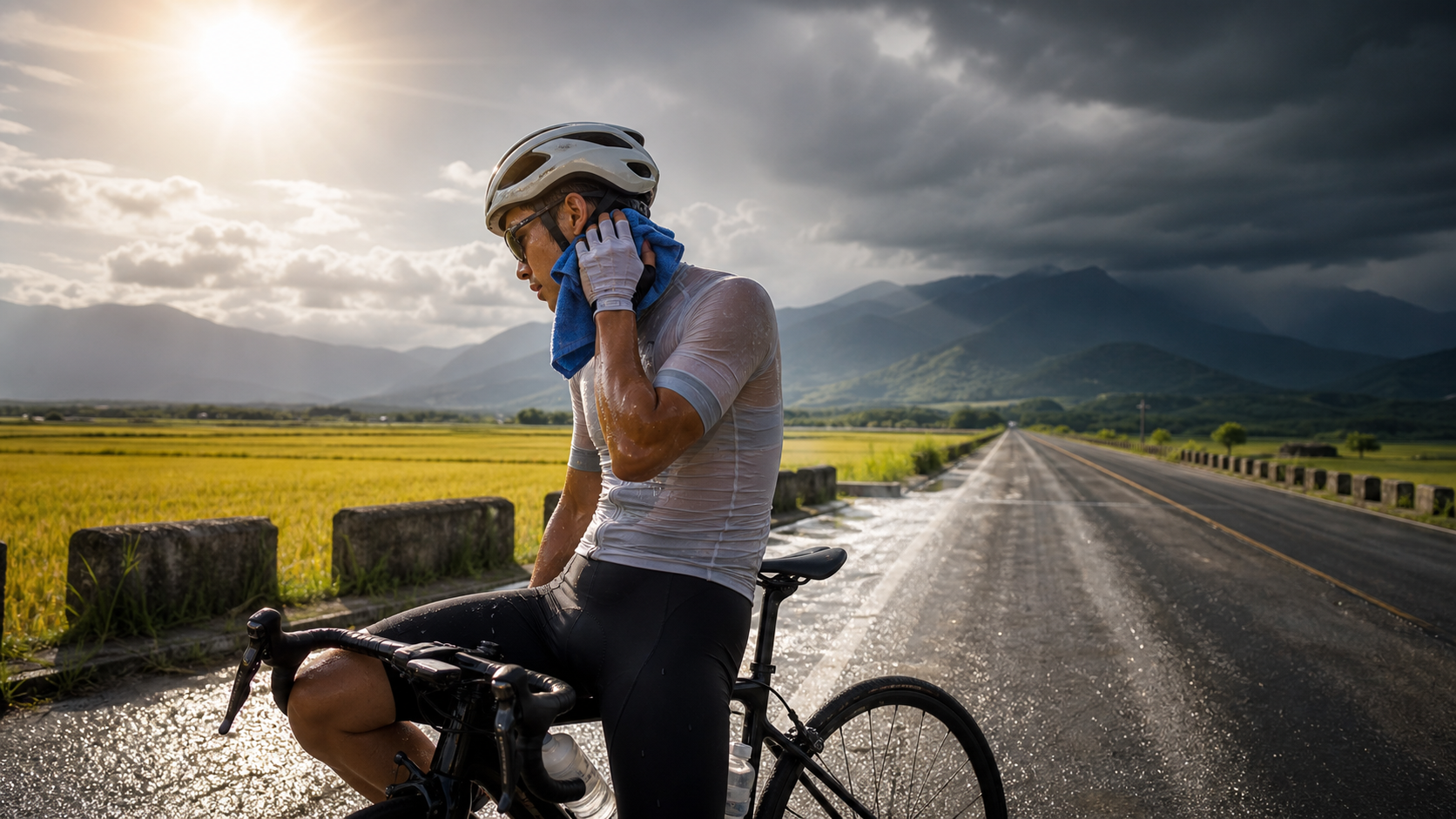
Summer weather in Taiwan presents a compound challenge for long-distance cyclists. After the plum rain season begins in June, the southwesterly flow and typhoon season from July to September bring the threat of afternoon convective thunderstorms nearly every day; at the same time, when the Pacific High dominates Taiwan, consecutive days of high temperatures can reach 36–40°C, turning outdoor riding into a battle against the heat.
But Taiwan’s most beautiful riding season also happens to be right now—the golden rice paddies of the Huatung Valley, the sunsets over the Taiwan Strait, and the cool mountain air are all sights unique to summer. Knowing how to adapt to the weather is the only way to enjoy these beauties safely.
Taiwan Summer Weather Risk Map for Cycling
| Weather Type | Timing | Main Risks | Affected Areas |
|---|---|---|---|
| Pacific High heat wave | July–September, clear days | Heat injury, heatstroke | All lowlands across Taiwan |
| Southwesterly flow thunderstorms | June–September, 1–5 PM | Lightning, poor visibility, landslides | Southern Taiwan, western side of the Central Mountain Range |
| Typhoon | July–October | Strong winds, heavy rain, road closures | All of Taiwan, more severe in the east |
| Foehn wind | Mainly spring/autumn, occasional in summer | Extreme dry heat (above 40°C) | Taitung, Hualien rift valley |
| Sea-breeze wind shear | Year-round, stronger in summer | Unstable crosswinds, difficult bike handling | West coast, Yunlin/Changhua coastal areas |
Physiological Mechanisms of Heat-Wave Riding and How to Respond
When core body temperature exceeds 39–40°C, the body enters a state of “heat stress,” characterized by:
- A sharp increase in sweat rate (up to 2–3 liters per hour)
- Heart rate rising 10–20 bpm at the same power output (the “cardiac drift” phenomenon)
- Declining cognitive function, with reduced judgment and reaction time
- In severe cases, heatstroke symptoms: cessation of sweating, hot dry skin, confusion
Time management strategies for long summer rides in Taiwan:
- Depart at 4:30–5:00 AM and complete 60–70% of the route before 10:00 AM
- 10:00 AM–2:00 PM: retreat to shaded locations (restaurants, convenience stores) for an extended break (30–60 minutes)
- After 2:00 PM: decide whether to continue based on weather conditions (if there are signs of thunderstorms, keep resting and wait for the weather to stabilize)
Active cooling techniques:
- Place ice packs or cold wet towels on the neck and wrists (over arteries) to rapidly lower core temperature
- Pour water over the helmet vents (highly effective; gas station owners on Taiwan’s summer mountain roads usually offer free water refills)
- Use a “cooling vest” (quite common in long-distance hot-weather races)
- When replenishing cold drinks, prioritize cold water or sports drinks at 5–10°C (studies show cold drinks can lower core temperature by 0.3–0.5°C)
Response Strategies for Southwesterly Flow Thunderstorms
During the southwesterly flow period, Taiwan experiences localized thunderstorms almost every afternoon, and they are difficult to predict. Long-distance cyclists need to establish a “thunderstorm response protocol”:
Pre-departure assessment:
- Check the CWA (Central Weather Administration)'s “3-hour rainfall forecast” chart
- If weather radar already shows cumulonimbus clouds forming at 9–10 AM, the afternoon riding risk is high
- Recommended Taiwan weather apps: the official CWA app, and “報天氣” (a local Taiwanese weather forecasting service)
Real-time response while riding:
- Watch the western/southern sky; if you see “towering cumulonimbus clouds (Cumulonimbus, with dark black tops),” immediately seek shelter
- After thunder, wait in a safe shelter: wait an additional 30 minutes after the thunder stops before resuming your ride
- Mountain waystations, pavilions, and gas stations are all reasonable places to take shelter from rain
Riding techniques in the rain:
- Taiwan’s summer afternoon rain typically lasts 30–90 minutes; if there is no lightning threat and road conditions are safe, you may choose to keep riding
- Braking distance on wet roads increases by 2–3 times, so you must increase following distance in advance
- When descending, prioritize the rear brake to avoid losing control of the front wheel and sliding out
Practical Advice
- Download and learn to use a weather radar app: The CWA’s “radar echo map” is the most important weather tool for long-distance riding in Taiwan; learn to read the rainfall intensity color scale on the radar image
- Carry waterproof bags and a lightweight rain jacket: Summer rain in Taiwan comes and goes quickly; an ultralight rain jacket under 100g is essential gear, stored at the outermost part of your saddle bag for quick access
- Build heat adaptation through summer training: After 7–14 days of continuous summer riding, your body develops “heat acclimatization,” lowering your heart rate by 5–10 bpm at the same intensity and reducing the sodium concentration in your sweat (retaining electrolytes more effectively)
- Stay alert on roads before and after typhoons: In the 24–48 hours after a typhoon passes, the risk of rockfalls, sand buildup, and broken branches on Taiwan’s mountain roads is at its highest; avoid long-distance mountain riding during this period
Conclusion
Although Taiwan’s summer weather is highly changeable, it is precisely for this reason that Taiwanese cyclists generally have stronger adaptability than riders elsewhere. Learning to “coexist” with the weather rather than “fight” it is the true wisdom of long-distance riding in Taiwan.
They say the sunset before a typhoon is one of the most beautiful sights in all of Taiwan. And the riders most likely to witness that moment are often those who know how to make the right decisions on the road.
Related Reading
- Weather Response for Long-Distance Riding: Real-Time Adjustments for Sudden Rain, Strong Winds, and High Heat
- Taiwan Cyclists’ Summer Survival Guide: Riding Strategies in Extreme Heat
- Strategy Adjustments for Climbing in High Heat: Notes on Summer Mountain Riding in Taiwan
- Bicycle Maintenance in High-Temperature Environments: Taiwan Summer Special Edition
一日北高前的西濱集訓 | 跟著11小時軍團 | 300W踩不動的大逆風 | 輪車破風差幾瓦?
6 年前
大武山後門26%歡樂陡坡!JJSC南台灣單車行Day2 / 被颱風追著跑 / 公路車 / CT Yeh
2 年前
虎豹潭!日本老師來台一日約騎 台灣車友熱情招待私房路線 / CT Yeh
21 天前
一日北高/長距離團騎 常見問題補充篇 / 組團或跟團的眉角 / 壯車友容易被瘦車友慢性拉爆 / 原來屁股痛可能是這個原因...? / 風場配速法 / 公路車 / CT Yeh
2 年前
單車 一日北高 ( 雙城 ) 肥宅雙人瘋狂行 紀錄片 REACTO
10 年前
TBA 北高360 逆風爆熱再送空汙 苦行挑戰賽全記錄 4K沈浸式臨空畫質| 公路車 | CT Yeh
3 年前
微東進 太魯閣 蘇花 單車兩日遊 ! 颱風過後路況超刺激 行程大亂 | 最狂的鹹酥雞訂單 | CT Yeh | 4K 高畫質空拍絕景!
4 年前
2022 環花東挑戰賽 Day2 搭到特快車 高速真空吸引! 台東一路逆風殺回花蓮! 總排 ??| Feiyu Pocket 2s | 公路車 | CT Yeh
4 年前