Cycling Electromyography Analysis: Muscle Activation Patterns of Major Muscle Groups in Different Pedaling Positions
Introduction
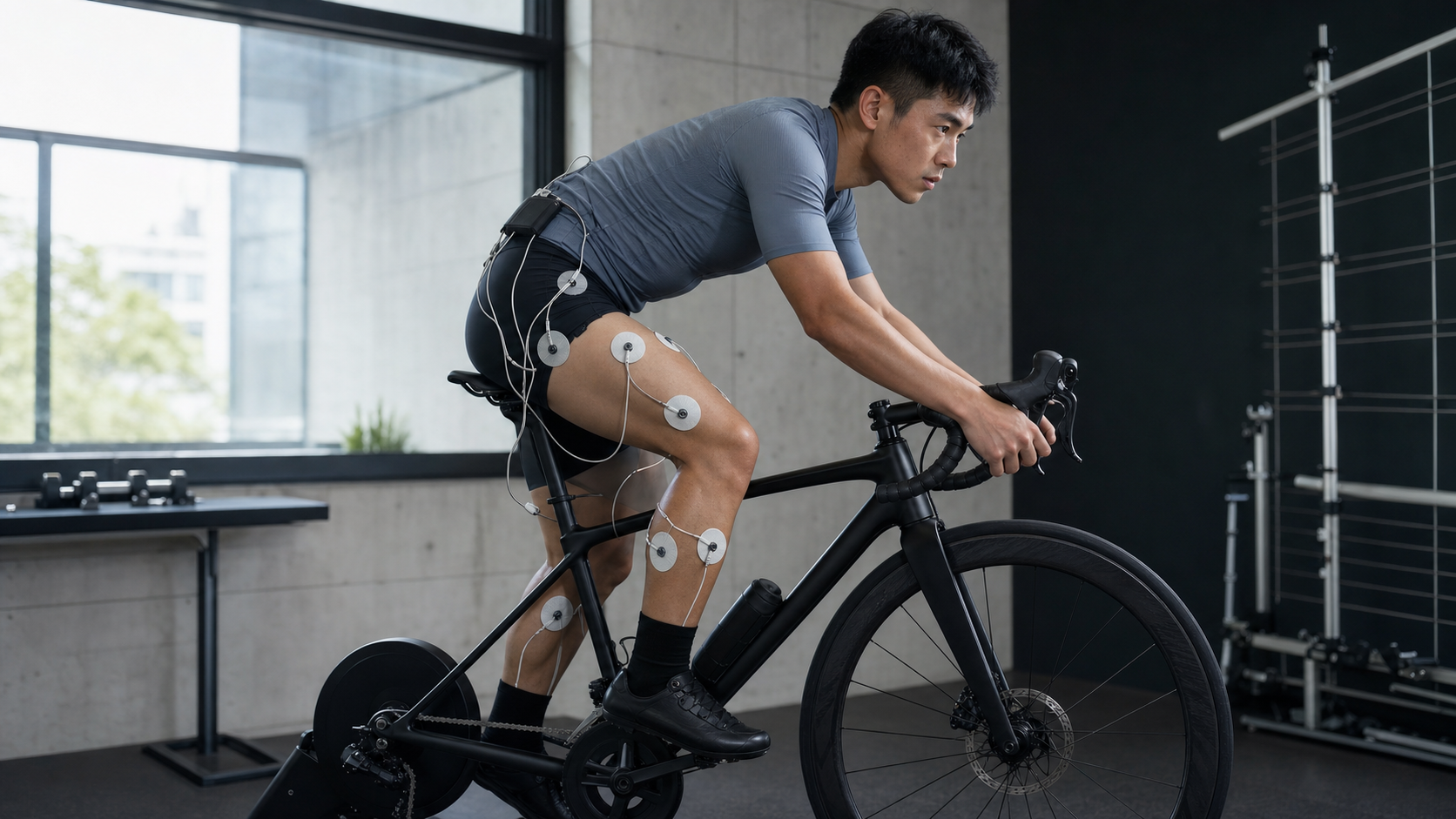
Pedaling a bicycle may appear to be a simple lower-limb extension movement, but it is actually a precisely coordinated neuromuscular sequence involving 8–10 muscle groups. Electromyography (EMG) technology allows sports scientists to precisely capture the activation timing, intensity, and duration of each muscle throughout the pedal cycle, revealing differences in movement patterns that are invisible to the naked eye.
This article will introduce the activation patterns of each muscle group during the pedal cycle, compare EMG differences across different pedaling positions (standing sprint, seated climbing, high-cadence cruising), and provide training recommendations for improving muscle coordination.
Muscle Group Activation Timing in the Pedal Cycle
The pedal cycle is measured clockwise from top dead center (TDC, the 12 o’clock position). The activation timing of each major muscle group is as follows:
| Muscle Group | Main Activation Range (degrees) | Function | Main Muscle Fiber Type |
|---|---|---|---|
| Rectus Femoris | 0–120° | Knee extension, hip flexion | Mixed (Type I + II) |
| Vastus Lateralis | 10–130° | Primary knee extensor | Type II dominant |
| Vastus Medialis | 30–150° | Terminal knee extension locking | Type I dominant |
| Gluteus Maximus | 0–180° | Primary hip extensor | Mixed |
| Biceps Femoris | 150–360° | Knee flexion (upstroke phase) | Mixed |
| Gastrocnemius | 60–210° | Ankle plantarflexion (downward force transmission) | Type I dominant |
| Tibialis Anterior | 180–360° | Ankle dorsiflexion (upstroke preparation) | Mixed |
Key Insight: Pedaling power primarily comes from the 0–180° (downstroke phase), driven by the quadriceps and gluteus maximus; the 180–360° (upstroke phase) contributes less power, where the coordination of the hamstrings and tibialis anterior mainly serves to “not impede” the downstroke leg rather than actively generating power.
EMG Pattern Comparison Across Different Pedaling Positions
Seated Flat Cruising (90 RPM)
- Characteristics: Moderate quadriceps activation; gluteus maximus contributes approximately 25–30% of pedaling power
- Common Issue: Taiwanese cyclists often exhibit a “quadriceps-dominant, gluteus-inhibited” pattern during long-distance rides, stemming from tight hip flexors that inhibit the gluteus maximus (cross syndrome)
- Optimization Direction: Activate the gluteus maximus through exercises such as glute bridges and clamshells to restore normal muscle recruitment patterns
Seated Climbing (Low Cadence 60–70 RPM, High Torque)
- Characteristics: Activation of the vastus lateralis and gluteus maximus increases significantly (40–60% higher than flat cruising); the hamstrings show stronger upstroke contribution around 180°
- EMG Findings: During low-cadence climbing, muscle activation occupies a higher proportion of time, approaching a near-continuous contraction state, which explains why climbing leads to faster muscle fatigue
- Optimization Direction: Perform glute and leg activation warm-ups before climbing; consciously push the heel back (ankle dorsiflexion) while climbing to increase gluteus maximus engagement
Standing Sprint (50–60 RPM, Extremely High Torque)
- Characteristics: Activation of all lower-limb muscle groups is at its highest; upper-body muscles (trapezius, biceps brachii) also participate significantly (counteracting handlebar reaction forces)
- EMG Findings: Peak activation intensity of the vastus lateralis during standing riding is 1.8–2.2 times that of seated riding; lumbar erector spinae load also increases significantly
- Taiwan Scenario: During a standing sprint on the final 5 km of a steep climb at Wuling, if the core is unstable, a significant amount of energy leaks through torso rotation
High-Cadence Cruising (110+ RPM)
- Characteristics: Muscle activation intensity per pedal stroke decreases, but the number of contractions per minute increases substantially, raising neuromuscular coordination demands
- EMG Findings: At high cadence, the rhythmic activation of the tibialis anterior becomes more regular, indicating improved ankle joint coordination
- Applicable Situations: Recovery rides and energy-saving strategies for long-distance riding on Taiwan’s western plains
EMG Analysis of Left-Right Leg Imbalance
Among Taiwanese cyclists, left-right power output imbalance (>5%) is quite common, with causes including:
- Old Injury Compensation: Old knee or ankle injuries leading to unconscious protective movements
- Dominant Leg Strengthening: The dominant leg develops stronger muscles through daily activities
- Sit Bone Asymmetry: Slight pelvic tilt altering the mechanical advantage of both legs
EMG Improvement Strategies:
- Use a power meter with bilateral sensing (such as the Favero Assioma Duo) to regularly monitor left-right balance
- Single-leg training on the weaker side (2 × 2 minutes per session) to establish neuromuscular symmetry
- Off-bike training: unilateral squats and Bulgarian split squats to strengthen the weaker side
Common Pedaling Technique Deficiencies and EMG Evidence
- “Dead spot” pedaling (discontinuous force application near 12 and 6 o’clock): EMG shows a coordination gap in the transition between the quadriceps and hamstrings at these points; single-leg pedaling drills can improve this
- Toe-down pedaling style: Excessive gastrocnemius activation and excessive forefoot loading, commonly seen in road cycling beginners
- Heel-down pedaling style: Easier recruitment of the gluteus maximus and hamstrings, but lower power transfer efficiency; commonly seen in riders transitioning from MTB to road cycling
Practical Recommendations
- Perform regular single-leg pedaling tests (30 seconds per leg) to feel for weak spots in the pedal cycle—a free alternative to EMG assessment
- 10 minutes before riding: 3 × 15 reps each of clamshells and glute bridges to activate the gluteus maximus and improve muscle recruitment patterns while pedaling
- When climbing, think “push down and back” to help increase gluteus maximus activation
- Avoid over-chasing the “perfect circular pedal stroke”—for most riders, a natural pedaling pattern combined with effective gluteus maximus recruitment is more efficient than forcing a circular stroke
Conclusion
EMG analysis reveals the intricate neuromuscular coordination of the pedaling motion, moving training guidance from “feel” to “data.” For Taiwanese cyclists, the most important takeaway is not purchasing EMG equipment, but understanding the logic of muscle activation and, through targeted off-bike training and pedaling awareness drills, making every pedal stroke convert more efficiently into forward momentum.
Related Reading
- EMG Analysis of Muscle Activation in Cycling: The Science of Muscle Synergy During Pedaling
- EMG Analysis of Muscle Activation Patterns in Running
- EMG Analysis of Cycling Climbing Training: Muscle Activation Study at 4% vs 8% vs 12% Grades
- EMG Analysis of Standing Cycling: Which Muscle Groups Are Really Working
單車 一日北高 ( 雙城 ) 肥宅雙人瘋狂行 紀錄片 REACTO
10 年前
#公路車 #Fitting 靠人工智慧APP 幫你調整單車
6 年前
一日北高/長距離團騎 常見問題補充篇 / 組團或跟團的眉角 / 壯車友容易被瘦車友慢性拉爆 / 原來屁股痛可能是這個原因...? / 風場配速法 / 公路車 / CT Yeh
2 年前
2023自行車展!與環台賽選手一同表演賽 / 全自動AI Fitting?/ TIME新車發表/神秘充電桌等 精華分享 VLOG | CT Yeh | 公路車
3 年前
西進武嶺 免費訓練分析服務 Intervals | 練不夠還是練過頭?你哪一種類型選手?AI模型告訴你! | 備戰神器 | 公路車 訓練 | CT Yeh
4 年前
一日北高常見問題大集合 | 攻略 | 路線 | 訓練 | 補給 | 自行車 單車 | 一日雙城 | 雙塔 | TWB北高360 | 屁股痛
6 年前
單車 梅山36灣 坡度介紹 路段介紹 空拍 (相關遊記影片,請參考說明或我的頻道喔,歡迎訂閱)
6 年前
DJI Osmo Action 6 / 單車運動拍攝實用技巧 公路車 CT Yeh
7 個月前