Neuromuscular Fatigue in Cycling Training: Distinguishing Central vs Peripheral Fatigue and Recovery
Introduction
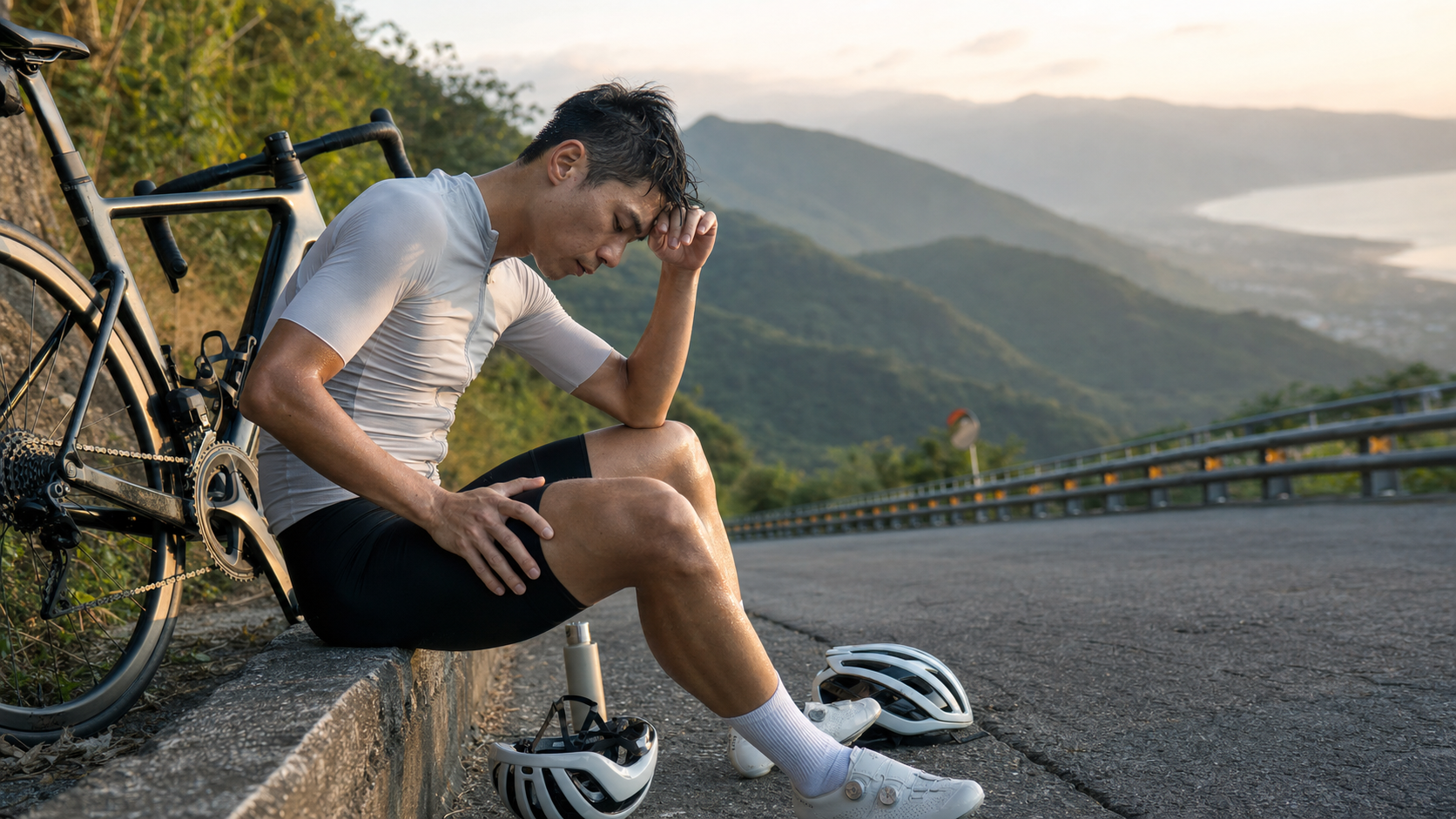
Have you ever experienced this: after a six-hour island-wide ride, your legs are sore the next day, but that’s not the worst part; what troubles you most is the “brain fog,” the aversion to training, and the inability to concentrate no matter what. This state of “feeling tired all over but unable to pinpoint where” is a classic manifestation of Central Fatigue, which operates through entirely different mechanisms than peripheral muscle fatigue and requires different recovery strategies.
This article will analyze the two dimensions of exercise fatigue from a neurophysiological perspective and provide targeted recovery protocols.
The Two Dimensions of Fatigue
Exercise fatigue can be divided into two levels, which often coexist but vary in degree:
Peripheral Fatigue
Fatigue occurring below the neuromuscular junction, with primary mechanisms including:
- Metabolic waste accumulation: Phosphate, hydrogen ions (a byproduct of lactate), and ADP accumulation interfere with the interaction of muscle contractile proteins
- Abnormal calcium release: Reduced calcium release capacity from the sarcoplasmic reticulum affects the initiation of muscle fiber contraction
- Muscle structural damage: Eccentric contractions (descending/coasting downhill) cause micro-damage to muscle fibers, leading to DOMS (Delayed Onset Muscle Soreness)
- Glycogen depletion: Intramuscular glycogen drops after long-distance rides, directly limiting the rate of ATP resynthesis
Recovery time: 24–72 hours (mild), 3–7 days (severe glycogen depletion + muscle damage)
Central Fatigue
Fatigue occurring at the nervous system level, from the cerebral cortex down to reduced drive capacity of spinal motor neurons:
- Reduced motor cortex excitability: The intensity of neural drive signals from the brain decreases, even when muscles theoretically retain contractile capacity
- Serotonin / dopamine imbalance: During prolonged exercise, tryptophan crosses the blood-brain barrier and converts to serotonin, lowering central activation levels; dopamine depletion affects motivation and reward sensation
- Ammonia accumulation: Ammonia produced by protein metabolism during long-distance rides enters the brain, interfering with neurotransmission
- Accumulated sleep debt: Repeated insufficient sleep impairs prefrontal cortex function, affecting training motivation and technical decision-making
Recovery time: 12–48 hours (acute), several weeks (chronic overtraining syndrome)
Assessment Methods for Distinguishing Central vs. Peripheral Fatigue
| Assessment Indicator | Peripheral Fatigue Characteristics | Central Fatigue Characteristics |
|---|---|---|
| Muscle soreness (DOMS) | Present and clearly localized | Usually mild |
| Maximal voluntary contraction (MVC) | Markedly reduced | Reduced but more widespread than DOMS alone |
| Morning HRV | Moderately reduced | Significantly reduced and persisting for multiple days |
| Subjective motivation | “I want to ride but can’t” | “I don’t want to ride and have no motivation” |
| Caffeine response | Slight improvement | Often cannot fully overcome fatigue sensation |
| Cognitive tests (reaction time) | Normal or slightly reduced | Markedly reduced |
| Sleep quality | Increased deep sleep (repair demand) | Poor sleep quality, light sleep |
Simple assessment for the Taiwan context: Every morning after waking up, before getting on the bike, ask yourself: “If there were a beautiful road right in front of me, would I want to ride it?” If the answer is “yes” but your legs feel heavy, it leans toward peripheral fatigue; if the answer is “no, I really don’t want to ride anything,” it leans toward central fatigue.
Fatigue Type Tendencies Induced by Different Training Types
Different training types have varying proportions of central/peripheral fatigue:
| Training Type | Primary Fatigue Type | Explanation |
|---|---|---|
| Short high-intensity intervals (< 30 min) | Primarily peripheral | Lactate and phosphate accumulation, high local muscular impact |
| Long-duration aerobic (> 4 hours) | Primarily central | Tryptophan-serotonin mechanism, prolonged neural drive expenditure |
| Descending/coasting rides (high eccentric contractions) | Primarily peripheral | Muscle fiber micro-damage, significant DOMS |
| Racing or riding under pressure | Primarily central | Cognitive and emotional stress accelerate central fatigue |
| Multi-day Taiwan tours/island circumnavigation | Both severe | Peripheral damage accumulation + continuous central depletion |
Targeted Recovery Strategies
Recovery from Peripheral Fatigue
- Glycogen replenishment: Within 30–60 minutes post-training, consume 1–1.2 g/kg of carbohydrates + 0.3 g/kg of protein to initiate the fastest glycogen resynthesis
- Contrast water bath: 10 minutes hot water (38°C) + 2 minutes cold water (12–15°C), repeated 3 times, to promote blood circulation and metabolic waste clearance
- Active recovery ride: Zone 1 (< 55% FTP) for 20–30 minutes, promoting lactate metabolism without adding muscular load
- Compression garments: Wear compression leg sleeves after riding to reduce tissue edema and accelerate micro-damage repair
Recovery from Central Fatigue
- Prioritize sufficient sleep: Central fatigue is most sensitive to sleep deprivation; 8+ hours of sleep is the only reliable method for central nervous system repair
- BCAA supplementation: BCAAs compete with tryptophan for transporter proteins at the blood-brain barrier, reducing serotonin precursors entering the brain (research-supported but with limited efficacy)
- Reduce cognitive/emotional stress: Work stress compounds central fatigue; proactively reduce training volume during high-stress periods
- Strategic caffeine use: Can temporarily overcome the subjective sensation of central fatigue, but cannot repair the underlying fatigue and should not be over-relied upon
- Complete 1–2 rest days: Rather than reduced-volume riding—the central nervous system requires complete “non-stimulation” for adequate recovery
Practical Recommendations
- Establish a weekly “fatigue log”: separately record “muscle fatigue sensation” and “mental/motivation sensation” on a 1–10 scale each, tracking the independent trends of central vs. peripheral fatigue
- If “mental/motivation sensation” scores below 5 for more than 4 consecutive days, even if “muscle fatigue sensation” has recovered, schedule a complete rest day
- Do not perform technical or tactical training (such as sprint timing practice) in a state of central fatigue—neuroplasticity is reduced in this state
- During multi-day rides over Taiwan’s long weekends (such as island circumnavigation events), prioritize central fatigue assessment at the end of each day, and insert rest or reduced-volume days as appropriate
Conclusion
Fatigue management is the most underestimated aspect of a training plan. Peripheral muscle fatigue provides clear soreness cues, but central nervous system fatigue often disguises itself as “laziness” or “lack of motivation,” leading many to mistake it for a willpower issue. Understanding the different mechanisms of these two types of fatigue and choosing targeted recovery methods is key to making a training plan sustainable long-term and avoiding overtraining. Fellow Taiwanese cyclists, treat your nervous system well—that means treating your training results well.
Related Reading
- Neuromuscular Fatigue in Running: The Science of Recovery After Long-Distance Runs
- The Science of Fatigue in Road Running: How Central and Peripheral Fatigue Jointly Determine Your Limits
- Overtraining and Mental Burnout in Cycling Training: Identification and Recovery Strategies
- Central Fatigue and Peripheral Fatigue: Decoding the Dual Mechanisms of Exercise Exhaustion
西進武嶺 免費訓練分析服務 Intervals | 練不夠還是練過頭?你哪一種類型選手?AI模型告訴你! | 備戰神器 | 公路車 訓練 | CT Yeh
4 年前
一日北高常見問題大集合 | 攻略 | 路線 | 訓練 | 補給 | 自行車 單車 | 一日雙城 | 雙塔 | TWB北高360 | 屁股痛
6 年前
單車 一日北高 ( 雙城 ) 肥宅雙人瘋狂行 紀錄片 REACTO
10 年前
Never Stop 西進武嶺 前後雙機 完整全程錄影 訓練台 實境
8 年前
大家都在開箱的...單車用藍芽對講耳機真的有幫助嗎? SENA BiKom 20 長距離旅遊 & 海鷗繞圈賽 實際體驗心得 / 公路車 / CT Yeh
9 個月前
一日北高/長距離團騎 常見問題補充篇 / 組團或跟團的眉角 / 壯車友容易被瘦車友慢性拉爆 / 原來屁股痛可能是這個原因...? / 風場配速法 / 公路車 / CT Yeh
2 年前
2019 夏季KOM 5小 完賽心得 準備攻略 東進武嶺 夏季登山王之路 Taiwan KOM Challenge
7 年前
一日北高 11小時 賽後心得分享篇 | TWB北高360 | 一日雙城 | 單車 | 公路車
6 年前