Introduction
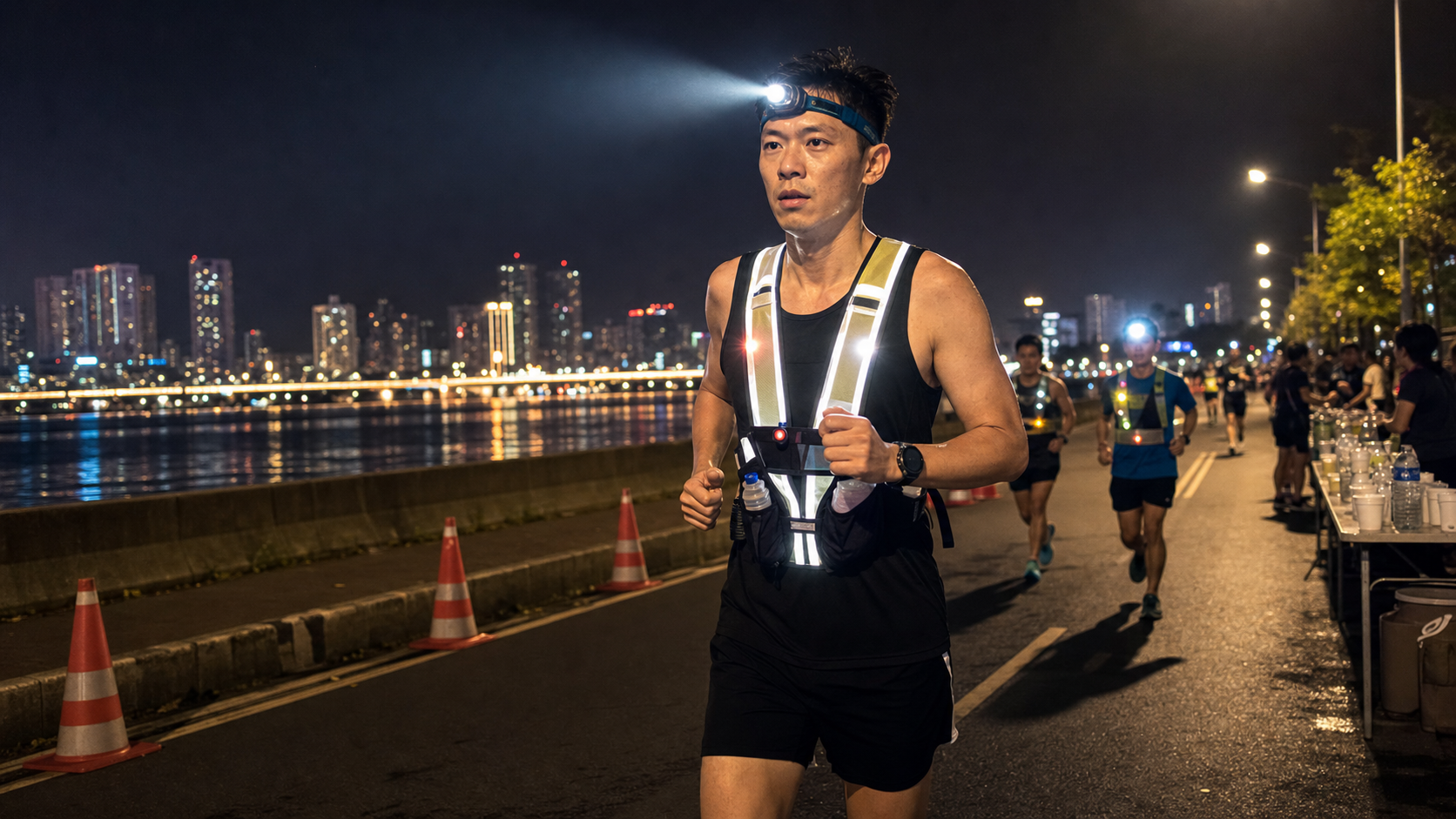
In recent years, night running races have flourished across Taiwan, from Taipei’s night glow marathons to nighttime running events in various counties and cities. More and more runners are experiencing the unique sensation of running under starlight or city lights. However, night races place fundamentally different demands on gear, safety, and fueling strategy compared to daytime races. Ignoring these differences can, at best, make for an uncomfortable run, and at worst, lead to a safety incident. This article provides a complete guide to preparing for night races.
Lighting Setup: The First Line of Safety
The core safety requirement for night running is “seeing where you’re going, and being seen by others.” This requires lighting configuration on two levels:
Active Lighting (Seeing the Road)
| Light Type | Recommended Lumens | Suitable Scenario | Battery Life |
|---|---|---|---|
| Headlamp | 200–400 lumens | Suburban areas, trails, uneven road surfaces | At least 4–6 hours |
| Wrist light | 50–100 lumens | Supplemental lighting for city courses | At least 6 hours |
| Handheld flashing light | 100–200 lumens | Backup lighting, signal warning | 6–8 hours |
Headlamp usage tips:
- Adjust the headlamp angle: tilt downward 15–20 degrees to illuminate the road 5–8 meters ahead
- Avoid using the highest brightness mode, to preserve battery life for the entire race
- When wearing it for extended periods, make sure the strap doesn’t press against your forehead, which would affect comfort
Passive Reflectivity (Being Seen by Others)
- Reflective vest: The most effective passive reflective gear, offering 360-degree coverage; choose a style with reflective strips on both front and back
- Reflective wristbands: Add visibility to your arm movements, one on each wrist
- Reflective stickers: Apply to the heel of your running shoes and the brim of your cap to increase visibility under low-angle lighting
- Tail light (flashing mode): Clip to your lower back or backpack to give vehicles approaching from behind the clearest warning signal
Night Running Stride Strategy: Shorter Strides, Higher Attention
With reduced visibility at night, your judgment of ground conditions is inevitably less precise than during the day, so your stride strategy needs to be adjusted accordingly:
- Shorten your stride by 10–15%: Increase your cadence to reduce the uncertainty of each footstrike
- Improve landing precision: Land with a midfoot strike to reduce the risk of a sprain when stepping on uneven ground
- Build in reaction time: Pace 15–30 seconds/km slower than in daytime races, to ensure enough time to respond to unexpected situations
- Transitioning between surface conditions: When moving from a well-lit section into a dark section, proactively slow down to let your eyes adjust to the change in light
Nighttime Adjustments to Fueling Strategy
Fueling strategy for night races needs to be adjusted based on the following factors:
Differences in thermoregulation:
- Nighttime temperatures are lower, so sweat loss is reduced, and hydration needs are correspondingly lower
- This doesn’t mean you can skip hydration: you should still proactively take in 150–200ml every 20–30 minutes
- Electrolyte needs are similar to daytime races; don’t neglect sodium and potassium intake just because you’re sweating less
Identifying aid stations visually:
- Nighttime aid stations are usually marked with special lighting, but you should still watch for distance markers in advance
- Crowds tend to be denser near aid stations, so watch your footing to avoid stepping on others or on cups
- It’s recommended to slow down briefly at aid stations rather than grabbing water at high speed in the dark, to avoid choking
Timing of caffeine intake:
- If a night race lasts longer than 3 hours, drowsiness may set in during the later stages, making caffeinated drinks especially effective at that point
- Consider taking in cola or a caffeinated energy gel after the 21km mark, or whenever you feel drowsy
Pre-Race Mental and Physical Preparation
Many runners are used to a daytime routine, and night races can disrupt the body clock significantly:
- Sleep strategy: If the race starts after 8pm, take a 20–30 minute nap in the afternoon before the race to restore energy
- Meal timing adjustment: Complete your main pre-race meal 3–4 hours before a night race start, to avoid stomach discomfort
- Warm-up considerations: Nighttime temperatures are lower, making static stretching less effective; a dynamic warm-up is recommended instead (high knees in place, hip circles)
Practical Tips
- Do night training runs the week before the race so your eyes and stride can adapt to nighttime conditions
- Pack your gear the day before the race and confirm all your lights are fully charged
- Bring spare batteries or a backup headlamp — don’t rely on a single light source for a long-distance night race
- Running with a partner isn’t just safer, it also lets you remind each other about fueling and watch out for course conditions together
Conclusion
The appeal of night races lies in their unique atmosphere and feel, but safety always comes first. A well-planned lighting setup, the right choice of reflective gear, and pacing and fueling strategies adjusted for nighttime conditions will let you run safely and enjoyably under the stars. Gear up, and get ready for your most beautiful night run yet.
Related Reading
- Reflective Vests and Safety Lights for Running: A Complete Safety Gear Guide for Night Running in Taiwan
- Reflective Safety Gear for Running: A Night Running Safety Gear Checklist and Usage Tips
- Night Running Safety Lighting Systems: A Complete Buying Guide from Headlamp Lumens to Reflective Gear
- The Complete Guide to Night Running Safety Gear: Reflective Accessories, Headlamp Selection, and Visibility Strategies
一日北高前的高裝檢 | 北高 360 | 挑戰11小時的裝備 | 一日雙塔 | 補給
6 年前
單車 一日北高 ( 雙城 ) 肥宅雙人瘋狂行 紀錄片 REACTO
10 年前
Live) 備戰2019彰化經典百K 賽前攻略 (已完賽請看新影片
7 年前
趣味單車配件:多功能智慧尾燈 / 有方向燈 可app編輯圖案!? / GRC x Lumii 聯名款 / 公路車 CT Yeh
9 個月前
雷達尾燈 雷不雷? 邁金L508 智慧雷達尾燈 情境考驗實測 | 同場加映 2千元等級的專業車錶 C406 Pro | 公路車 | CT Yeh
3 年前
大家都在開箱的...單車用藍芽對講耳機真的有幫助嗎? SENA BiKom 20 長距離旅遊 & 海鷗繞圈賽 實際體驗心得 / 公路車 / CT Yeh
9 個月前
新玉門關 單車挑戰賽 多視角主集團衝刺菁華版 4K #公路車
5 年前
新屋團體繞圈賽 | 眾多菁英好手賽道奔馳 | 千瓦女子軍團 | 無敵交管狂獲好評 明年你一定不能錯過 | #公路車
5 年前