Introduction
Summer marathons in Taiwan face one of the most severe challenges globally: the combination of high heat and high humidity. Unlike dry heat, Taiwan’s summer wet bulb globe temperature (WBGT) frequently exceeds 28°C, meaning that even in shaded areas, the body’s heat dissipation efficiency is significantly limited. Many runners use their Taipei Marathon winter pace as a reference for summer road running, only to collapse in the heat. This article provides a scientific pace adjustment method to help you finish high-temperature races safely and smartly.
The Relationship Between Wet Bulb Temperature and Running Performance
Wet bulb globe temperature (WBGT) is a composite index that integrates air temperature, humidity, wind speed, and radiant heat, reflecting the body’s heat dissipation stress more accurately than air temperature alone:
| WBGT Range | Risk Level | Recommended Pace Adjustment | Hydration Needs |
|---|---|---|---|
| <18°C | Low Risk | Maintain normal pace | Normal hydration |
| 18–23°C | Mild Caution | Slow by 0–30 sec/km | Increase by 10–15% |
| 23–28°C | Moderate Warning | Slow by 30–60 sec/km | Increase by 20–30% |
| 28–32°C | High Danger | Slow by 60–90 sec/km | Increase by 30–50% |
| >32°C | Extreme Danger | Abandon racing for speed; aim for safe completion | Continuous replenishment |
Reference temperatures for common races in Taiwan:
- Taipei summer road races (July–September): WBGT typically 28–32°C
- Kaohsiung Marathon (January): WBGT around 18–22°C, relatively comfortable
- Taroko Marathon (March): WBGT 15–20°C, cool but with large temperature swings
Scientific Pace Adjustment Formula
Based on exercise physiology research, pace adjustments in high-temperature environments can be estimated using the following formula:
Adjusted target pace = Normal pace × (1 + 0.04 × (WBGT - 10) / 10)
Practical example:
- Normal pace: 6:00 min/km, WBGT = 28°C
- Adjustment factor: 1 + 0.04 × (28-10)/10 = 1 + 0.072 = 1.072
- Adjusted target pace: 6:00 × 1.072 ≈ 6:26 min/km
Simple rule of thumb: for every degree WBGT exceeds 20°C, slow your pace by 5–7 sec/km.
Cooling Strategies: Practical Tools for Finishing in High Heat
Pace adjustment is only the first step; proactive cooling strategies are the key weapon for finishing in high heat:
Pre-race cooling:
- Drink 200–300ml of ice water 30 minutes before the start to lower core body temperature by 0.3–0.5°C
- Wear an ice vest or cooling neck towel to maintain a low body temperature before the start
- Wait in shaded areas, avoiding sun exposure that depletes your heat dissipation reserves
During-race cooling:
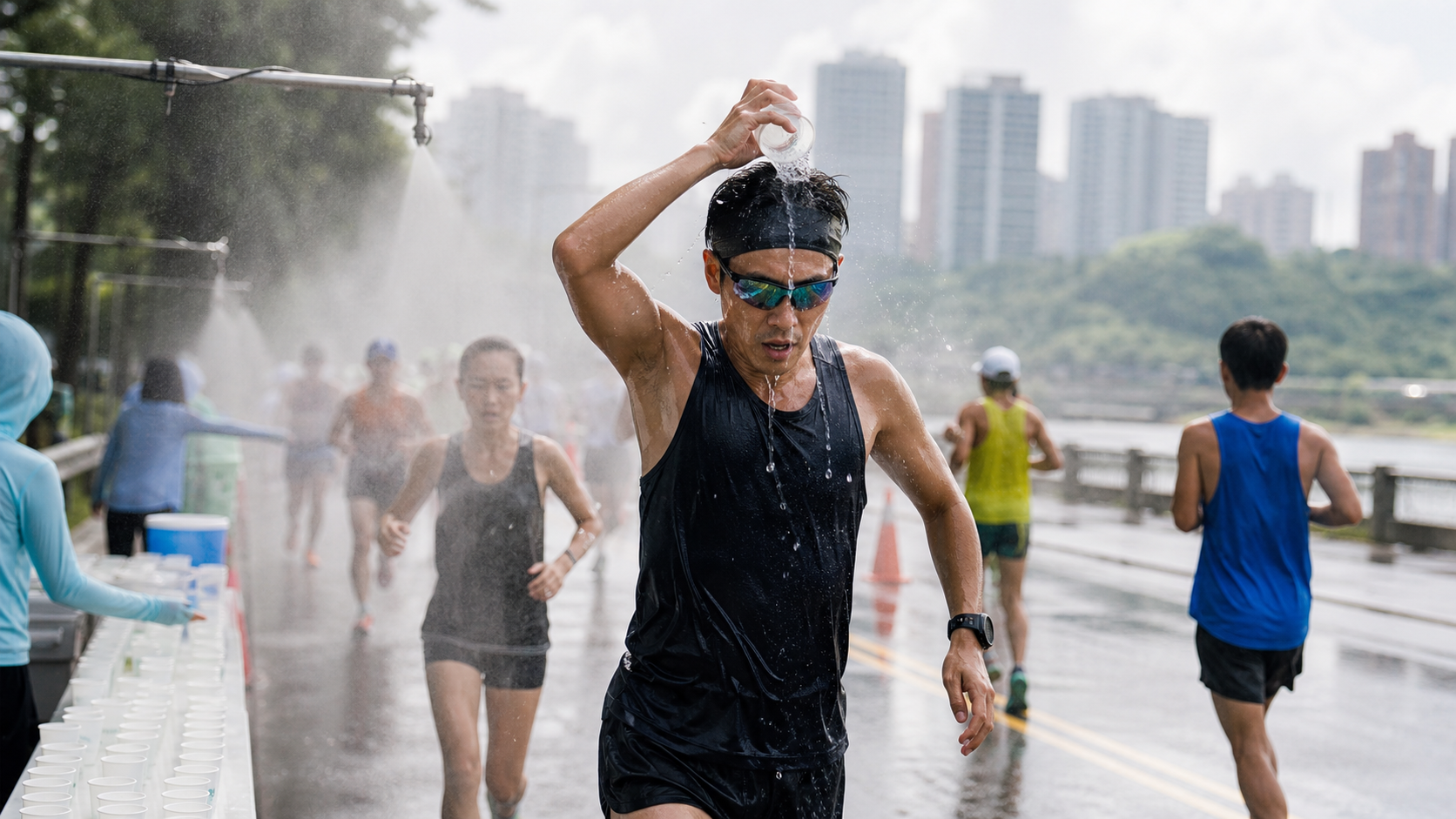
- Pour water over your head, neck, and wrists (areas where arteries run close to the surface) at every aid station
- Sponge cooling: if aid stations provide wet sponges, prioritize cooling your neck and forearms
- Wear a hat for sun protection (light-colored hats preferred) to reduce radiant heat absorption on the head
- Choose the shaded side of the course, using shadows from buildings or roadside trees
Recognizing warning symptoms:
- Stopped sweating but skin is burning hot: sign of heat exhaustion, slow down immediately and seek medical assistance
- Headache, nausea, disorientation: heat stroke warning, stop racing immediately
- Heart rate elevated but unable to speed up: cardiac heat stress, proactively slow down by 60–90 sec/km
High-Temperature Adjustments for Hydration and Electrolytes
Sweat rate increases significantly in high heat, so hydration strategies need corresponding upgrades:
| Item | Normal Weather Intake | High Heat (WBGT>28°C) Intake |
|---|---|---|
| Fluid per hour | 400–600ml | 600–900ml |
| Sodium (electrolytes) | 300–500mg/hr | 500–700mg/hr |
| Energy gel interval | 45–60 minutes | 40–50 minutes (faster metabolism) |
Hydration tips:
- Small amounts, frequent intake: 150–200ml each time, do not chug 500ml at once
- Ice water over room-temperature water: ice water directly lowers esophageal and stomach temperature, accelerating core cooling
- Prioritize electrolyte drinks: excessive plain water can cause hyponatremia, worsening dizziness symptoms
Practical Recommendations
- Check the WBGT forecast for race day in advance and adjust your target pace accordingly; do not stubbornly insist on a personal best
- Train during hot periods to allow your body to undergo heat acclimatization, which typically takes 10–14 days
- Wear light-colored, breathable moisture-wicking clothing; avoid dark heat-absorbing materials
- Inform companions or course volunteers of your location; running alone in high-temperature races carries far greater risk than in cool weather
Conclusion
High-temperature marathons are an unavoidable challenge for Taiwanese runners, but responding scientifically can turn passivity into proactivity. Acknowledging the impact of heat on performance, proactively adjusting pace, and actively executing cooling strategies are the only correct answers for safely finishing summer road races in Taiwan. Only by finishing healthy can you have the opportunity to set personal bests in the cooler autumn and winter races.
Related Reading
- Pace Adjustments in High-Temperature Environments: WBGT and Pace Reduction Formulas
- The Impact of Taiwan’s Summer Heat on Pace: Pace Adjustments During the Heat Acclimatization Period
- PB Adjustments in Hot Weather: Pace Adjustment Formulas for 35°C Environments
- Running Strategies in High Temperatures: Heat Dissipation and Pace Adjustments for Taiwan Summer Training
TBA 北高360 逆風爆熱再送空汙 苦行挑戰賽全記錄 4K沈浸式臨空畫質| 公路車 | CT Yeh
3 年前
單車 一日北高 ( 雙城 ) 肥宅雙人瘋狂行 紀錄片 REACTO
10 年前
一日北高/長距離團騎 常見問題補充篇 / 組團或跟團的眉角 / 壯車友容易被瘦車友慢性拉爆 / 原來屁股痛可能是這個原因...? / 風場配速法 / 公路車 / CT Yeh
2 年前
CT暗黑廚房) 車友必備 宇宙無敵鮮蚵湯 幫助訓練恢復 天然食補 好市多 超肥鮮蚵 破PR
7 年前
一日北高 11小時 賽後心得分享篇 | TWB北高360 | 一日雙城 | 單車 | 公路車
6 年前
#公路車 #Vo2Max #最大攝氧量 測驗 體驗 | 心肺測試
6 年前
一日北高前的高裝檢 | 北高 360 | 挑戰11小時的裝備 | 一日雙塔 | 補給
6 年前
微雨戰! 2022桃園市長盃錦標賽 無敵交管 沒來玩太可惜了! 羅馬公路太可怕 差點成佛! 公路車 | CT Yeh
4 年前