Introduction
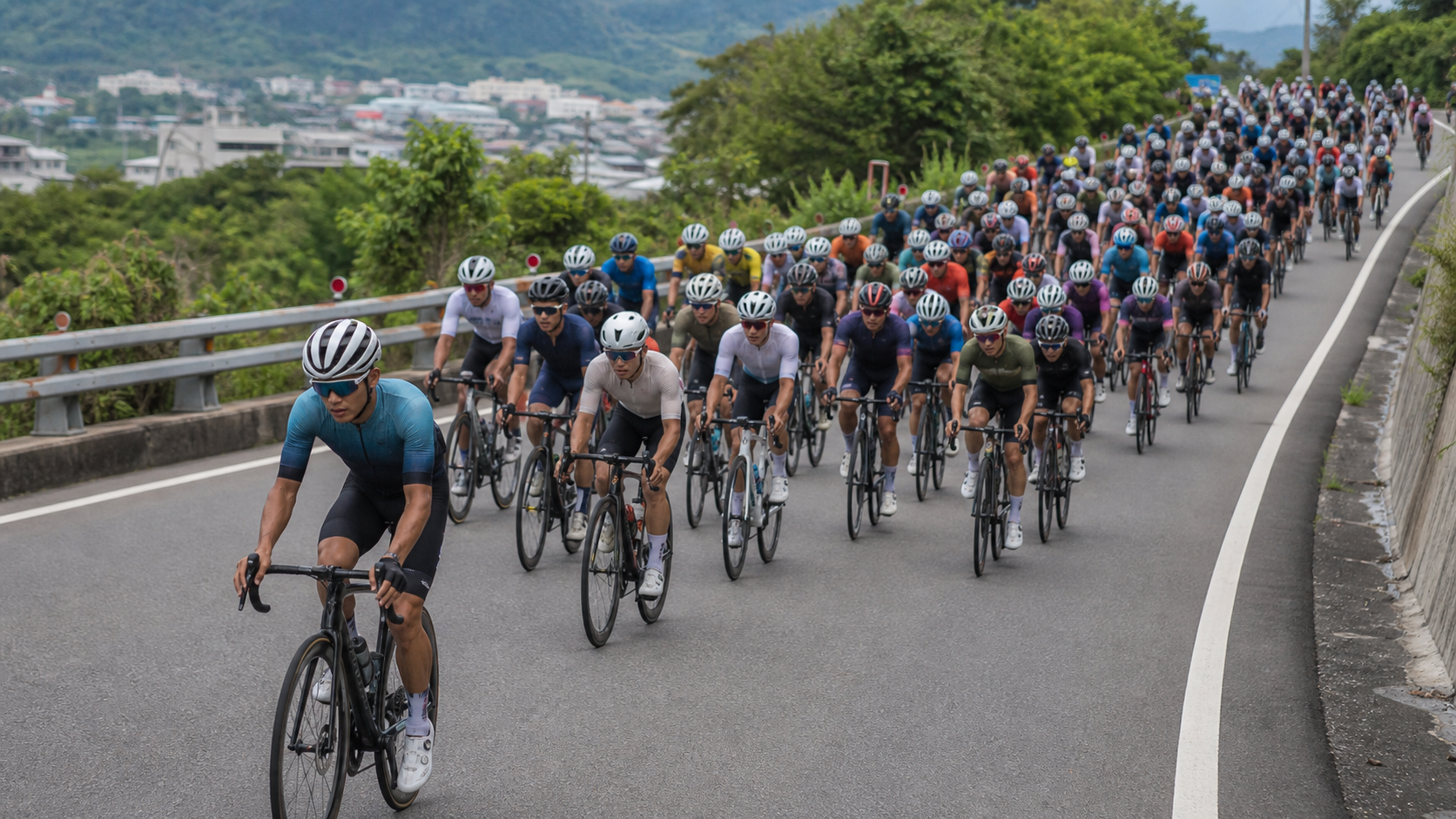
Taiwan hosts dozens of road cycling races every year, from the Tour de Taiwan to national championships, and the pelotons of over a hundred riders intimidate many amateur cyclists. A 150-rider group isn’t just about numbers—it’s a living, breathing organism with its own dynamics, changing in an instant, where one misstep means a touch of wheels and a crash. This article takes you deep into the core logic of riding in a large peloton, so you can not only survive but also smartly conserve energy and wait for the right moment.
Peloton Dynamics Basics
Understanding how the peloton works is the prerequisite for finding a safe position. Riders at the very front face the most wind resistance and expend the most energy; the further back you go, the more pronounced the “accordion effect” becomes—a slight slowdown at the front forces hard braking at the rear, and accelerating again costs even more effort.
Wind Drag Savings
| Position in Peloton | Wind Drag Reduction | Relative Energy Expenditure |
|---|---|---|
| Very front of peloton (riders 1–5) | 0% | 100% |
| Front third of peloton (riders 5–50) | Approx. 25–35% | 70–80% |
| Middle of peloton (riders 50–100) | Approx. 35–45% | 60–70% |
| Rear of peloton (after rider 100) | Approx. 40–50% (but severe accordion effect) | 75–85% |
It looks like the further back you go, the less wind resistance you face, but the “accordion effect” forces riders at the rear to accelerate repeatedly, so their actual energy expenditure isn’t lower than those in the middle. The best value-for-energy position is on the left or right flank of the front third of the peloton—you get shelter from the wind while still having lateral escape room if an incident occurs.
Three Principles for a Safe Position
Principle 1: Maintain Lateral Vision
- Avoid being boxed in the dead center: If a crash happens in the middle, you’re surrounded on all sides with nowhere to go
- Stay near the roadside but not glued to it: Keep 50–80 cm from the edge, leaving room for an emergency dodge
- Constantly watch the riders beside you: Hands off the bars, head shaking, drifting—all are warning signs of danger
Principle 2: Identify “Time-Bomb Riders”
In the peloton, certain behavior patterns signal danger:
- Riders who drift left and right frequently and can’t hold a straight line
- Riders who follow too closely (less than 30 cm) while staring straight ahead and not looking around
- Riders showing clear signs of fatigue (excessive bike swaying, rapid breathing)
- Riders using disc brakes but lacking skill, braking too aggressively (especially important in races mixing disc brakes and rim brakes)
The moment you spot a time-bomb rider, move sideways or pass them immediately—do not stay on their wheel for long.
Principle 3: Master the Peloton’s Pace
- Anticipate acceleration moments: The peloton always accelerates before climbs, after corners, and after feed zones
- Prepare in advance: Start accelerating slowly 10–15 seconds before the peloton speeds up, so you don’t get dropped
- Don’t chase every surge: When you see riders sprint ahead, first check whether the whole peloton is accelerating or just a few riders going out
Special Considerations for Taiwan Race Scenarios
Taiwan’s road races are often held in mountainous areas, and peloton riding comes with several Taiwan-specific challenges:
- Narrow roads: Taiwan mountain roads often measure just 4–5 meters wide, squeezing a 150-rider peloton like toothpaste from a tube—you must move to the front in advance
- Road surface quality: Some courses have expansion joints and potholes that require warning riders behind you
- Motorcycle officials and support vehicles: In Taiwan races, support vehicles and motorcycle officials weave through the peloton—watch for changes in traffic flow
- High corner density: Mountain roads have many bends, and before every corner you need to re-check whether your position is safe
Practical Advice
- Recon the course beforehand: Know the exact location of every critical section (narrow roads, sharp corners) and plan when to move up
- Practice riding in a group: Join weekend club rides to get used to riding in a 30–50 rider group before tackling larger events
- Learn to communicate: Pointing back to signal potholes, shouting “Brake!” or “Left! Right!” is peloton etiquette and key to safety
- Control your mindset: In a large peloton, anxiety makes your movements stiff and reactions slow—breathe deeply and stay relaxed to respond quickly to sudden situations
- Have an emergency plan ready: Every stretch of road, ask yourself, “If someone crashes right in front of me now, where do I dodge?”
Conclusion
A 150-rider peloton may look fraught with danger, but once you grasp the dynamics, spot the danger zones, and keep a cool head, the peloton is actually the best tool for amateur riders to save energy and reach the finish safely. Next time you’re on the start line, position yourself as a “tactical observer” rather than just a cog following the pack.
Related Reading
- Road Race Peloton Riding: Complete Guide to Position Choice and Energy-Saving Strategies
- Position Management in Road Race Pelotons: Aerodynamic Principles for Saving Energy
- Road Bike Group Riding Techniques: Safe and Efficient Wheel-Sucking Skills
- Complete Analysis of Professional Cycling Team Tactics: Formations, Echelon Effect, and Final Sprint Launch
風櫃嘴 | 全台最多大砲的單車路線 | 尋寶網攝影師告訴你怎麼擺拍起來才好看 | 熱門攝影地點巡禮
6 年前
2025 海鷗團體繞圈賽 / 前八強賽事精華!/ 環台賽等級拍攝 / 國手菁英隊伍較勁 / CT Yeh #公路車
8 個月前
車隊介紹) 台北 一年開團365天 車隊 Apollo Ride 晨騎 好選擇 ( 陽明山 風櫃嘴 冷水坑 平等里 聖人 關渡 大稻埕 ) 找人騎車
7 年前
96 彰化讚 挑戰組實錄 x 空拍繞圈賽集團衝刺 | 公路車 | ARTC 車測中心 | CT Yeh
6 年前
備戰 戀戀197 賽前關門點分析 西濱團練 #公路車 4K高畫質
6 年前
風櫃嘴時間 預測西進武嶺時間?13000名車友統計數據分析告訴你 !
5 年前
「悲情男車友」創作單曲 爆笑MV / 公路車 / CT Yeh / 4K劇情版
7 個月前
2024 如來神掌 百人約騎挑戰!feat. 秘境單車社團 / 神人們太可怕 / 全程錄影 x 完整坡度解析 / 公路車 / CT Yeh
2 年前