Introduction
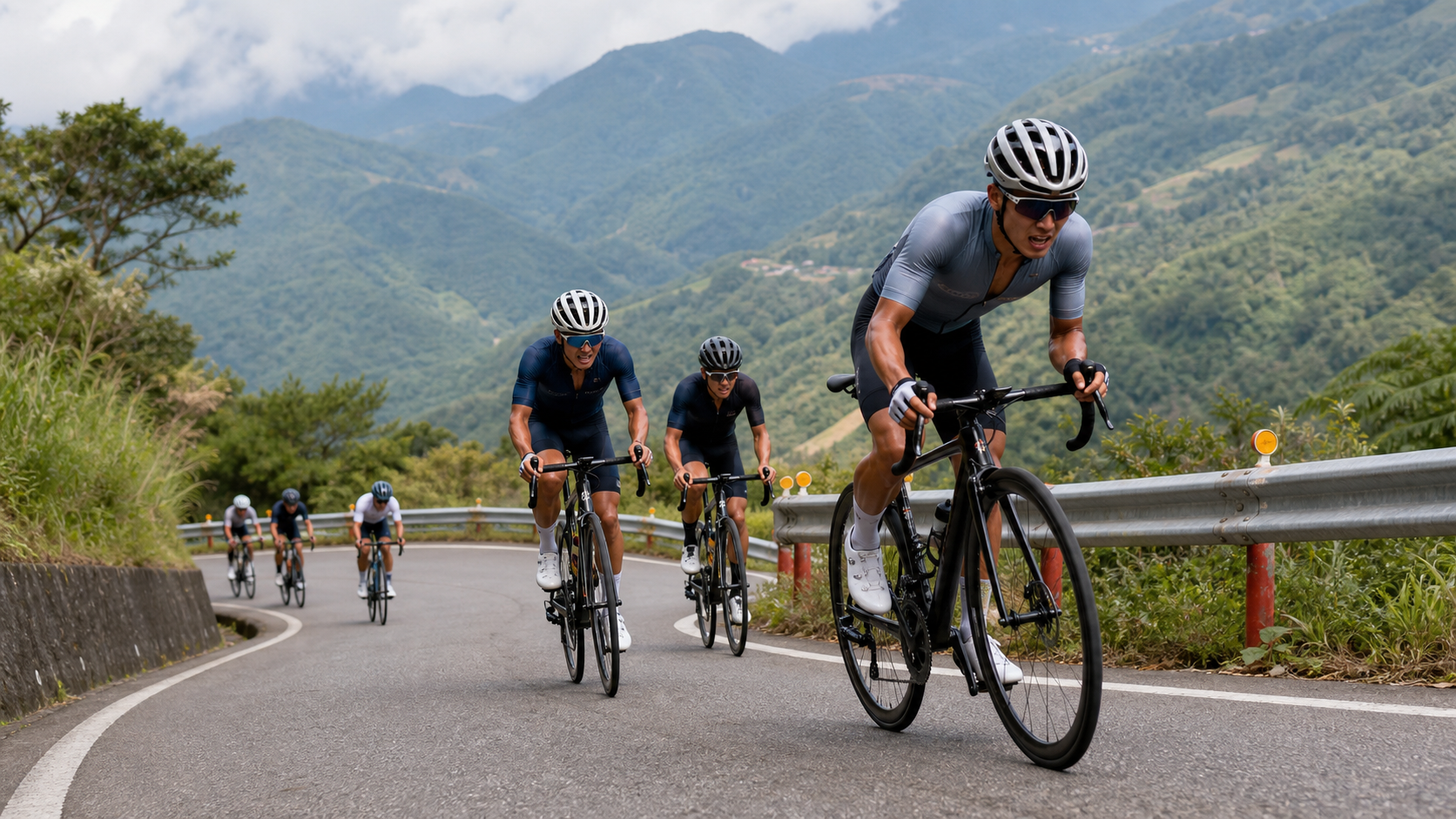
Climbing races are one of the harshest tests in road cycling. Wuling KOM, Taipingshan, Hehuanshan—Taiwan boasts world-class climbing routes and has produced a cohort of strong riders specializing in climbing. However, many amateur riders find themselves in a dilemma during climbing races: attacking too early leads to a late-race collapse, while attacking too late means missing the window. This article analyzes the optimal timing for attacking when the group splits, from both tactical and physiological perspectives.
The Pattern of Group Splits in Climbs
In climbing races, the group does not split suddenly at a single moment, but rather through a process of gradual selection. Understanding this process is key to finding the most effective attack point.
Climbing Intensity and Elimination Rhythm
| Climbing Duration | Common Split Points | Reason for Split |
|---|---|---|
| Within 15 minutes | Minutes 3–5 | Pace too fast; those with insufficient anaerobic threshold blow up early |
| 15–40 minutes | Minutes 10–15 | FTP gaps begin to show; weaker riders lose speed |
| Over 40 minutes | Minutes 20–30, final 5 km | Glycogen depletion; psychological breaking points cluster |
Core principle: The split of the group on a climb is determined jointly by “the strong riders’ steady output” and “the weak riders’ physiological limits.” An attack merely accelerates this inevitable process.
The Physiological Basis for Attack Timing
When Is an Attack Most Devastating?
Sections where the gradient suddenly steepens are the most effective attack points. The reasons are:
- A sudden increase in gradient requires an immediate rise in power output
- Riders already in a high heart-rate zone lack the reserve to follow a sudden acceleration
- The visual impact (seeing the steeper road ahead) accelerates psychological collapse
Common climbing routes in Taiwan, such as the Kunyang to Wuling section of the Wuling KOM and the consecutive hairpin turns after Cingjing Farm, are classic examples of sudden gradient increases.
Four Common Attack Patterns
- Tempo Attack: Gradually increase the group’s speed, causing weaker riders to drop off without realizing it. Suitable for riders with ample energy who aim to wear down opponents
- Punch Attack: A short burst of high power (120–150% FTP, sustained for 20–45 seconds) to create a gap. Suitable for sudden gradient increases or straight sections after corners
- Feint: Pretend to attack to lure opponents into following, then resume normal pace to exhaust their energy
- Wind-side Attack: On crosswind or headwind sections, deliberately move to the outside of the group to force others to follow; crosswinds drain riders behind more than those in front
Real-World Scenarios on Taiwanese Race Courses
Wuling KOM Section Strategy
The Wuling KOM covers approximately 105 km with about 3,275 meters of elevation gain, making it Taiwan’s most iconic climbing event. Based on race data from past years, the group typically splits noticeably in the following sections:
- Cingjing Farm (approx. KM 70): After the early attrition, this is the first psychological and physical filter
- Kunyang to Wuling (final 12 km): Average gradient rises to 7–8%, where the outcome is truly decided
- Final 3 km: All riders still in the lead group begin their final showdown
Recommended attack timing for amateur riders: Don’t chase the lead from the start. Instead, after Kunyang when the gradient steepens again, hold 110% FTP for 3–5 minutes and open a gap while opponents’ mental focus wavers.
Preparation and Judgment Before Attacking
Before deciding to attack, you must assess the following:
- Your remaining energy: Is your power meter’s W’/Bal (anaerobic reserve) sufficient?
- Your opponents’ condition: Observe whether their breathing depth and pedaling rhythm are becoming inconsistent
- Distance to the finish: A successful attack made too early often cannot be sustained to the line
- Current weather and wind direction: Attacking into a headwind costs far more energy; attacking with a tailwind is more effective
Practical Advice
- Record your training data and identify your Maximal Aerobic Power (MAP), which serves as the benchmark for judging whether you can follow an attack
- Pre-ride the target sections before race day to familiarize yourself with gradient changes and road conditions
- Do not attack from the last 5 positions in the group—your position is already disadvantageous, and the chance of a successful attack is extremely low
- Observe the strong riders’ behavior in the early race and follow their attack rhythm rather than launching blindly on your own
- Have a fueling strategy: Consume fast-acting carbohydrates (energy gels) 15 minutes before attacking to ensure enough energy to sustain the effort
Conclusion
There is no standard answer for attack timing in climbing races, but there is logic to follow. Gradient changes, opponents’ fatigue, your own physical condition, and mental readiness—the intersection of these four variables is your optimal attack window. Rather than waiting for the “perfect moment,” repeatedly simulate attack scenarios in training so your body remembers the pacing feel after a high-intensity surge, allowing you to make composed decisions on race day.
Related Reading
- Race Climbing: Timing Judgment Between Group Riding and Solo Breakaways
- Strategy Analysis for Climbing Races: Timing for Following, Overtaking, and Saving Energy
- Breakaway Tactics: How to Successfully Escape the Peloton in Professional Cycling
- Pacing Strategy in Professional Cycling: Flat Breakaways and Climbing in the Group
富士山KOM 賽事篇 VLOG!/ 小野田出沒!/ 完整路段分析 / 武嶺要騎多快才能拿環?/ 台灣選手 第20回Mt.富士ヒルクライム 参加!/ 公路車 / CT Yeh
2 年前
戰略) Zwift Race 如何咬在第一集團 如何評估自己要開多少推力 (請開1.5倍速看)
7 年前
2019 夏季KOM 5小 完賽心得 準備攻略 東進武嶺 夏季登山王之路 Taiwan KOM Challenge
7 年前
#公路車 #西進武嶺 配速配瓦實驗 坡度分析 四小時內攻略 建大盃 NeverStop #西進武嶺攻略
6 年前
2026 輪霸西濱200K 挑戰VLOG / 第一集團 / 首次參加..經驗不足、膀胱不足 /死守6H內 / AI戰鬥力顯示系統 / 公路車 / CT Yeh
4 個月前
FTL 與 SYB 車隊專訪 西進武嶺 實用攻略分享! 2小時 如何練?!你不知道的眉角!新手準備武嶺必看 EP1 | 實力派女車友 | 精華版 | 公路車 | CTYeh
4 年前
單車 梅山36灣 坡度介紹 路段介紹 空拍 (相關遊記影片,請參考說明或我的頻道喔,歡迎訂閱)
6 年前
西進武嶺 8000名單車友數據分析 PART1 | 從新手到高手數量/瓦數/推力比/FTP推力比/功率計使用率 大解析 | 公路車 | CTYeh
5 年前