Introduction
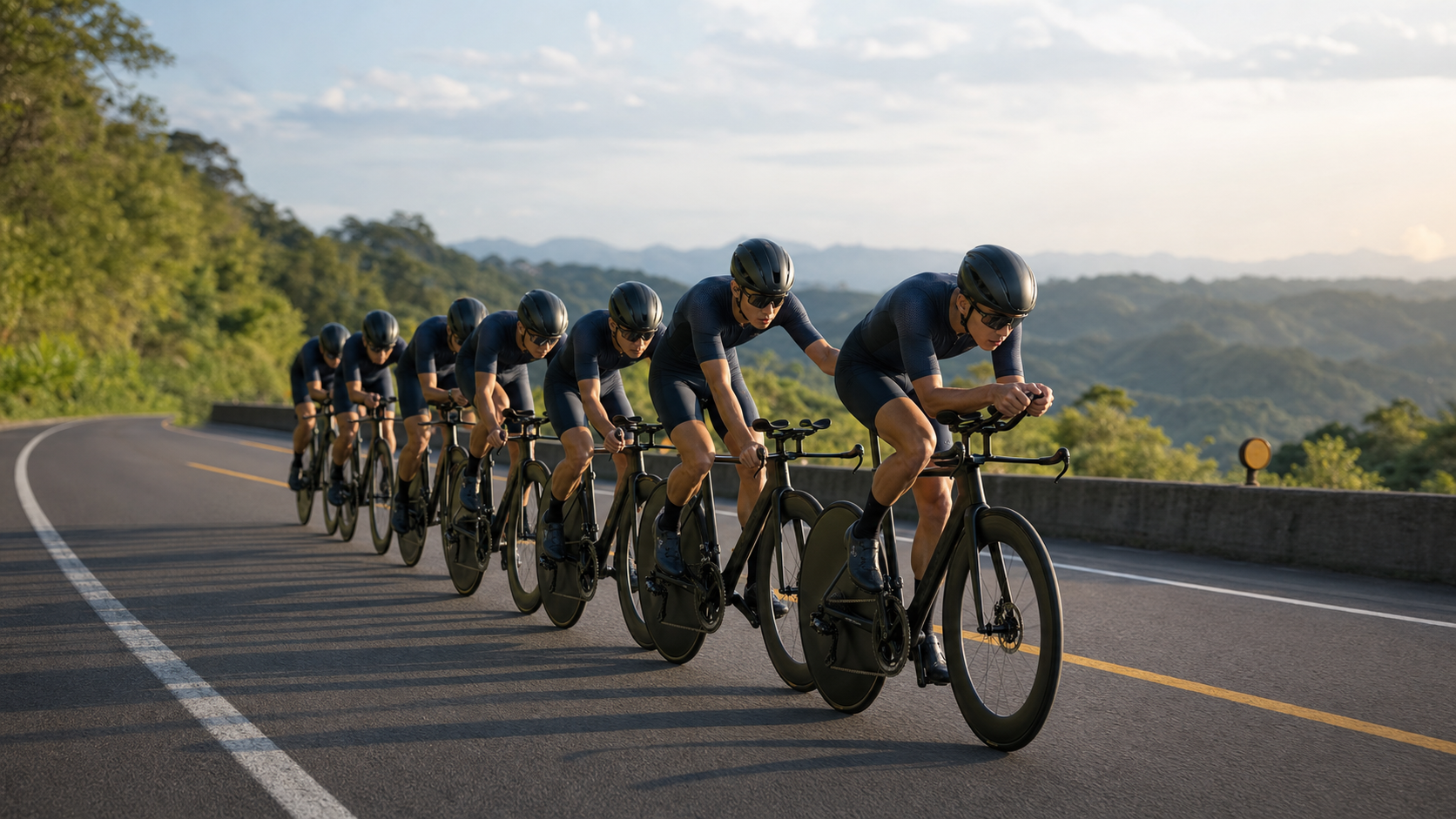
The Team Time Trial (TTT) is the cycling discipline that demands the most teamwork and coordination. A team of four to eight riders moves at high speed in a tight formation, taking turns at the front to absorb wind resistance while the remaining riders draft behind to conserve energy. It sounds simple, but in reality, the rotation rhythm, energy allocation, and formation maintenance in a TTT require long hours of practice to achieve maximum efficiency.
The Basic Mechanism of Lead Rotation
Standard Rotation Procedure
There are two mainstream rotation models in a TTT:
- Timed Pull: Each rider leads at the front for a fixed duration (usually 20–45 seconds), then peels off to the side when the time is up, allowing the rider behind to take over
- Feel-based Pull: The lead rider decides when to peel off based on their own fatigue level, typically used by higher-level teams
Amateur teams are advised to use timed rotation, as it is easier to coordinate and prevents stronger riders from over-pulling, which could lead to a late-race collapse.
Energy Calculation for 30-Second Pulls
| Role | Power Output | Duration | Energy Cost |
|---|---|---|---|
| Lead rider | 105–115% FTP | 30 seconds | High |
| 2nd rider in line | 87–92% FTP | 30 seconds | Medium |
| 3rd–4th riders in line | 80–85% FTP | 30 seconds | Low-medium |
| Dropping back to recover (after rotation) | 70–75% FTP | 10–15 seconds | Low |
Using a 6-rider team as an example, each rider pulls once every 3 minutes (30 seconds × 6 riders), with a recovery time of approximately 2.5 minutes.
Optimizing Energy Allocation in Rotation Rhythm
Rotation Order Based on Strength Matching
An ideal TTT team does not have everyone rotating at the same frequency; instead, adjustments are made according to differences in physical capacity:
- Strongest riders: Pull 10–15 seconds longer per turn, and extend their pull duration on critical sections (headwinds, climbs)
- Mid-pack riders: Maintain the standard 30-second rotation rhythm
- Weakest riders: Shorten each pull to 15–20 seconds, but maintain the formation without creating a “black hole”
Key principle: It is better for the weakest rider to shorten their pull than to get dropped—once a rider falls off, the team’s collective drafting benefit drops significantly.
Special Handling on Climbs
On climbs, wind resistance has less impact, reducing the drafting benefit of pulling. The strategy should be adjusted accordingly:
- Shorten rotation intervals to 15–20 seconds
- Allow slight gaps (2–5 meters) to avoid emergency braking when the rider ahead suddenly slows on a climb
- Strongest riders pull more, giving weaker riders more recovery time on climbs
Details of Formation Maintenance
Optimal Drafting Distance
- Flat road, headwind: 0.5–1 meter, maximizing the drafting benefit
- Crosswind: Draft from a “diagonal rear” position, staying within the wind shadow of the rider ahead
- Climb: 1.5–3 meters, leaving braking buffer room for yourself
- Descent: 3–5 meters, safety comes first
Hand Signals for Peeling Off
- Left hand off the bars, waving left: preparing to rotate to the left
- Right hand off the bars, waving right: preparing to rotate to the right
- Slight bike sway (gentle rocking side to side): indicating fatigue, requesting a rotation
Practical Considerations for TTT Events in Taiwan
TTT events in Taiwan are typically held on mountain roads or flat courses, and the following factors need to be considered:
- Taiwan’s mountain roads have many corners: Signals must be given well before corners, with unified braking timing
- Large speed differences: Descents can reach 60–70 km/h; no rotation is allowed at these speeds—wait until speed stabilizes before resuming the rhythm
- Feeding strategy: Feeding timing in a TTT must be communicated to the whole team in advance; riders cannot suddenly slow down to grab a bottle
Practical Recommendations
- Complete at least 3–5 full TTT training sessions before the race so team members become familiar with the rotation rhythm and hand signals
- Confirm each rider’s FTP to calculate a reasonable allocation of pull times
- Designate a “pace-setter” role: when the team’s speed is too fast or too slow, the designated rider calls out the speed adjustment
- Practice emergency drop-off procedures: when the weakest rider is about to fall off, there must be a pre-arranged “release” command so the remaining riders can maintain speed
- Record power data for each rotation to identify the rotation interval that best suits the team
Conclusion
A 30-second pull in a TTT may seem brief, but the cumulative energy expenditure and allocation determine whether the team can sustain maximum speed to the finish line. The best TTT teams are not those whose members are all powerhouses, but those where everyone knows exactly how much power to output at any given moment, when to peel off, and how to protect their teammates. This precise collective intelligence is what makes the TTT so fascinating.
Related Reading
- Team Time Trial (TTT) Training and Tactics: The Science of Drafting and Handoffs
- Team Time Trial (TTT) Tactics: Why Formation and Positioning Matter More Than Individual Power
- Individual TT vs. Team TT (TTT) Tactical Differences: Pull Rhythm and Formation
- Collective Strategy for Amateur Teams: Lead Rotation Time and Rotation Gaps
Live) 備戰2019彰化經典百K 賽前攻略 (已完賽請看新影片
7 年前
Zwift跨國線上追逐賽 第二站 台灣 TTR vs. 日本 JETT 第二場 (台灣追日本) | 數百位國內外公路車高手,同場較勁 | 多視角賽事直播
4 年前
CT 喇低賽) 武嶺牽車 才是王道 西進牽車四小時內秘訣 攝手位置 如何判斷 防抽筋小秘訣
7 年前
TIME 公路車 Alpe d'Huez 21 開箱實錄! 購車/Fitting/組車/心得 | 新車入艙 | 時間的主人 CT Yeh
3 年前
西進武嶺 免費訓練分析服務 Intervals | 練不夠還是練過頭?你哪一種類型選手?AI模型告訴你! | 備戰神器 | 公路車 訓練 | CT Yeh
4 年前
2023 時代騎輪節挑戰全記錄 / VB小隊 / 差點被收掉... / Remix 第一集團 / 公路車 / CT Yeh
2 年前
單車AI教練!全新 ChatGPT4o 幫你分析訓練成果!排武嶺課表,分析騎車姿勢! 太神了! / 公路車 / CT Yeh / feat. 緯緯
2 年前
2024 彰化經典百K 參賽直播 / 黃亭茵集團 / 公路車 / CT Yeh
2 年前