Introduction
Nine out of ten people trying Bikepacking for the first time make the same mistake: bringing too much. On my first trip around Taiwan, my bags weighed 18 kg at the start. By Taichung, my knees were hurting; by Hualien, my back was so sore I couldn’t sleep. The biggest takeaway from that trip wasn’t the scenery along the way—it was learning a lesson that applies to all travel: everything you carry must be paid for with your pedaling power.
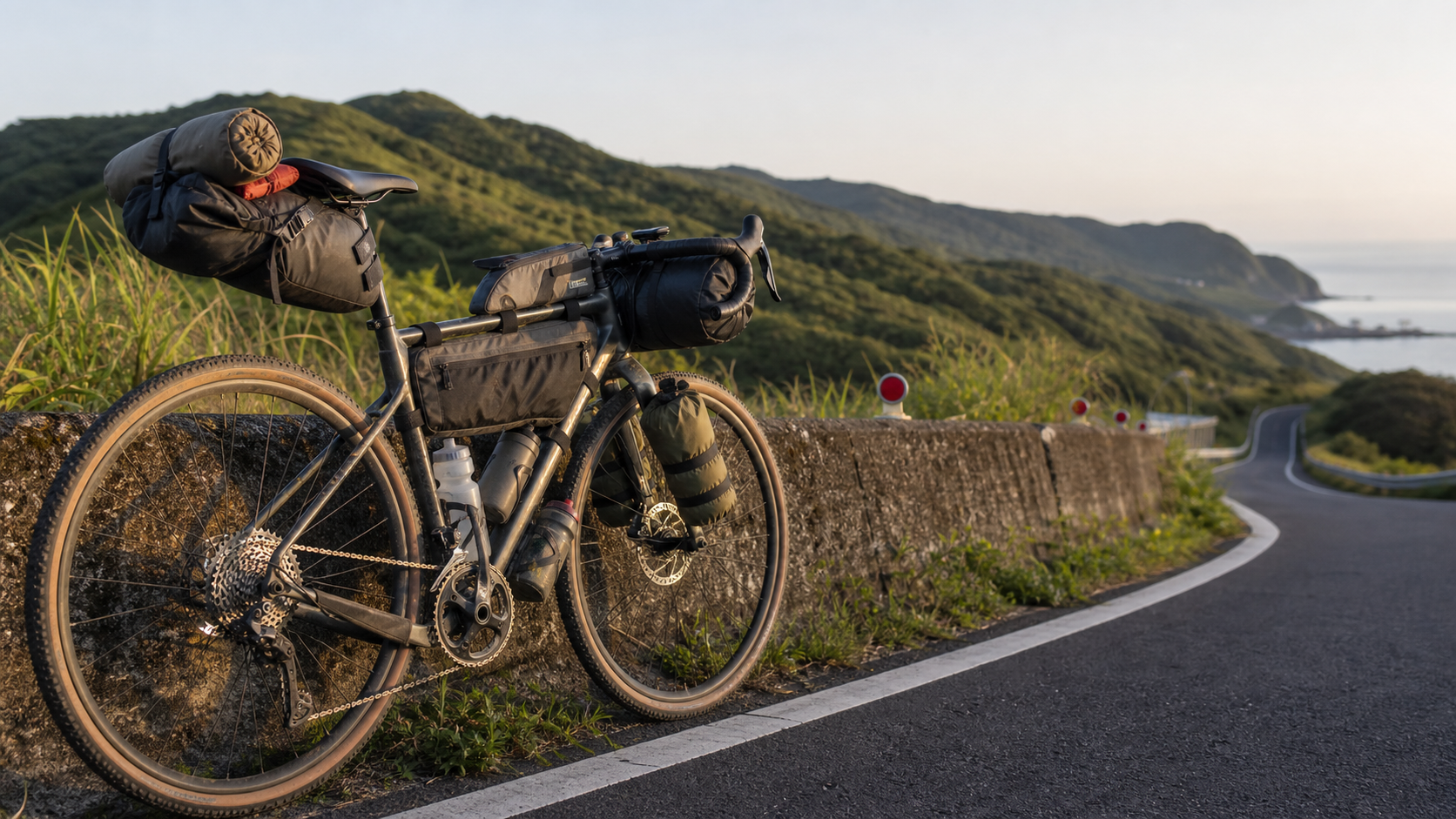
Bikepacking is a way of traveling that mounts gear directly onto the bike. Unlike the traditional rear rack + pannier system, modern Bikepacking emphasizes low center of gravity, lightweight design, and aesthetics integrated with the bike frame. This article compiles a packing philosophy for a one-week trip suited to Taiwan’s terrain, climate, and resupply conditions.
Introduction to Bikepacking Bag Systems
The core of modern Bikepacking is “distributed load”—spreading weight across the bike:
| Bag Type | Mounting Position | Capacity Range | Best For |
|---|---|---|---|
| Frame Bag | Main triangle | 3–10 L | Tools, food, batteries |
| Handlebar Bag | Handlebar | 5–15 L | Sleep system, clothing |
| Saddle Bag | Seatpost | 8–20 L | Tent, spare clothing |
| Top Tube Bag | Top tube | 0.5–2 L | Phone, snacks, nutrition |
| Fork Bag | Fork legs | 2–4 L each | Water bottles, tent poles, cookware |
Gear Selection Logic for a One-Week Trip
Sleep System (Target: Under 3 kg)
Taiwan has a dense network of guesthouses and hostels, so pure Bikepacking doesn’t necessarily require camping. But if you want maximum route freedom, a sleep system is a worthwhile investment:
- Sleeping Bag: For Taiwan’s lowlands in summer, an ultralight down bag with a 10°C comfort rating works (about 350–500 g). Mountain areas have large nighttime temperature swings, so consider a 5°C version.
- Sleeping Pad: An inflatable pad with an R-value of 2 or higher, weighing about 400–600 g, is the best preventive medicine for a sore back.
- Tent vs. Tarp: Taiwan has frequent afternoon convective showers, so a one-person tent with rain protection is recommended; ultralight models weigh about 900 g–1.2 kg.
Clothing (The 3-Piece Rotation Rule)
- Cycling jerseys × 2: Hand-wash after each day’s ride; dry by the next day.
- Casual outfit × 1: Lightweight, quick-dry fabric so you don’t stand out in town.
- Rain jacket × 1: Doubles as a windbreaker; Taiwan’s convective showers arrive fast.
Avoid jeans and thick cotton clothing—these are weight killers and dry extremely slowly.
Tools & Repair
- Portable pump + 2 spare inner tubes
- Multi-tool (hex wrenches, chain tool, screwdrivers)
- Chain lube × 1 small bottle (Taiwan’s humid, hot environment requires daily lubrication)
- Glue-type tire patch kit × 1 (for emergencies)
Electronics
Taiwan has the highest convenience store density in the world, making recharging very easy—this drastically reduces your power needs for Bikepacking:
- A small power bank (10,000 mAh) is enough for a day’s charging needs
- Cycling computer charging cable (USB-C)
- No need to carry a large solar panel unless you’re heading into remote mountain sections
The Golden Rules of Packing
Here are the core principles distilled from multiple trips:
- Heavy items close to the bike’s center of gravity: Put heavy things (water, tools, food) in the frame bag; put soft, light items (clothing, sleeping bag) in the handlebar and saddle bags.
- Every item should have at least two uses: Rain jacket = windbreaker, sleeping pad = yoga mat, buff = neck pillow.
- Taiwan’s resupply is too convenient—don’t stockpile food: There’s a convenience store every 20–30 km, so you don’t need to carry more than half a day’s worth of food.
- Test the weight before departure: With all gear loaded, aim to keep the total weight on the bike under 12 kg, and target 18 kg total including the bike itself.
Practical Advice
- For your first trip, choose a route with resupply points, such as the western plains or the eastern coastal highway. Build confidence before tackling mountains or outlying islands.
- Strava’s Bike Packing route collections and Bikepacking.com’s Taiwan routes are great starting resources.
- Taiwan’s wild hot springs are a hidden highlight of Bikepacking—the joy of boiling a pot of water to soak your feet is something no luxury hotel can replace.
Conclusion
The art of packing is really a practice in life philosophy—figuring out what you truly need versus what you habitually want to bring but never actually use. After a one-week Bikepacking trip, you’ll find yourself back in daily life also thinking: do I really need this thing? That might be the quietest gift this sport gives you.
Related Reading
- Bikepacking for Beginners: Gear Checklist and Recommended Taiwan Routes
- Packing for Bicycle Travel: Weight-Saving Tips for Cycling Expeditions
- Minimalism in Bicycle Travel: The Light-Travel Philosophy of One Bike, One Bag
- The Art of Packing for Bike Travel: How to Fit a Week of Clothing into a Bike Bag
單車 一日北高 ( 雙城 ) 肥宅雙人瘋狂行 紀錄片 REACTO
10 年前
靠單車減肥35公斤 心得分享與整理
7 年前
#公路車 #Fitting 靠人工智慧APP 幫你調整單車
6 年前
多到選擇障礙... 換個單車把帶想一個小時 / BTP / 編織&軟木特有材質超吸睛! / 公路車 / CT Yeh
1 年前
太平山單車員工旅遊 | 這樣玩CP值最高!| 公路車
5 年前
風櫃嘴 | 全台最多大砲的單車路線 | 尋寶網攝影師告訴你怎麼擺拍起來才好看 | 熱門攝影地點巡禮
6 年前
北宜騎車⋯好刺激 差點被🐒尻 / 露營單車旅 / 公路車後背攜車架開箱!/ 百人大團露 / YAKIMA 設備開箱儀式感都來了 / 公路車 / CT Yeh
11 個月前
一日北高常見問題大集合 | 攻略 | 路線 | 訓練 | 補給 | 自行車 單車 | 一日雙城 | 雙塔 | TWB北高360 | 屁股痛
6 年前