Beginner Swimming 12-Week Plan: A Progressive Schedule from 25m Nonstop to a Continuous 1500m Swim
Introduction
Many adults in Taiwan face the same dilemma after learning to swim: they can barely finish one lap (25 meters) in the pool before gasping for air, and they cannot imagine how triathletes manage to swim 1500 meters or more continuously. In fact, this gap can be closed through a systematic 12-week progressive plan. The key is not talent, but workout design and patient execution.
This plan is suitable for swimmers who already have basic freestyle technique (can complete one lap but with great effort), can train 3 times per week, and aim to complete a continuous 1500-meter swim after 12 weeks.
Workout Design Principles
Progressive Overload
The body needs time to adapt to water training. The weekly increase in distance should not exceed 10–15% of the previous week’s total volume, otherwise it may lead to excessive fatigue or technical breakdown. Here is the overall distance plan for the 12 weeks:
| Week | Distance per Session | Total Weekly Distance | Key Focus |
|---|---|---|---|
| Weeks 1–2 | 300–500m | 900–1500m | Establish breathing rhythm |
| Weeks 3–4 | 500–700m | 1500–2100m | Extend continuous swimming distance |
| Weeks 5–6 | 700–900m | 2100–2700m | Stabilize pacing |
| Weeks 7–8 | 900–1100m | 2700–3300m | Break through 500m continuous swim |
| Weeks 9–10 | 1000–1200m | 3000–3600m | Practice pace control |
| Weeks 11–12 | 1200–1500m | 3600–4500m | Complete target distance |
Breathing Technique First
The most common problem for beginners is “pushing too hard + holding breath too long,” which leads to oxygen deprivation, lactic acid buildup in muscles, and forced stops. The correct approach:
- Begin exhaling continuously immediately after entering the water (slowly release air through the nose or the corner of the mouth)
- When turning the head to breathe, inhale quickly as soon as the mouth clears the water surface—do not wait until the head is fully rotated
- Breathe every 3 strokes (bilateral breathing) to avoid the body favoring rotation to one side
- Practice the feeling of “floating on the water surface” rather than “pulling yourself forward”
Weeks 1–4: Foundation Building Phase
The core goal of this phase is to build an aerobic base and a stable breathing rhythm, without chasing speed.
Weekly workout schedule (3 times per week):
- Warm-up: 5 minutes of water walking or easy kicking
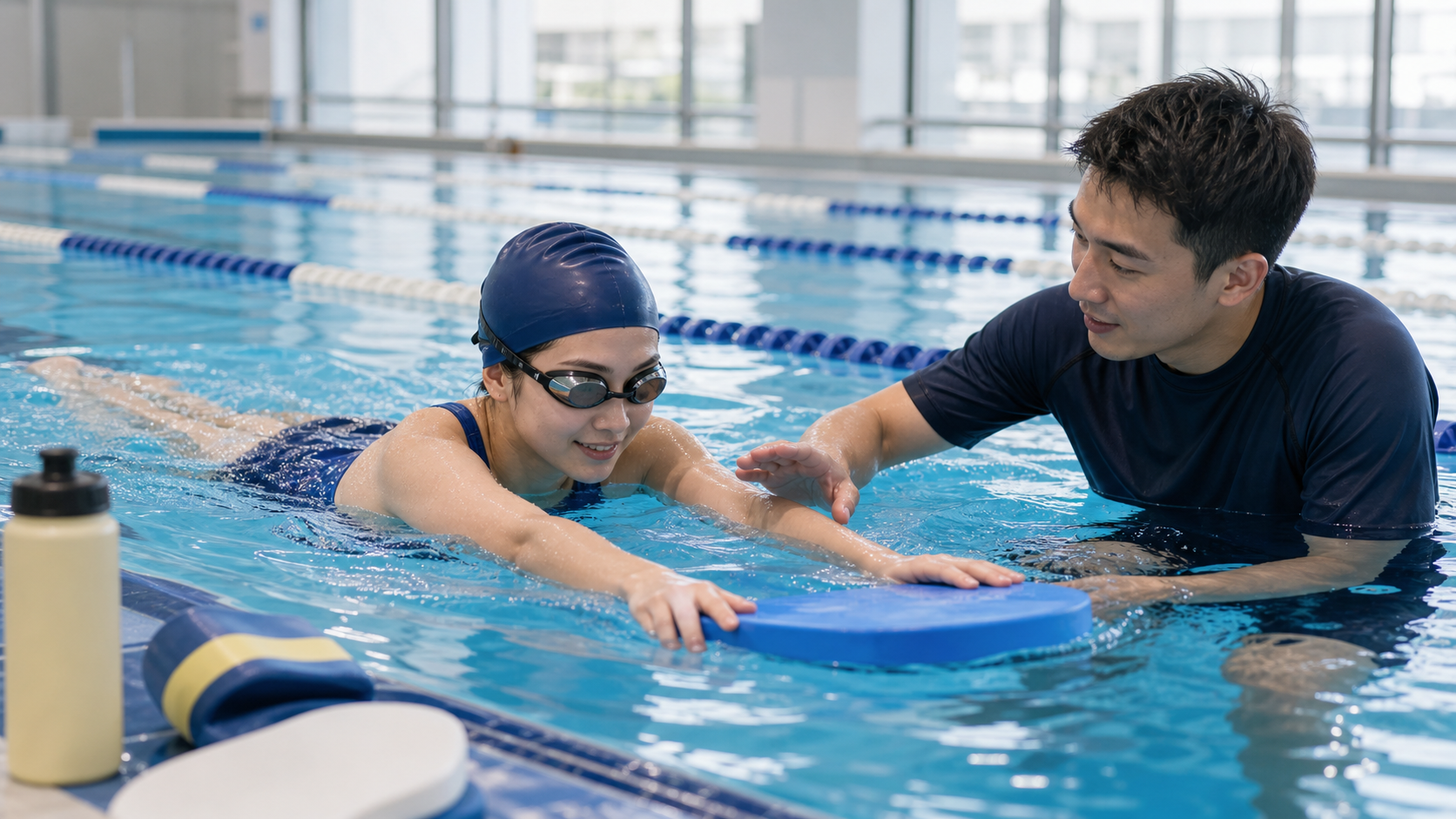
- Technique set: Use a pull buoy between the legs, practice arm stroke drills 4×25m (30 seconds rest between each)
- Main set: One cycle of “swim 25m + rest 30 seconds,” repeat for 8–12 cycles
- Cool-down: 50–100m relaxed backstroke
From weeks 3–4 onward, begin attempting “50m nonstop.” If you cannot complete it in one go, you may pause briefly in the middle, but record the distance you can swim continuously each time and gradually extend it.
Weeks 5–8: Endurance Development Phase
This phase introduces conscious training for “continuous swimming,” teaching the body to exercise at lower intensity for longer durations.
Sample workout for Week 6:
- Warm-up: 200m easy freestyle
- Technique set: Single-arm paddle 4×25m (holding a kickboard with the other hand)
- Main set: 3×150m, with 60 seconds rest between each (attempt to complete at a steady pace)
- Cool-down: 100m backstroke or breaststroke
Key training tips:
- The main set pace should be at an intensity where “you can speak short sentences, feel somewhat challenged but not gasping for air”
- If you truly need to stop mid-set, grab the lane line and rest for 10 seconds before continuing—do not abandon the set
- Record your “rating of perceived exertion” (1–10) after each session; the ideal range is 5–7
Weeks 9–12: Goal Sprint Phase
This phase focuses on getting the body accustomed to continuous aerobic swimming of 1000m or more.
Sample workout for Week 11:
- Warm-up: 300m mixed strokes (alternating freestyle and breaststroke)
- Technique set: Stroke rate control drill 4×50m (deliberately slow down the stroke rate and feel the propulsion of each pull)
- Main set: 1×1000m continuous swim (do not watch the clock; focus on breathing and body position)
- Cool-down: 100m relaxed kicking with a kickboard
For the final session of Week 12, attempt a full 1500-meter test swim. It is recommended to start at a pace about 10% slower than your usual main set pace, and be sure not to go out too fast in the first 500 meters.
Practical Tips
- Avoid heavy meals 1.5–2 hours before swimming, but a small amount of carbohydrates is fine (such as half a banana)
- Consume protein within 30 minutes after training to aid muscle recovery (soy milk and eggs are good options)
- Record yourself on video against the wall at least once a week to review your hand entry angle and body rotation amplitude
- If you feel very fatigued in a given week, shorten one session’s distance by 30%—do not push through
- Rehydrate immediately after swimming—you still sweat heavily during water training without realizing it
Conclusion
The 12-week progressive plan may seem long, but every session is an accumulation of physical adaptation. The most common reason beginners give up is “progress is too slow,” but in reality, improvements in aerobic capacity in the water usually become clearly noticeable around weeks 4–6. As long as you maintain a consistent 3-times-per-week routine and combine it with proper breathing technique, the 1500-meter goal is entirely within your reach. Give yourself 12 weeks, and you will be amazed at your body’s ability to adapt.
Related Reading
- 12-Week Plan for Beginner Swimmers: Progressive Training from 25m to 1000m
- 12-Week Advanced Plan for Beginner Swimmers: From 25 Meters to Continuous 1000-Meter Swimming
- 8-Week Beginner Swimming Training Plan: From 25m to Continuous 1000m Swimming
- Open Water Swimming Training Plan: Progressive Schedule from 500 Meters to 3.8 Kilometers
西進武嶺 免費訓練分析服務 Intervals | 練不夠還是練過頭?你哪一種類型選手?AI模型告訴你! | 備戰神器 | 公路車 訓練 | CT Yeh
4 年前
半日 小台灣 極限單車路線挑戰實錄
7 年前
live) 超越北高 之一日北高12小時 策略
7 年前
Live) 備戰2019彰化經典百K 賽前攻略 (已完賽請看新影片
7 年前
一日北高常見問題大集合 | 攻略 | 路線 | 訓練 | 補給 | 自行車 單車 | 一日雙城 | 雙塔 | TWB北高360 | 屁股痛
6 年前
一日北高 11小時 賽後心得分享篇 | TWB北高360 | 一日雙城 | 單車 | 公路車
6 年前
一日北高前的高裝檢 | 北高 360 | 挑戰11小時的裝備 | 一日雙塔 | 補給
6 年前
2019 夏季KOM 5小 完賽心得 準備攻略 東進武嶺 夏季登山王之路 Taiwan KOM Challenge
7 年前