Glute Training for Runners: Applying the Bridge, Clamshell, and Side-Lying Leg Raise to Your Running
Introduction
Many runners chase mileage while overlooking the importance of glute training. The gluteus maximus, gluteus medius, and gluteus minimus together form one of the body’s most powerful muscle groups, responsible during running for hip extension, pelvic stability, and generating propulsive force. Sports science research shows that weak glutes are a leading cause of runner’s knee (patellofemoral pain syndrome), iliotibial band syndrome, and lower back pain.
Because many runners spend long hours sitting at a desk, gluteal amnesia — a condition where the glutes fail to activate properly — is especially common. When the glutes can’t fire correctly, the body recruits compensatory patterns that place extra strain on the lumbar spine and knees, gradually raising the risk of injury over time. This article introduces three glute exercises best suited to runners and explains how to integrate them effectively into a training plan.
The Bridge: A Foundational Move to Activate the Glute Max
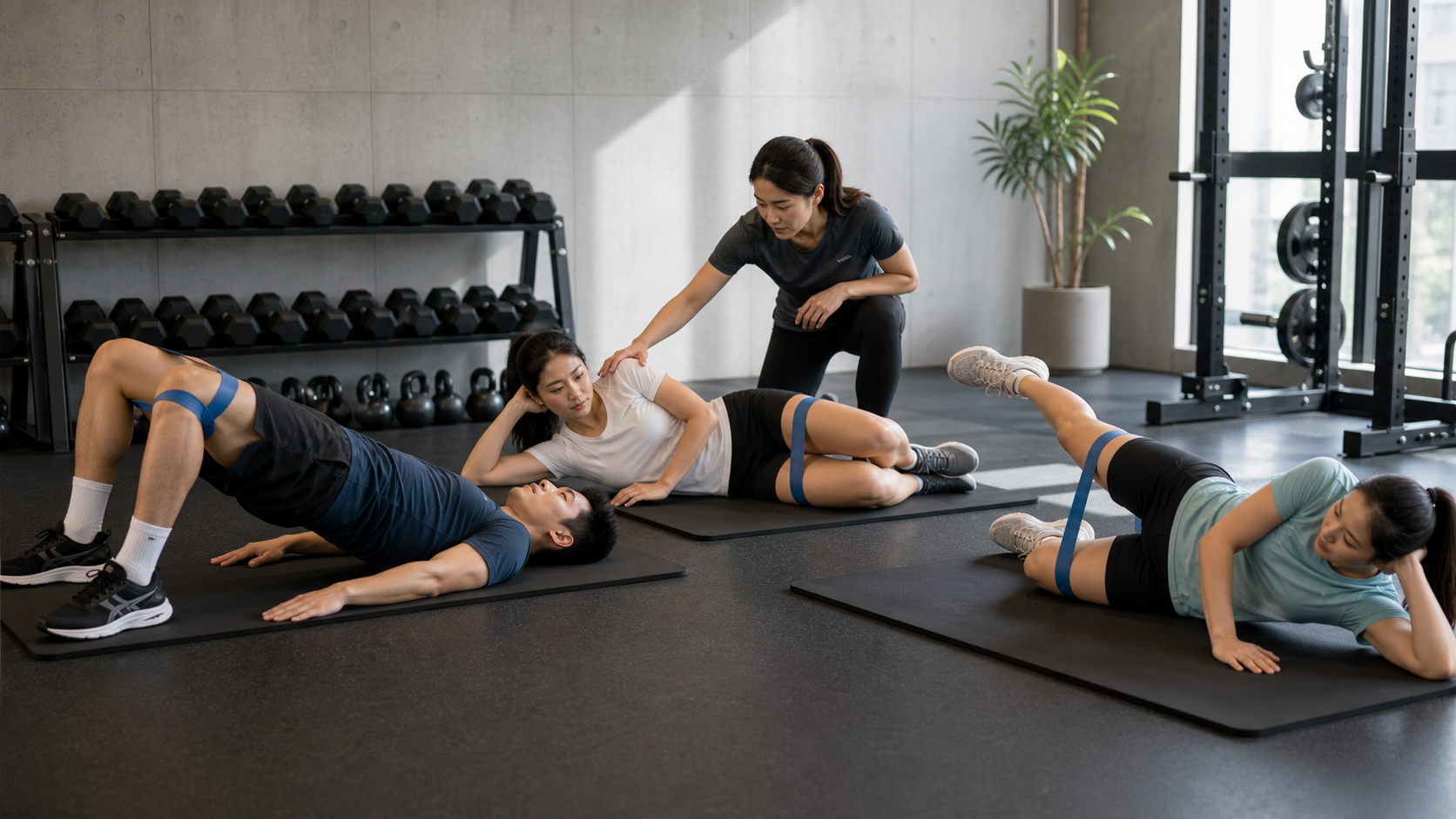
The hip bridge is one of the most effective exercises for waking up the gluteus maximus, making it ideal for early-stage glute training or as a pre-run warm-up.
How to perform the basic bridge:
- Lie on your back with knees bent to roughly 90 degrees, feet flat on the floor, hip-width apart
- Brace your core and keep your spine in a neutral position
- Squeeze the glutes and drive the hips upward until shoulders, hips, and knees form a straight line
- Hold at the top for 2–3 seconds, focusing on the glute contraction
- Lower slowly without letting your hips fully touch the ground, keeping tension in the muscle
- Recommended: 3 sets of 15–20 reps
Progression: Single-Leg Bridge
Lifting the non-working leg significantly increases the difficulty and more closely mirrors the single-leg support demands of running. The single-leg bridge also trains pelvic stability, preventing pelvic drop compensation.
Weighted Bridge
Adding a weight plate across the hips or looping a resistance band above the knees increases resistance, suitable for runners who already have a solid foundation and want to push their training further.
The Clamshell: The Key Move for Strengthening the Glute Medius
The gluteus medius sits on the outer hip and plays a crucial role in controlling pelvic stability and preventing knee valgus (inward knee collapse). With every foot strike during running, the glute medius must resist gravity to prevent the opposite hip from dropping (Trendelenburg sign).
| Exercise | Primary Muscles Targeted | Sets & Reps | Difficulty |
|---|---|---|---|
| Basic Bridge | Gluteus maximus | 3×15–20 | Beginner |
| Clamshell | Gluteus medius, gluteus minimus | 3×15–20 (per side) | Beginner |
| Side-Lying Leg Raise | Gluteus medius, tensor fasciae latae | 3×15–20 (per side) | Beginner |
| Single-Leg Bridge | Gluteus maximus, gluteus medius | 3×10–12 (per side) | Advanced |
| Lateral Band Walk | Gluteus medius, gluteus maximus | 3×15 steps (per side) | Advanced |
How to perform the clamshell:
- Lie on your side with legs stacked, knees bent to roughly 45 degrees, hips slightly flexed
- Keep your heels together and slowly open the top knee outward, like a clamshell opening
- Keep the pelvis still — don’t let it roll backward
- Pause for 1 second at the widest point, then return slowly
- Looping a resistance band above the knees adds extra resistance
The Side-Lying Leg Raise: Building All-Round Glute Stability
The side-lying leg raise trains the coordinated work of the gluteus medius and tensor fasciae latae, and is particularly beneficial for lateral stability during running.
How to perform the side-lying leg raise:
- Lie on your side, supporting your head with your lower arm or resting it flat, keeping your body in a straight line
- Point the toes of the top foot forward (not upward) to avoid hip-flexor compensation
- Engage the glute medius and lift the top leg roughly 30–45 degrees
- Lower slowly, without letting the top foot fully touch the bottom foot
- Adding an ankle weight increases resistance
Suggested integration into running training:
- Pre-run warm-up: Bridge 2×10, clamshell 2×10 (per side), side-lying leg raise 2×10 (per side)
- Strength training day: Complete a full 3–4 sets, adding load variations as needed
- Frequency: 2–3 times per week, avoiding excessive fatigue that could interfere with running training
Practical Tips
The benefits of glute training take time to show up in your running. Here are a few key points to maximize your results:
- Activation before training matters: Before running or any other workout, spend 5–10 minutes on glute activation drills to ensure the glutes engage properly during exercise
- Focus on the mind-muscle connection: Glute training emphasizes truly feeling the target muscle contract, not just going through the motion
- Adjust your running form alongside strength gains: As your glutes get stronger, also pay attention to your forward lean and foot strike position so that your stronger glutes can actually translate into performance
- Progress gradually: Start with bodyweight training, confirm your movement pattern is correct, then add resistance
Conclusion
Glute training is an indispensable part of a runner’s strength program. The bridge, clamshell, and side-lying leg raise may look simple, but performed consistently and with quality form, they can effectively improve running efficiency, reduce injury risk, and help you maintain better posture and propulsion over long-distance runs. Aim for 2–3 sessions per week alongside your aerobic training, and after 6–8 weeks you’ll notice your running feels noticeably stronger and more stable.
Related Reading
- Glute Strengthening for Runners: The Stabilizing Role of the Glute Medius and Glute Max in Running
- Strength Training for Runners: Injury Prevention Benefits and Execution Details of Hip Bridges, Single-Leg Squats, and Hip Abduction
- Glute Training for Road Runners: Weak Glute Max Is the Real Culprit Behind Knee Injuries
- Preventive Strength Training: Twice-Weekly Glute and Core Training Lowers Injury Rates
一日北高常見問題大集合 | 攻略 | 路線 | 訓練 | 補給 | 自行車 單車 | 一日雙城 | 雙塔 | TWB北高360 | 屁股痛
6 年前
西進武嶺 免費訓練分析服務 Intervals | 練不夠還是練過頭?你哪一種類型選手?AI模型告訴你! | 備戰神器 | 公路車 訓練 | CT Yeh
4 年前
實景訓練台) 彰化經典百K 高強度喵團 90分鐘 跟著一起練功 2019 Indoor workout Changhua Classic 100 Taiwan
7 年前
白沙屯媽祖進香在家走!UREVO 坡度自調走步機 / 可連接訓練遊戲APP MyWhoosh / 邊看直播邊走起來 / CT Yeh
11 個月前
訓練台體驗) 2019台北自行車展 三大家 訓練台體驗 Tacx Neo Flux 2 Xepdo Apx Wahoo Kickr
7 年前
一日北高/長距離團騎 常見問題補充篇 / 組團或跟團的眉角 / 壯車友容易被瘦車友慢性拉爆 / 原來屁股痛可能是這個原因...? / 風場配速法 / 公路車 / CT Yeh
2 年前
CT暗黑廚房) 車友必備 宇宙無敵鮮蚵湯 幫助訓練恢復 天然食補 好市多 超肥鮮蚵 破PR
7 年前
2019 柯P 超越北高 第一集團實錄 (11小時實錄請參考另一部影片) 一日雙城 一日北高 NeverStop Taiwan Long Distance Cycling Challenge
7 年前