Introduction
The word “core” is widely used in the world of athletic training, but many runners still equate core training with sit-ups or crunches. In reality, the core stability required for running is closer to an “anti-movement” ability — the capacity to keep the spine neutral and the pelvis stable during the dynamic motion of running, so that energy transfers efficiently from the lower body into the ground.
The core muscle group includes the deep multifidus, the transverse abdominis, the pelvic floor muscles, and the diaphragm. Together, these muscles form the body’s “natural back brace.” When the core is weak, runners tend to develop compensatory patterns such as excessive pelvic rotation, an over-arched lower back, or arms crossing the midline of the body — all of which reduce efficiency and increase the risk of injury.
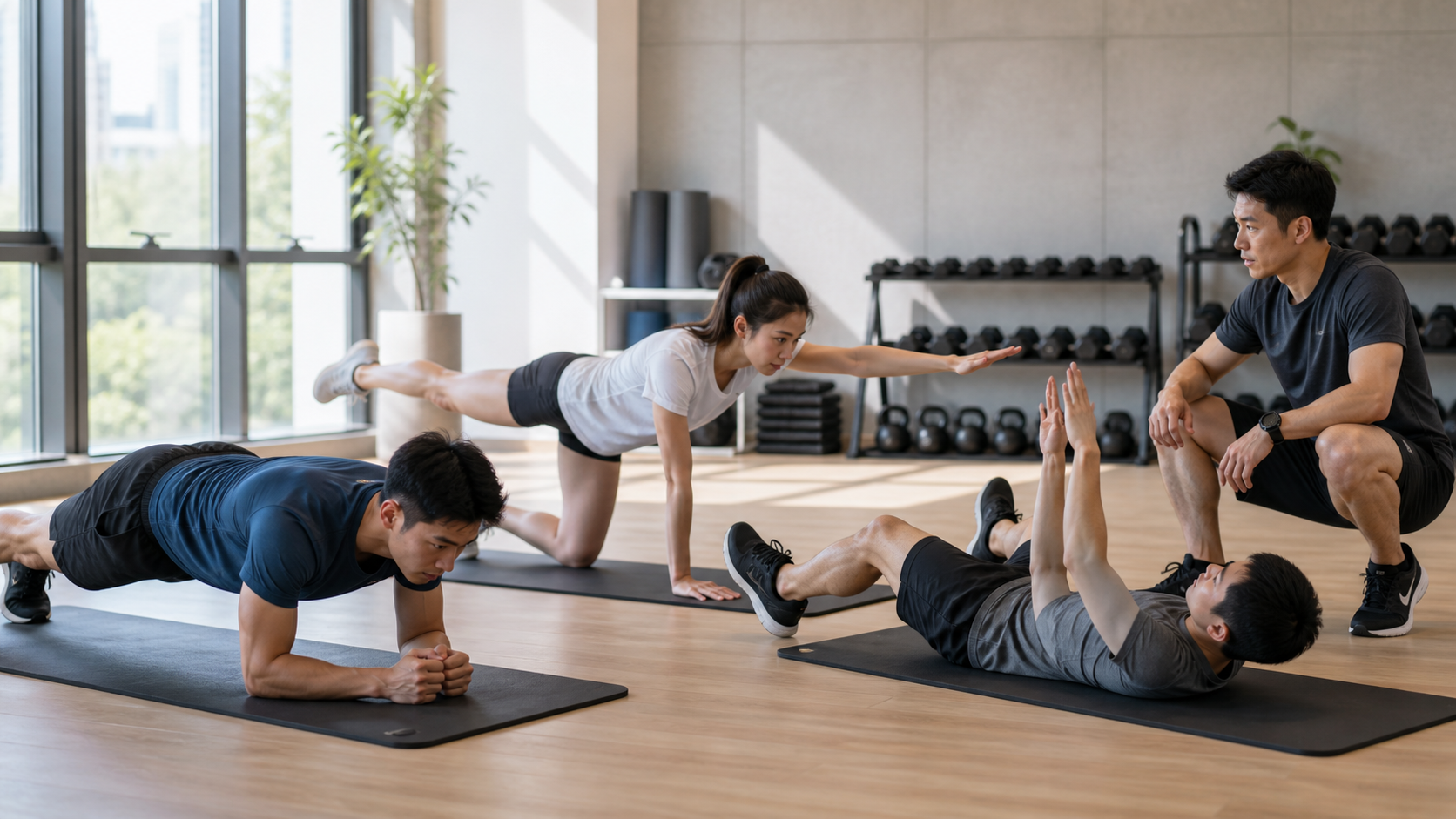
This article introduces three of the best core exercises for runners — the dead bug, the bird dog, and the plank — and explains how to apply them effectively within a training plan.
Dead Bug: Precise Activation of the Deep Core
The dead bug is one of the most recommended core exercises in physical therapy, because it trains the deep core’s ability to stabilize the spine during limb movement, all in a low-risk supine position.
How to perform the dead bug:
- Lie on your back with your arms raised straight up and your legs lifted into a tabletop position (hips and knees at 90 degrees)
- Take a deep breath in, then as you exhale, press your lower back flat into the floor (flattening the lumbar arch)
- Keeping your lower back pressed to the floor, slowly extend your right arm overhead while straightening your left leg forward
- Extend until you’re close to, but not touching, the floor, then pause for 2 seconds
- Return to the starting position and repeat on the opposite side
- Key point: your lower back must never lift off the floor at any point
Common mistakes:
- The lower back arches (the core isn’t engaged, causing excessive lumbar compensation)
- Moving too quickly (losing control of the lumbar spine)
- Holding your breath (you should maintain normal breathing throughout)
Bird Dog: Spinal Stability Under Diagonal Limb Movement
The bird dog trains the spine’s ability to stay stable under asymmetric load, closely mimicking the coordinated diagonal pattern of arm swing and leg drive during running.
| Exercise | Primary Training Benefit | Running Application | Recommended Frequency |
|---|---|---|---|
| Dead Bug | Lumbar stability (supine) | Reduces anterior pelvic tilt, optimizes stride | 3x per week |
| Bird Dog | Lumbar stability (quadruped) | Diagonal coordination in running, pelvic control | 3x per week |
| Plank | Full-core static endurance | Maintaining posture during long runs | 3x per week |
| Side Plank | Quadratus lumborum, gluteus medius | Lateral stability, prevents pelvic drop | 2–3x per week |
How to perform the bird dog:
- Start on all fours, hands directly under your shoulders and knees directly under your hips
- Keep your spine neutral (don’t arch or sag your back), with your abdomen lightly braced
- Simultaneously extend your right arm forward and your left leg backward, both parallel to the floor
- Hold for 3–5 seconds, return, and repeat on the opposite side
- Advanced variation: make small circles or small up-and-down pulses at the top of the movement
A special note for runners:
The diagonal extension pattern of the bird dog closely mirrors the arm-leg coordination used in running. Pay close attention to whether your pelvis drops when extending the leg (indicating insufficient strength in the gluteus medius or lumbar multifidus), or rotates when extending the arm (indicating insufficient rotational control).
Plank: A Static Endurance Test for Full Core Integration
The plank is the most common core exercise, but many people’s plank form has obvious flaws that significantly reduce its training benefit.
Key points for a standard plank:
- Support your weight on your forearms, with elbows directly under your shoulders, feet on the ground
- Keep your body in a straight line from head to heels — don’t let your hips sag or pike up
- Brace your abdomen (draw in and up), lightly squeeze your glutes, and don’t hold your breath
- Keep your neck neutral, eyes looking at a point on the floor about 30 cm ahead
- Build up your hold time gradually: start with 20–30 seconds and work up to 60–90 seconds
Advanced plank variations for runners:
- Plank leg lift: from the plank position, alternately lift one foot about 10 cm off the ground while keeping the pelvis stable — directly training the pelvic control used in running
- Plank shoulder taps: from a high plank on your hands, alternately tap the opposite shoulder with each hand to train rotational control
- Walking plank: repeatedly transition between a forearm plank and a high plank to build dynamic core strength
Why the side plank matters:
The side plank trains the quadratus lumborum and lateral core, and is essential for preventing lateral pelvic drop while running. Lie on your side supported on your forearm, keep your body in a straight line, and hold for 20–45 seconds per side.
Practical Recommendations
To effectively integrate core training into your running program, keep the following in mind:
- Timing your training: Core training is best scheduled after a run or as a standalone session — core fatigue before running can affect your ability to control running form
- Quality over quantity: Core training emphasizes movement quality; 8 perfectly executed dead bug reps are more effective than 20 sloppy ones
- Coordinate your breathing: Proper breathing technique (engaging the deep core on the exhale) matters more than the movement itself
- Progress gradually: Master the position statically first, then add dynamic elements, and finally integrate the movement into functional patterns
- Stay consistent: The benefits of core training typically take 4–6 weeks to become noticeable — don’t give up if you don’t see results right away
Conclusion
The dead bug, bird dog, and plank together form a complete foundation for core training in runners. These three exercises may look simple, but performing them with true, effective form requires focus and patience. We recommend runners schedule 2–3 core sessions per week, about 15–20 minutes each. After 8 consistent weeks, you’ll notice a lighter lower back during long runs, more stable running form, and greater resistance to postural breakdown when fatigued — all real, tangible results of core training.
Related Reading
- Core Stability and Running Efficiency: Which Core Exercises Work Best
- Core Training for Running: Which Movements Are Most Effective
- Core Endurance Training for Runners: Building Staying Power to Maintain Form on Long Runs
- Core Training for Road Runners: Stabilizing the Pelvis to Improve Running Efficiency
實景訓練台) 彰化經典百K 高強度喵團 90分鐘 跟著一起練功 2019 Indoor workout Changhua Classic 100 Taiwan
7 年前
[教學] Premiere 影片 手震 修正 教學 防抖 單眼 影像 GoPro 穩定 Video Stabilization
8 年前
西進武嶺 免費訓練分析服務 Intervals | 練不夠還是練過頭?你哪一種類型選手?AI模型告訴你! | 備戰神器 | 公路車 訓練 | CT Yeh
4 年前
西進武嶺 自製新版AI配速表產生器 x 賽前攻略 抱佛腳! 沒有功率計也可以產生配速表嗎?有什麼其他眉角賽前要注意的呢? | 西進武嶺 / 東進武嶺 KOM 攻略 | 公路車 | CT Yeh
4 年前
Live) 備戰2019彰化經典百K 賽前攻略 (已完賽請看新影片
7 年前
一個測試有沒有認真練車的方法😂 #公路車
10 個月前
大禹嶺 到 武嶺牌樓 全程前後實況錄影 | 北進武嶺 | 東進武嶺 | KOM | 訓練台 | 坡度分析 | Taiwan KOM Last 10 km HARD | 公路車
6 年前
邁金 T500 訓練台開箱!有下坡輔助、路感模擬、不用插電、直驅電機 !兩萬級距頂規享受新選擇!/ 公路車 / 室內訓練 / CT Yeh
1 年前