Introduction
The hip flexors are one of the most paradoxical muscle groups in running training — they can be both overly tight (from prolonged sitting) and overly weak (from lack of training) at the same time. The iliopsoas, the primary hip flexor, is made up of the psoas major and iliacus, and is responsible for driving the thigh forward during the swing phase. When the iliopsoas is weak, runners often rely on compensatory movements (such as excessive forward lean or increased anterior pelvic tilt) to generate leg swing, which not only reduces efficiency but is also a major contributor to lower back pain.
Among office-working runners in Taiwan, hip flexor tightness caused by prolonged sitting is extremely common. Sitting at a desk for 8+ hours a day keeps the hip flexors in a chronically shortened position, leading to neural inhibition (reflexive relaxation). Heading straight out for a run after work, the tightened hip flexors are unable to generate maximum drive, and stride length is naturally limited.
This article explains the role of the hip flexors in running from a functional anatomy perspective and provides a systematic strengthening program.
Functional Analysis of the Hip Flexors in Running
The running gait cycle can be divided into the stance phase and the swing phase. In the early swing phase, the hip flexors (primarily the iliopsoas) actively contract to pull the trailing leg back from hip extension and initiate the forward swing. Research shows that faster running speeds correspond to higher hip flexor activation and greater power output.
Signs of weak hip flexors during running:
- Shortened stride (due to insufficient leg swing range)
- A tendency to lean forward while running (compensatory forward lean)
- Tight or painful lower back after running
- More pronounced gait breakdown at high intensity
- Uphill running feels especially strenuous
| Running Speed | Hip Flexor Power Demand | Contributing Factors |
|---|---|---|
| Easy jog (6:00/km) | Low | Propulsion mainly from hip extensors |
| Tempo run (4:30/km) | Moderate | Hip flexors begin to contribute significantly |
| Interval run (3:45/km) | High | Hip flexors become one of the limiting factors |
| Sprint (<3:00/km) | Very high | Hip flexor strength directly limits stride length |
Hip Flexor Strengthening Exercises
1. Standing Knee Drive:
This is the most direct hip flexor exercise for running mechanics.
- Stand on one leg with the heel raised, and use groin (hip flexor) strength — not the knee — to drive the other knee up to waist height
- Hold for 1 second, feeling a full hip flexor contraction
- Lower slowly (eccentric control)
- 3 sets x 12 reps (each side)
- Progression: add resistance with a resistance band or cable machine
2. Hanging Leg Raise:
- Hang from a pull-up bar with the core braced
- Raise both legs (or one leg) forward to 90 degrees or higher
- The bent-knee version (Hanging Knee Raise) is easier and suitable for beginners
- The straight-leg version is most effective for training the iliopsoas
- This exercise also trains the anterior core chain, making it highly suitable for runners
3. Lying Leg Raise:
- Lie on your back with arms at your sides and lower back pressed into the floor
- Slowly raise both straight legs to 90 degrees, then slowly lower them
- Key point: the lower back must not lift off the floor during the lowering phase — stop immediately if it does
- If this is too difficult, use a bent-knee version or alternate single legs
- 3 sets x 10-15 reps
4. Hill Sprints:
- Short (20-30 meter) uphill sprints are the most effective functional hip flexor training
- The incline forces the body to swing the legs through a greater hip flexion range, naturally strengthening the hip flexors
- 6-8 reps per session with full recovery (walk back down), 1-2 times per week
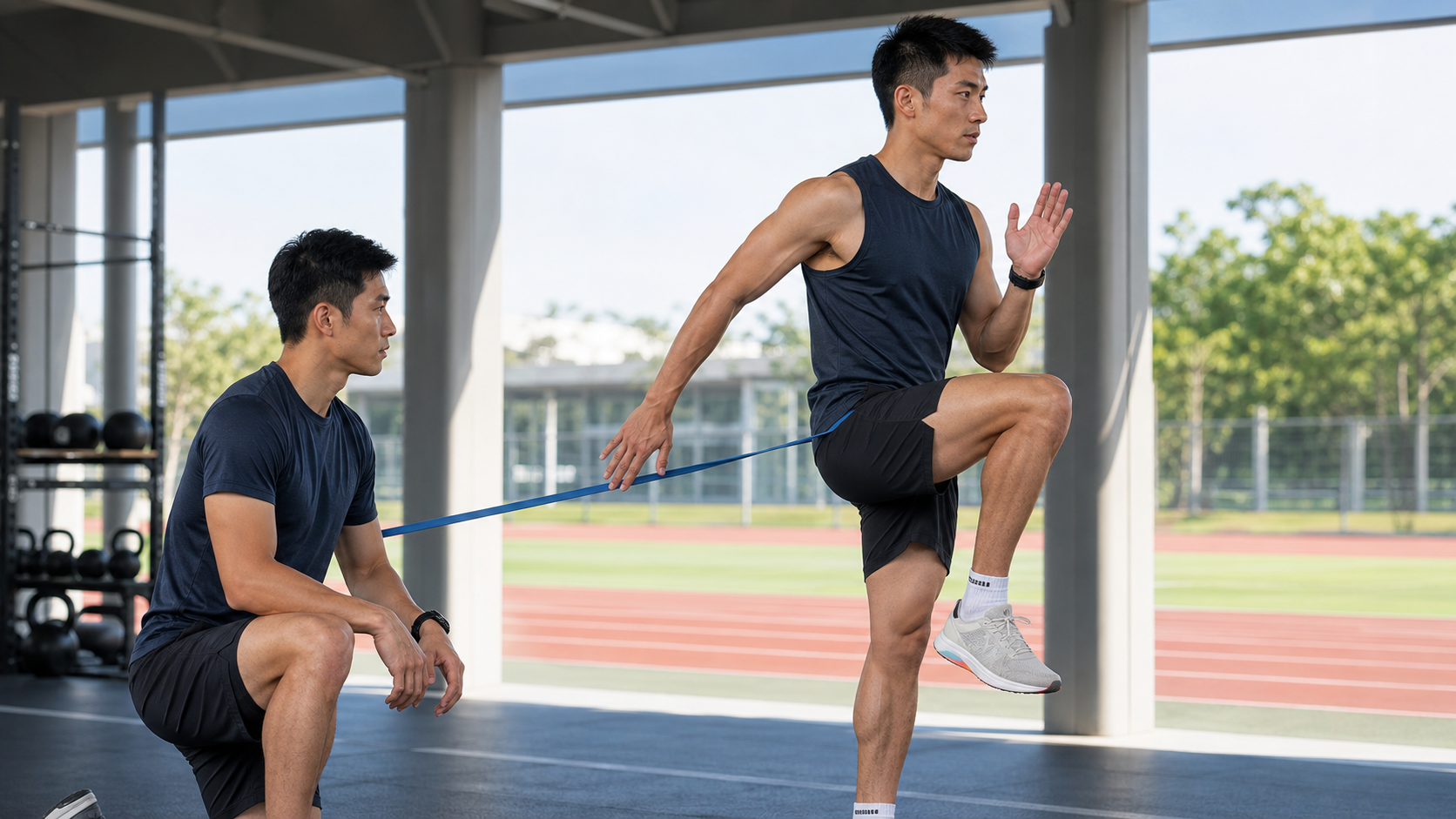
5. Band Kick Forward:
- Loop a resistance band around the ankle, anchored behind you
- Standing, kick the banded leg forward, mimicking the leg swing motion of running
- Trains functional hip flexor strength that transfers directly to running mechanics
- 3 sets x 15 reps (each side)
Balancing Hip Flexor Flexibility and Strength
While strengthening the hip flexors, it is also important to maintain their flexibility to avoid excessive tightness that limits stride length.
Recommended hip flexor stretches:
- Low lunge stretch: front knee at 90 degrees, back knee on the ground, torso upright, feeling the stretch in the back leg’s groin; hold for 30-45 seconds
- Dynamic stretching before every run (high knee walks, butt-kick walks)
- Static stretching for 2-3 minutes after every run
Practical Recommendations
- Essential daily habit for office-working runners: stand up every 45-60 minutes and do a 30-second low lunge stretch to prevent ongoing hip flexor tightness
- Dynamic activation before running: 2x20 steps of high-knee walking plus 2x20 steps of butt-kick walking to wake up the hip flexor neuromuscular connection
- Integration with run training: hip flexor training can be done after a run, or scheduled separately on a strength training day
- How to measure progress: track the maximum height and hold time of your standing knee drive, as well as your stride length while running (can be monitored with a GPS watch)
Conclusion
There is a direct, scientifically supported relationship between hip flexor strength and running stride length and efficiency. For Taiwanese runners looking to break through a pace plateau, adding systematic hip flexor strengthening on top of their weekly running volume is a high-return strategy. With 2-3 sessions per week of about 15 minutes of targeted training, combined with adequate stretching, you will feel a smoother leg swing rhythm and an easier tempo-run experience after 3 months.
Related Reading
- Hip Flexor Training for Runners: A Key Muscle Group for Injury Prevention
- Runners with Tight Hip Flexors: Causes, Assessment, and Stretching Protocols
- Hip Flexor Strengthening for Runners: A Training Plan for Climbing Ability and Stride Extension
- Tight Hip Flexors While Running: Causes, Effects, and a Complete Stretching Guide
一日北高/長距離團騎 常見問題補充篇 / 組團或跟團的眉角 / 壯車友容易被瘦車友慢性拉爆 / 原來屁股痛可能是這個原因...? / 風場配速法 / 公路車 / CT Yeh
2 年前
iPhone內建一秒變長腿🤣 車友必備#cycling
2 年前
一日北高常見問題大集合 | 攻略 | 路線 | 訓練 | 補給 | 自行車 單車 | 一日雙城 | 雙塔 | TWB北高360 | 屁股痛
6 年前
[教學] Premiere 影片 手震 修正 教學 防抖 單眼 影像 GoPro 穩定 Video Stabilization
8 年前
白沙屯媽祖進香在家走!UREVO 坡度自調走步機 / 可連接訓練遊戲APP MyWhoosh / 邊看直播邊走起來 / CT Yeh
11 個月前
CT 喇低賽) 單車 比賽總是沒照片? 攝影師的觀點大公開 姿勢就是力量! 請加速1.25倍收看
7 年前
西進武嶺 免費訓練分析服務 Intervals | 練不夠還是練過頭?你哪一種類型選手?AI模型告訴你! | 備戰神器 | 公路車 訓練 | CT Yeh
4 年前
實景訓練台) 彰化經典百K 高強度喵團 90分鐘 跟著一起練功 2019 Indoor workout Changhua Classic 100 Taiwan
7 年前