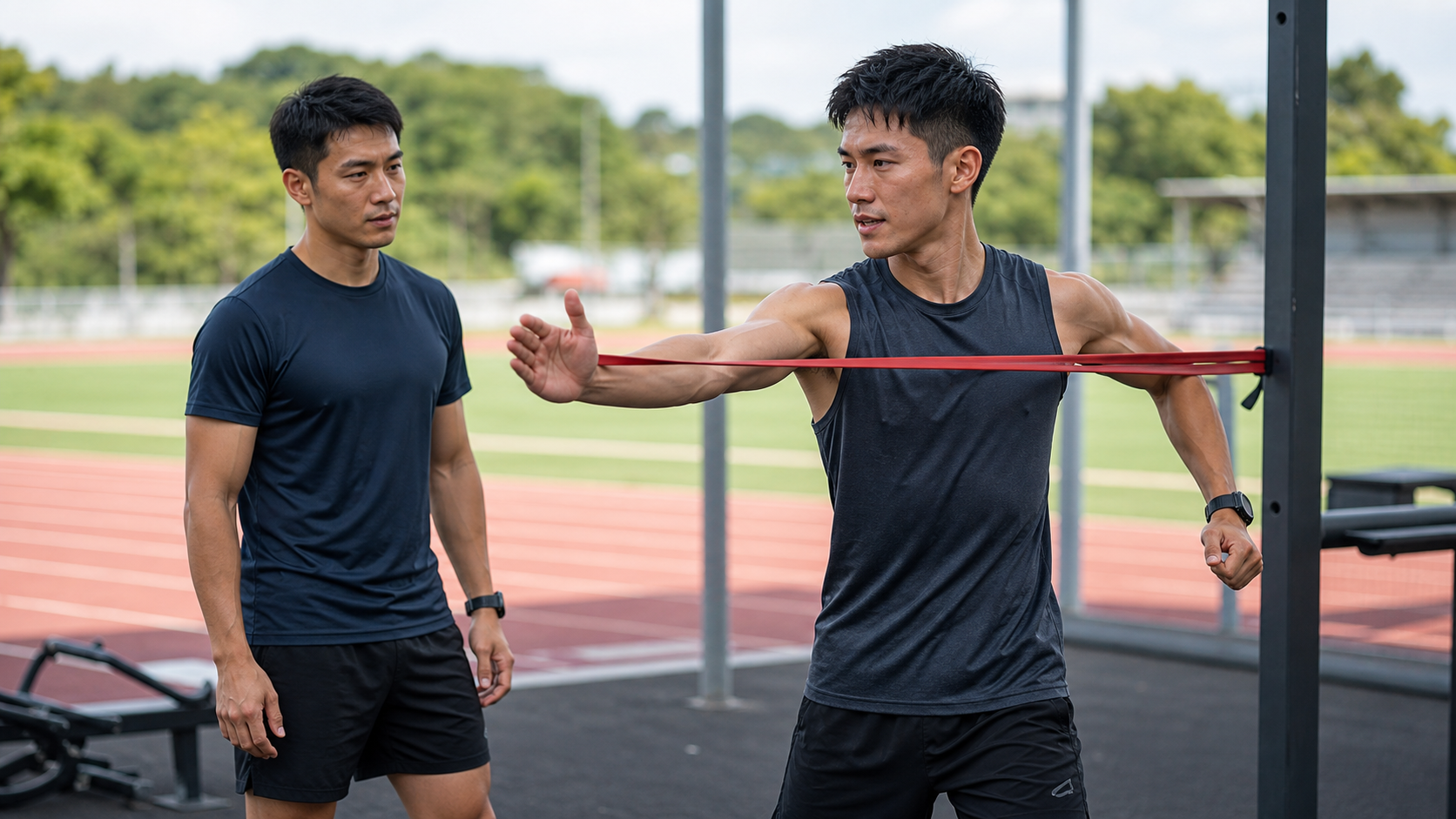
Introduction
“Running is a lower-body sport”—this notion has led many runners to completely neglect upper body training. However, sports science research clearly shows that arm swing plays an important biomechanical role in running: it is not merely a passive accompaniment to lower limb movement, but a key component that actively influences cadence, rhythm, and energy expenditure.
In Taiwan’s hot and humid summer marathon environment, fatigue in the later stages of a run often manifests first in the upper body—shoulders rolling forward, arms swinging across the midline of the body, upper back hunching, and head tilting forward. These compensatory postures disrupt overall running efficiency and increase energy expenditure. Insufficient upper body strength and stability are the main causes of this fatigue-induced breakdown in running form.
This article will systematically introduce the upper body training runners need, including scapular stability, arm push-pull strength, and methods for improving running arm swing efficiency.
The Biomechanics of Arm Swing
Understanding the function of arm swing helps in designing more targeted upper body training.
Three key functions of arm swing:
- Angular momentum balance: When the right leg swings forward, the right arm swings backward in sync, maintaining rotational momentum balance and preventing excessive torso rotation
- Propulsion assistance: Effective arm swing can provide additional forward propulsion momentum with each step; research estimates it can improve running efficiency by approximately 2–5%
- Cadence regulation: Arm swing frequency guides stride cadence; training faster arm swings is an effective way to increase cadence
Proper arm swing posture:
- Elbows bent at approximately 90 degrees (adjustable between 80–110 degrees depending on speed)
- Arms swing forward and backward without crossing the midline of the body
- Hands relaxed, as if holding a potato chip without crushing it
- Shoulders relaxed and down, not shrugged
- Wrists not drooping; the arms remain compact overall
| Upper Body Strength Issue | Impact on Running Performance | Corresponding Training |
|---|---|---|
| Scapular protraction (rounded shoulders) | Chest cavity compression, restricted breathing | Scapular retraction training, rows |
| Weak shoulders prone to fatigue | Arms crossing midline in later stages | Shoulder presses, flyes |
| Weak upper back | Hunched running posture | Pull-ups, rows |
| Unstable upper core | Excessive torso rotation | Anti-rotation training |
Scapular Stability Training: The Most Essential Upper Body Foundation for Runners
The scapula is the foundational platform for arm movement, and scapular stability determines the efficiency of the entire upper body kinetic chain. For runners, training in retraction and depression is most important.
Scapular retraction training:
-
Band Row:
- Anchor the band in front of you, hold the handles with both hands, and pull back with elbows bent
- Focus on scapular retraction (rather than arm strength), feeling the shoulder blades draw together
- 3 sets × 15 reps, can be used as a pre-run warm-up exercise
-
Dumbbell Row:
- Support one hand on a bench, hold a dumbbell with the other, and perform the row led by the scapula rather than the arms
- Trains the latissimus dorsi, rhomboids, and middle/lower trapezius
- 3 sets × 10–12 reps (each side)
-
Face Pull:
- Set a cable machine or band at eye height
- Hold the handles with both hands, elbows at shoulder height, and pull toward the face
- Strengthens the posterior rotator cuff (rear deltoids, infraspinatus) to prevent forward shoulder rotation during running
The Running Application of Arm Push-Pull Strength
Pushing strength (chest, anterior deltoids):
Although running primarily uses pulling movements, pushing strength maintains an open chest cavity, ensuring breathing depth.
- Push-up variations (narrow grip, wide grip)
- Dumbbell bench press
Pulling strength (back, posterior deltoids):
Pulling strength is what runners need more, preventing rounded shoulders and upper back collapse.
- Wide Pull-up: the most comprehensive upper back pulling exercise
- Seated Cable Row
- Inverted Row: a bodyweight version, suitable for beginners
Core anti-rotation training:
Torso rotation during running needs to be properly controlled; excessive rotation wastes energy.
- Pallof Press: 3 sets × 10–12 reps (each side)
- Plank with Rotation: from a plank position, rotate one arm upward
Practical Recommendations
- Weekly upper body training frequency: 2 sessions, 20–30 minutes each
- Upper body activation before running: Perform 10–15 reps each of scapular retraction, arm circles, and band rows 5 minutes before a run to improve upper body posture while running
- Running posture practice in front of a mirror: Run on a treadmill facing a mirror for 5 minutes, observing whether your arms cross the midline and whether your shoulders are shrugged
- Fatigue awareness reminders: Set a metronome cue every 5 minutes to remind yourself to “relax your shoulders, swing your arms,” building automatic correction after fatigue sets in
- Arm training during long runs: In the final 30 minutes of a long run, deliberately increase arm swing amplitude to simultaneously train cardiorespiratory fitness and upper body strength
Conclusion
Upper body training is the most overlooked component of a runner’s training plan, yet it is often the hidden key to overall efficiency gains. Strong scapular stability and arm push-pull strength not only keep your running form from collapsing in the latter half of a race, but also make every arm swing part of your forward propulsion. Adding 2 sessions of approximately 20 minutes of upper body strength training per week is a smart choice for Taiwanese runners to effectively improve running efficiency without increasing mileage.
Related Reading
- Upper Body Training for Runners: Arm Swing and Torso Rotation Efficiency
- Upper Body Training for Road Runners: The Key to Arm Swing Efficiency and Pace Stability
- Arm Swing Efficiency and Scapular Control: The Overlooked Key to Speed Improvement
- The Impact of Arm Swing on Running Efficiency: The True Role of Arms from a Biomechanical Perspective
西進武嶺 免費訓練分析服務 Intervals | 練不夠還是練過頭?你哪一種類型選手?AI模型告訴你! | 備戰神器 | 公路車 訓練 | CT Yeh
4 年前
[教學] Premiere 影片 手震 修正 教學 防抖 單眼 影像 GoPro 穩定 Video Stabilization
8 年前
白沙屯媽祖進香在家走!UREVO 坡度自調走步機 / 可連接訓練遊戲APP MyWhoosh / 邊看直播邊走起來 / CT Yeh
11 個月前
西進武嶺 自製新版AI配速表產生器 x 賽前攻略 抱佛腳! 沒有功率計也可以產生配速表嗎?有什麼其他眉角賽前要注意的呢? | 西進武嶺 / 東進武嶺 KOM 攻略 | 公路車 | CT Yeh
4 年前
CT 喇低賽) 武嶺牽車 才是王道 西進牽車四小時內秘訣 攝手位置 如何判斷 防抽筋小秘訣
7 年前
抖肩舞 台灣x日本交流版 (台灣 vs 前橋) 赤城山登山賽 coincidance
8 年前
#公路車 #Fitting 靠人工智慧APP 幫你調整單車
6 年前
FTL 與 SYB 車隊專訪 西進武嶺 實用攻略分享! 2小時 如何練?!你不知道的眉角!新手準備武嶺必看 EP1 | 實力派女車友 | 精華版 | 公路車 | CTYeh
4 年前