The Complete Guide to Cycling Knee Pain: Causes and Treatment for Front, Back, and Outer Knee Pain
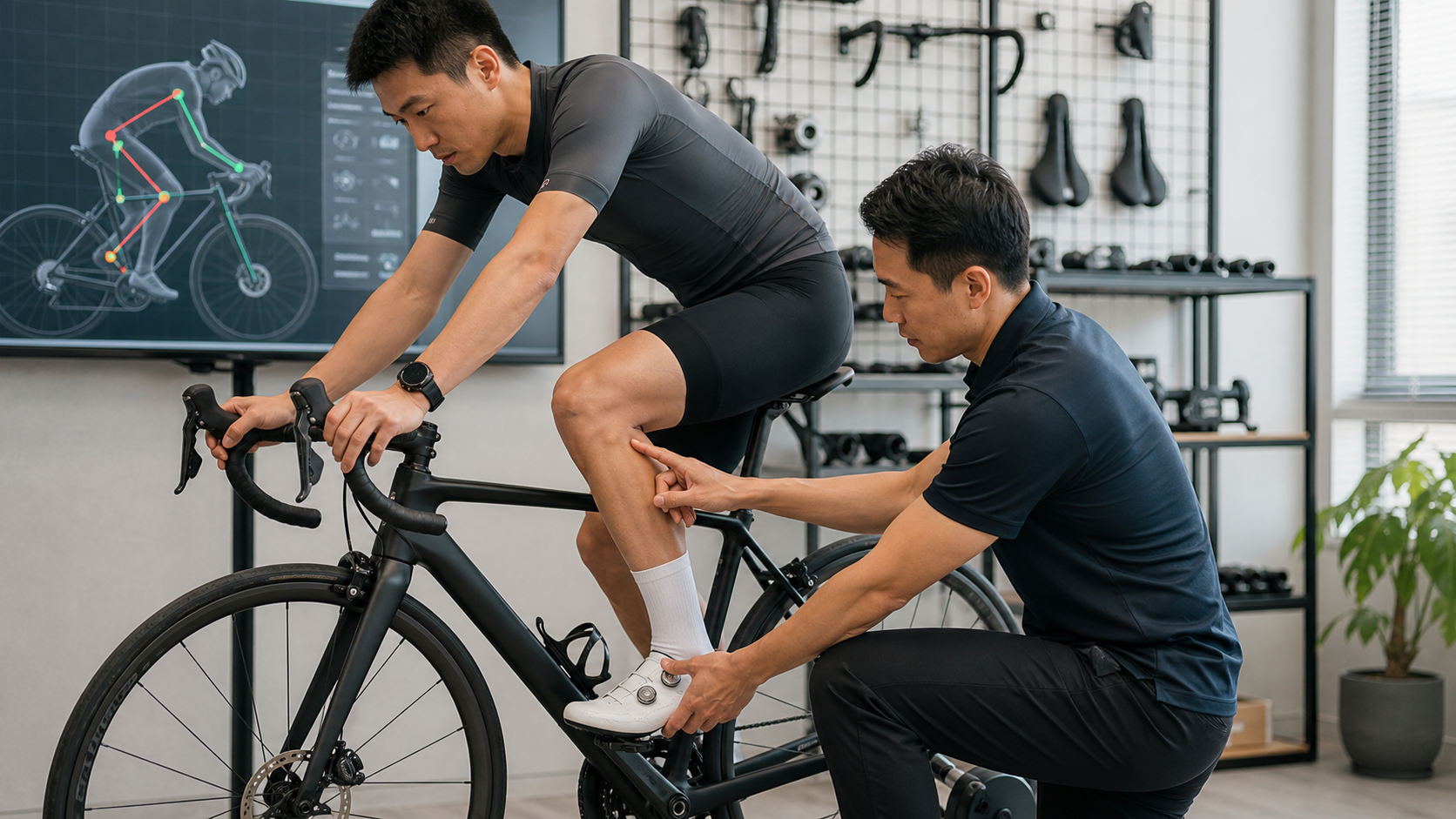
Introduction
The knee is one of the most commonly injured areas for cyclists. Taiwan’s terrain is hilly, and the combination of long climbs, high-cadence riding, and many riders neglecting the importance of Bike Fitting keeps the incidence of knee injuries persistently high. However, “knee pain” is not a single diagnosis—pain in the front knee, back knee, and outer knee corresponds to different anatomical structures and biomechanical issues, each of which must be clarified individually to provide the right treatment.
Front Knee Pain (Anterior to the Patella)
Common Diagnoses
- Patellofemoral Pain Syndrome (PFPS)
- Patellar Tendinopathy
Main Causes
| Cause | Explanation |
|---|---|
| Saddle too low | Excessive knee flexion angle increases pressure on the patella |
| Cadence too low | Pushing big gears forces the knee to bear greater torque |
| Tight quadriceps | Pulls the patella upward, altering its tracking |
| Knee varus/valgus | Insufficient cleat float angle causes the knee to deviate from its natural path |
| Sudden training spike | Sharp short-term increase in climbing volume or distance |
Key Treatments
- Raise the saddle: Aim for a slight knee bend (approximately 25–30 degrees) at the bottom of the pedal stroke
- Increase cadence: Target 85–95 RPM to reduce torque per pedal stroke
- Quadriceps stretching: Perform standing stretches daily, holding each for 30 seconds × 3 sets
- Seek medical evaluation: Sports medicine or orthopedics departments in Taiwan can arrange patellar tracking assessments and ultrasound examinations
Back Knee Pain (Posterior Knee)
Common Diagnoses
- Hamstring Tendinopathy
- Baker’s Cyst (if swelling is present)
- Gastrocnemius origin issues
Main Causes
- Saddle too high is the most common single cause of posterior knee pain. A saddle set too high forces the rider to over-extend the knee at the bottom of the pedal stroke, repeatedly stressing the hamstring at its shortened end
- A heel-drop pedaling style also over-stretches the hamstrings
- Improper handlebar-to-saddle fore/aft positioning causes the knee to travel too far past the pedal spindle
Key Treatments
- Lower the saddle: Adjust in increments of no more than 3–5mm at a time to allow the body to adapt
- Check cleat fore/aft position: Generally, the ball of the foot (MTP joint) should align with the pedal spindle
- Strengthen the hamstrings: Nordic Curls, Romanian Deadlifts
- If there is noticeable swelling in the back of the knee, prioritize an orthopedics visit to rule out Baker’s Cyst or meniscus issues
Outer Knee Pain (Iliotibial Band Syndrome)
Common Diagnoses
- Iliotibial Band Syndrome (ITBS)
Anatomical Principle
The iliotibial band is a thick fascia extending from the ilium (outer pelvis) to the lateral tibial condyle. At approximately 30 degrees of knee flexion—a common angle during the pedal stroke—the IT band repeatedly rubs against the lateral femoral condyle, and cumulative friction leads to inflammation.
Main Causes
| Cause | Explanation |
|---|---|
| Saddle too high | IT band tension is greatest as the knee approaches full extension |
| Excessive Q-angle | Women have wider pelvises, causing the knees to angle inward naturally and increasing ITBS risk |
| Weak gluteus medius | Inability to stabilize the pelvis causes pelvic tilt during pedaling, increasing IT band tension |
| Insufficient recovery after training | Descending after mountain races is particularly likely to trigger symptoms |
Key Treatments
- Foam Roller: Roll the IT band daily, 3 minutes per side, but avoid pressing directly on tender points
- Gluteus medius strengthening: Clamshells, side-lying leg raises, 2–3 sets daily
- Saddle fine-tuning: Lower slightly by 1–2mm as needed
- Acute inflammation phase: Ice + rest, avoid high-intensity training; use NSAIDs only as prescribed by a physician
Quick Differential Table for the Three Types of Knee Pain
| Feature | Front Knee | Back Knee | Outer Knee |
|---|---|---|---|
| Pain location | Around the patella | Posterior knee | Lateral femoral condyle |
| Main cause | Saddle too low | Saddle too high | Saddle too high + weak gluteal muscles |
| Typical riding pattern | Hard climbing efforts | Over-extending knee with saddle too high | High-mileage climbing |
| Common Taiwan road conditions | Mountain climbs, Hehuan Mountain | Fast descending pedaling | Continuous climbing on Wuling |
Practical Advice
- Keep a pain diary: After each ride, record the pain location, intensity (1–10), and when it occurs to help your physician diagnose
- The 10% rule: Increase weekly training volume by no more than 10% to prevent overuse injuries
- Bike Fitting is an investment: Professional measurement of saddle height and cleat float angle can resolve 80% of knee pain
- Don’t ride through injury: Minor discomfort can be tolerated, but if pain persists for more than 2 hours after each ride or is still present the next day, reduce volume immediately and seek medical attention
Conclusion
Front, back, and outer knee pain each have their own origins and should never be treated as one and the same. With proper differential diagnosis, bike adjustments, and targeted rehabilitation, most cycling-related knee pain can be fully resolved. Taiwan has excellent orthopedic and sports medicine resources—riders don’t need to suffer in silence. Addressing the issue early is the best way to protect the knees that will keep you riding for years to come.
Related Reading
- Cycling Knee Pain: Differential Diagnosis and Treatment for Front, Back, and Lateral Knee Pain
- The Complete Guide to Knee Protection for Cyclists: Common Injuries and Prevention Strategies
- Don’t Tolerate Knee Pain: Prevention and Management of Common Cycling Knee Injuries
- Knee Pain in Cyclists: Distinguishing and Treating Front Knee, Back Knee, and IT Band Issues
一日北高常見問題大集合 | 攻略 | 路線 | 訓練 | 補給 | 自行車 單車 | 一日雙城 | 雙塔 | TWB北高360 | 屁股痛
6 年前
#公路車 #Fitting 靠人工智慧APP 幫你調整單車
6 年前
靠單車減肥35公斤 心得分享與整理
7 年前
單車 一日北高 ( 雙城 ) 肥宅雙人瘋狂行 紀錄片 REACTO
10 年前
一日北高/長距離團騎 常見問題補充篇 / 組團或跟團的眉角 / 壯車友容易被瘦車友慢性拉爆 / 原來屁股痛可能是這個原因...? / 風場配速法 / 公路車 / CT Yeh
2 年前
碟煞公路車 銑面器 !? 原來銑完差這麼多! 降低蹭碟機率! | TIME 公路車 保養小記錄 | CT Yeh
3 年前
高雄綠園道鐵路自行車道 / 外地人能輕鬆駕馭 還是整路崩潰? / 2025 全線開通 春節實地探索一次!(附GPS連結)/ 公路車 / CT Yeh
1 年前
2016 桐花飛舞 單車挑戰 精華片段
10 年前