Cycling Achilles Tendon Issues: How Pedaling Angle and Cleat Adjustment Affect the Achilles Tendon
Introduction
The Achilles Tendon is the thickest and strongest tendon in the human body, connecting the calf’s gastrocnemius and soleus muscles to the heel bone. It bears tremendous repetitive tension during the pedaling motion of cycling. Although cycling is a low-impact sport, each pedal stroke requires dorsiflexion and plantarflexion of the ankle joint. Accumulating over 5,000 times per hour, the microtrauma inflicted on the Achilles tendon is considerable. Among Taiwan’s triathletes and long-distance cycling groups, the incidence of Achilles tendon issues is no less than that among runners.
Achilles Tendon Mechanics in the Pedaling Motion
Achilles Tendon Tension Changes Throughout One Pedal Revolution
| Pedal Phase | Ankle Joint Movement | Achilles Tendon State |
|---|---|---|
| 12 o’clock (top) | Slight dorsiflexion | Moderate tension |
| 3 o’clock (maximum power output) | Neutral position | Maximum tension |
| 6 o’clock (bottom) | Slight plantarflexion | Reduced tension |
| 9 o’clock (upstroke) | Dorsiflexion | Moderate tension |
Dangerous Pedaling Habits
Heel Drop pedaling style: At the bottom of the pedal stroke, the heel sits noticeably lower than the toes, forcing the Achilles tendon to be overstretched under high tension. This is a primary trigger for Achilles tendinitis.
Toes Down pedaling style: Conversely, although excessive downward pointing may appear powerful, over time it tends to compress the Achilles tendon in a shortened position, causing injury through a different mechanism.
The ideal pedaling angle: the foot is nearly horizontal, or the heel is slightly higher than the toes by no more than 5–10 degrees.
The Impact of Cleat Fore-Aft Position on the Achilles Tendon
Biomechanical Principles of Cleat Position
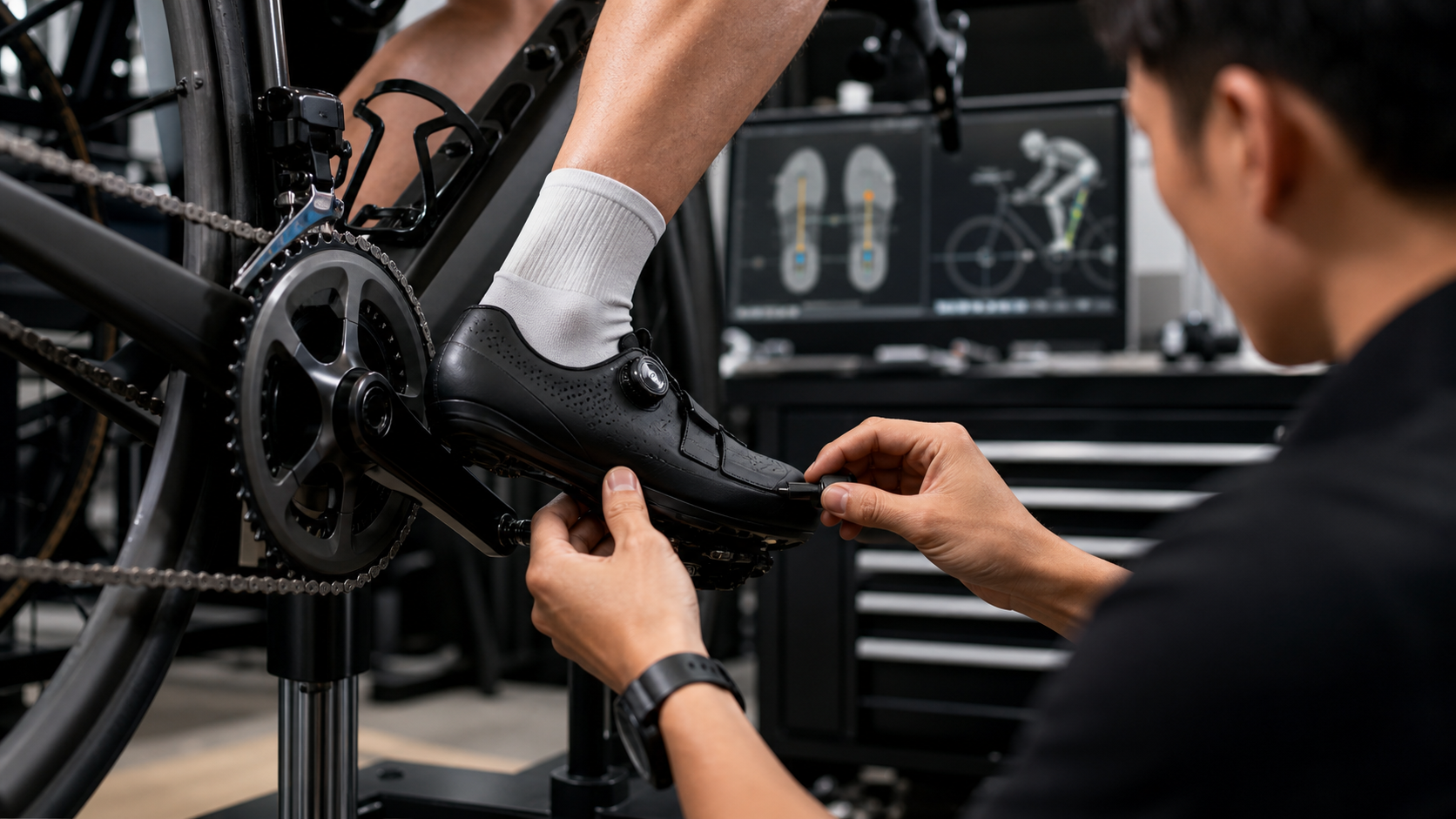
The fore-aft position of the cleat on the shoe sole directly determines the force transmission point and the length of the ankle joint moment arm:
- Cleat too far forward (near the toes): shorter effective moment arm, requiring more ankle joint stability, increasing Achilles tendon tension
- Cleat too far back (near the heel): the rear of the foot bears the load, pedaling efficiency decreases, but Achilles tendon load is reduced—this is actually a temporary solution for those with Achilles tendon issues
- Standard position: cleat aligned with the first metatarsal head (ball of the foot, MTP joint)
How to Determine if Cleat Position is Correct
- Put on your cycling shoes and use your fingers to feel along the side of the shoe to locate the prominence of the first metatarsal head
- Make a mark
- Compare it with the center of the cleat; the two should be vertically aligned
Wedges and Sole Thickness
The Function of Wedges
Wedges are placed under the insole or between the cleat and the sole to adjust the inward/outward tilt angle of the forefoot (pronation/supination).
- Medial wedge (Varus wedge): raises the medial side of the arch, suitable for riders with collapsed arches (flat feet), reducing oblique tension on the Achilles tendon caused by knee valgus
- Lateral wedge (Valgus wedge): suitable for high-arched feet, reducing ankle eversion
Incorrect foot biomechanics (such as overpronation) cause the Achilles tendon to bear non-axial tension during pedaling—a common yet often overlooked cause of chronic Achilles tendinitis.
Sole Stiffness
Modern high-end cycling shoes feature carbon fiber soles with extreme rigidity for optimal pedaling efficiency, but this also means the foot cannot “absorb” any impact—all forces are transmitted directly to the Achilles tendon and knees. Beginners or riders with Achilles tendon issues may consider transitioning with cycling shoes made of softer synthetic materials.
The Relationship Between Saddle Height and the Achilles Tendon
Saddle too low: the knee bends excessively at the bottom of the pedal stroke, keeping the triceps surae shortened throughout, causing the Achilles tendon to be repeatedly compressed in a shortened state (a trigger for insertional tendinopathy)
Saddle too high: the heel is forced to drop at the bottom of the pedal stroke, overstretching the Achilles tendon (a trigger for mid-portion tendinopathy)
Scientific Methods for Achilles Tendon Rehabilitation
Eccentric Training (Eccentric Protocol)
The most evidence-based rehabilitation method for Achilles tendinitis is the Alfredson Protocol:
- Stand on the edge of a step with your heels hanging off
- Use the healthy leg to rise up onto your toes (concentric contraction), then switch to the affected leg and lower slowly (eccentric contraction)
- 3 sets × 15 repetitions, twice daily, for 12 consecutive weeks
- Continue even with mild pain (but stop if there is severe pain)
Timeline for Returning to Cycling
| Phase | Condition | Recommendation |
|---|---|---|
| Acute phase (0–2 weeks) | Obvious swelling and pain | Complete rest + ice application |
| Subacute phase (2–6 weeks) | Morning stiffness but able to walk | Eccentric training + light cycling |
| Recovery phase (6–12 weeks) | Pain improving | Gradually increase riding intensity |
| Full return to training (>12 weeks) | Asymptomatic | Resume normal training |
Practical Recommendations
- Warm up your calves before every ride: perform 20 standing calf raises in place to activate the calf muscles
- Stretch your calves after riding: face a wall in a lunge position, keep the back leg’s knee straight, and feel the stretch in the Achilles tendon, 30 seconds × 3 times per side
- Increase training load progressively: for long rides (>100km), increase weekly mileage by no more than 10%
- Taiwan medical resources: for Achilles tendon issues, it is recommended to consult an orthopedist or a rehabilitation specialist. Ultrasound can clearly show Achilles tendon thickness and structure, making it the most practical non-invasive assessment tool
Conclusion
Achilles tendon issues often accumulate from small details that go unnoticed—an incorrect cleat position, a pair of ill-fitting cycling shoes, or a saddle set too high or too low can all be culprits behind Achilles tendinitis. Starting today, check your pedaling angle and cleat setup so that your Achilles tendon can work in the healthiest way possible with every pedal stroke.
Related Reading
- Tendinitis Prevention and Recovery for Cyclists: A Complete Guide to the Knee, Achilles Tendon, and IT Band
- Foot Pain in Cyclists: Cleat Position Adjustment and Arch Support
- Tendon Protection in Ultra-Endurance Cycling: A Complete Guide to Preventing Achilles Tendon and IT Band Injuries
- The Achilles Tendon Doesn’t Just Break Down Overnight: A Full Breakdown of Achilles and Calf Pain Mechanisms, Eccentric Training, and Load Management
#公路車 #Fitting 靠人工智慧APP 幫你調整單車
6 年前
一日北高/長距離團騎 常見問題補充篇 / 組團或跟團的眉角 / 壯車友容易被瘦車友慢性拉爆 / 原來屁股痛可能是這個原因...? / 風場配速法 / 公路車 / CT Yeh
2 年前
碟煞公路車 銑面器 !? 原來銑完差這麼多! 降低蹭碟機率! | TIME 公路車 保養小記錄 | CT Yeh
3 年前
CT 喇低賽) 單車 比賽總是沒照片? 攝影師的觀點大公開 姿勢就是力量! 請加速1.25倍收看
7 年前
CT 喇低賽) 武嶺牽車 才是王道 西進牽車四小時內秘訣 攝手位置 如何判斷 防抽筋小秘訣
7 年前
Never Stop 西進武嶺 前後雙機 完整全程錄影 訓練台 實境
8 年前
多到選擇障礙... 換個單車把帶想一個小時 / BTP / 編織&軟木特有材質超吸睛! / 公路車 / CT Yeh
1 年前
風櫃嘴 | 全台最多大砲的單車路線 | 尋寶網攝影師告訴你怎麼擺拍起來才好看 | 熱門攝影地點巡禮
6 年前