Introduction
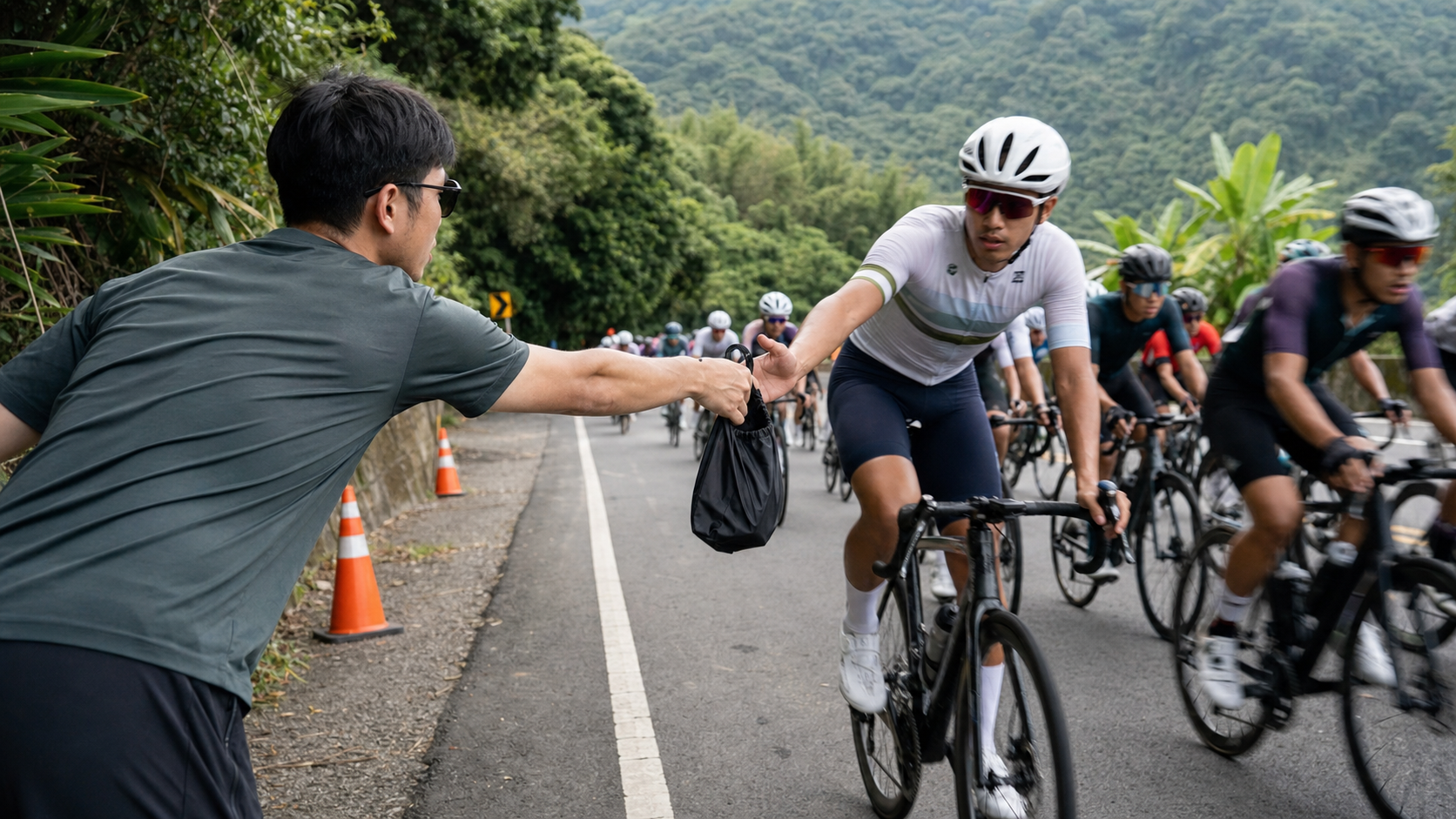
In professional cycling races, the Feed Zone is one of the most chaotic and dangerous sections of the course. As 150 riders pass through the feed zone at 45–55 km/h, team staff (Soigneurs) extend feed bags from the roadside, and riders must grab them with precision within a second or two. A botched feed or poorly timed delivery can range from compromising energy intake to causing a crash. This article analyzes the art of feeding from the perspective of team support strategy.
Calculating Basic Feeding Needs
Before developing a feeding strategy, it is essential to understand the physiological requirements:
Feeding Requirements Calculation Table
| Race Duration | Fluid Needed | Carbohydrates Needed | Electrolytes Needed |
|---|---|---|---|
| 2–3 hours | 1.2–1.8 L | 120–180g | 1–2 electrolyte packs |
| 3–4 hours | 1.8–2.4 L | 180–240g | 2–3 electrolyte packs |
| 4–5 hours | 2.4–3.0 L | 240–300g | 3–4 electrolyte packs |
| 5+ hours | 3.0 L+ | 300g+ | 4+ electrolyte packs |
Note: In Taiwan’s hot and humid summer conditions, hourly sweat rate can reach up to 1.5 L, so fluid intake should be increased by 20–30% above the standard baseline.
Timing the Feed Bag Delivery
Optimal Delivery Window
The ideal timing for feed bag delivery is:
- Sections where the peloton speed is relatively low: Feed stations are typically placed on gentle descents or flat roads after a summit, where delivery is safest at speeds of 35–45 km/h
- When the peloton is relatively stable: Avoid delivering during accelerations, after corners, or in the chaotic moments right after an attack has just ended
- When the rider’s position is clear: Riders should move toward the edge of the road well before reaching the feed zone so the Soigneur can identify them clearly
Common Causes of Delivery Failures
- Rider miscalculates speed, extending the feed bag too early or too late
- Rider is buried in the middle of the peloton and cannot reach the roadside, forcing them to skip the feed
- Feed bag strap is not secure and comes loose during delivery
- Sweaty gloves or nervousness cause the rider to miss the grab
Feed Bag Preparation and Contents
Standard Feed Bag Contents Recommendations
A standard Musette typically contains:
- 2–3 bottles of energy drink (or water + electrolyte packs)
- 2–3 energy bars or rice bars (packaged in a form that is easy to eat while riding)
- 2–3 energy gels
- Backup supplies (e.g., small sugar packets, salt tablets)
- Spare clothing (e.g., rain jacket): If weather conditions may change, a lightweight rain jacket can be passed in the feed zone
Special Feed Items for Taiwan Races
Feeding in Taiwan races has several local characteristics:
- Small-packaged savory foods (e.g., small steamed buns, rice balls): In long-distance races, savory foods can relieve the fatigue of sweet foods
- Cold-pressed juice or fruit juice: Provides a cooling sensation in high heat, but ensure it is sealed to avoid spills
- Ginger warming drinks: After climbing to high altitudes, consider adding a warming beverage to the feed
Positioning Strategy in the Feed Zone
Soigneur Positioning Choices
The team Soigneur’s choice of position in the feed zone affects the delivery success rate:
- Near the front of the feed zone: Riders still have better positions in the peloton, and speeds are relatively lower
- Avoid corner entrances: If the feed zone includes a corner, positioning 200 meters before the corner is safer
- Observe the peloton dynamics: If the peloton is unusually dense, move forward or backward to find a point where the group is slightly more spread out
Multi-Point Feeding Strategy
For long-distance races, multiple Soigneurs can be stationed at different locations to increase the rider’s chances of receiving a feed. For example:
- Primary feed: Wait at the standard feed zone
- Backup feed: Wait 500–1000 meters after the feed zone to serve riders who missed their feed
Rider Handling After the Feed
What the rider does after grabbing the feed bag is also part of the strategy:
- Do not stop pedaling immediately: After grabbing the bag, maintain pedaling rhythm to avoid losing ground to the peloton
- Quickly organize the feed bag: While riding, quickly transfer needed items to jersey pockets and discard the empty bag at the roadside (in the designated drop zone)
- Hydrate before eating: Hydration takes priority over solid food
Practical Advice
- Communicate with the Soigneur before the race: Agree on jersey color, identification number, and positioning
- Practice grabbing the bag while riding: Practice one-handed bag pickup during training rides to become familiar with the grabbing motion
- Carry backup supplies: If the feed zone delivery fails, have 1–2 energy gels in jersey pockets as an emergency backup
- Know the race rules: Some races explicitly define the feed zone boundaries; accepting feeds in prohibited areas may result in penalties
- Increase feeding frequency in hot races: For Taiwan summer races, it is recommended to feed every 40–50 minutes rather than every 60–70 minutes
Conclusion
Feeding strategy is the aspect most often overlooked by amateur riders in cycling races, yet it has the deepest impact on long-distance race outcomes. From preparing the feed bag to choosing the delivery timing, every detail can become a decisive variable on race day. In Taiwan’s summer races, a well-planned feeding strategy is not just a competitive tactic—it is the most fundamental protection for your own body.
Related Reading
- Cycling Race Feeding Strategy: What to Put in Your Pockets and When to Eat
- Cycling Feed Station Design: Preparation and Usage Strategy for Personal Feed Bags
- Pro Cycling Team Car Strategy: A Complete Guide to Food Supply and Mechanical Support
- Feeding Isn’t Just Stuffing It in Your Pocket: A Complete Guide to Athletes’ Portioning, Carrying, and Race-Day Packing
一日北高/長距離團騎 常見問題補充篇 / 組團或跟團的眉角 / 壯車友容易被瘦車友慢性拉爆 / 原來屁股痛可能是這個原因...? / 風場配速法 / 公路車 / CT Yeh
2 年前
西進武嶺 免費訓練分析服務 Intervals | 練不夠還是練過頭?你哪一種類型選手?AI模型告訴你! | 備戰神器 | 公路車 訓練 | CT Yeh
4 年前
西進武嶺各路段 前8000名 大數據分析 配速攻略/功率/心律/推力比/維持率/踏頻/踏瓦比/牽車率 大公開 | 建大盃 NeverStop 可參考 | 公路車 | CT Yeh
5 年前
FTL 與 SYB 車隊專訪 西進武嶺 實用攻略分享! 2小時 如何練?!你不知道的眉角!新手準備武嶺必看 EP1 | 實力派女車友 | 精華版 | 公路車 | CTYeh
4 年前
#公路車 #西進武嶺 配速配瓦實驗 坡度分析 四小時內攻略 建大盃 NeverStop #西進武嶺攻略
6 年前
CT 喇低賽) 武嶺牽車 才是王道 西進牽車四小時內秘訣 攝手位置 如何判斷 防抽筋小秘訣
7 年前
一日北高前的高裝檢 | 北高 360 | 挑戰11小時的裝備 | 一日雙塔 | 補給
6 年前
備戰 戀戀197 賽前關門點分析 西濱團練 #公路車 4K高畫質
6 年前