Rehabilitation Plan After Cycling Fractures: Return-to-Training Timeline for Clavicle and Wrist Fractures
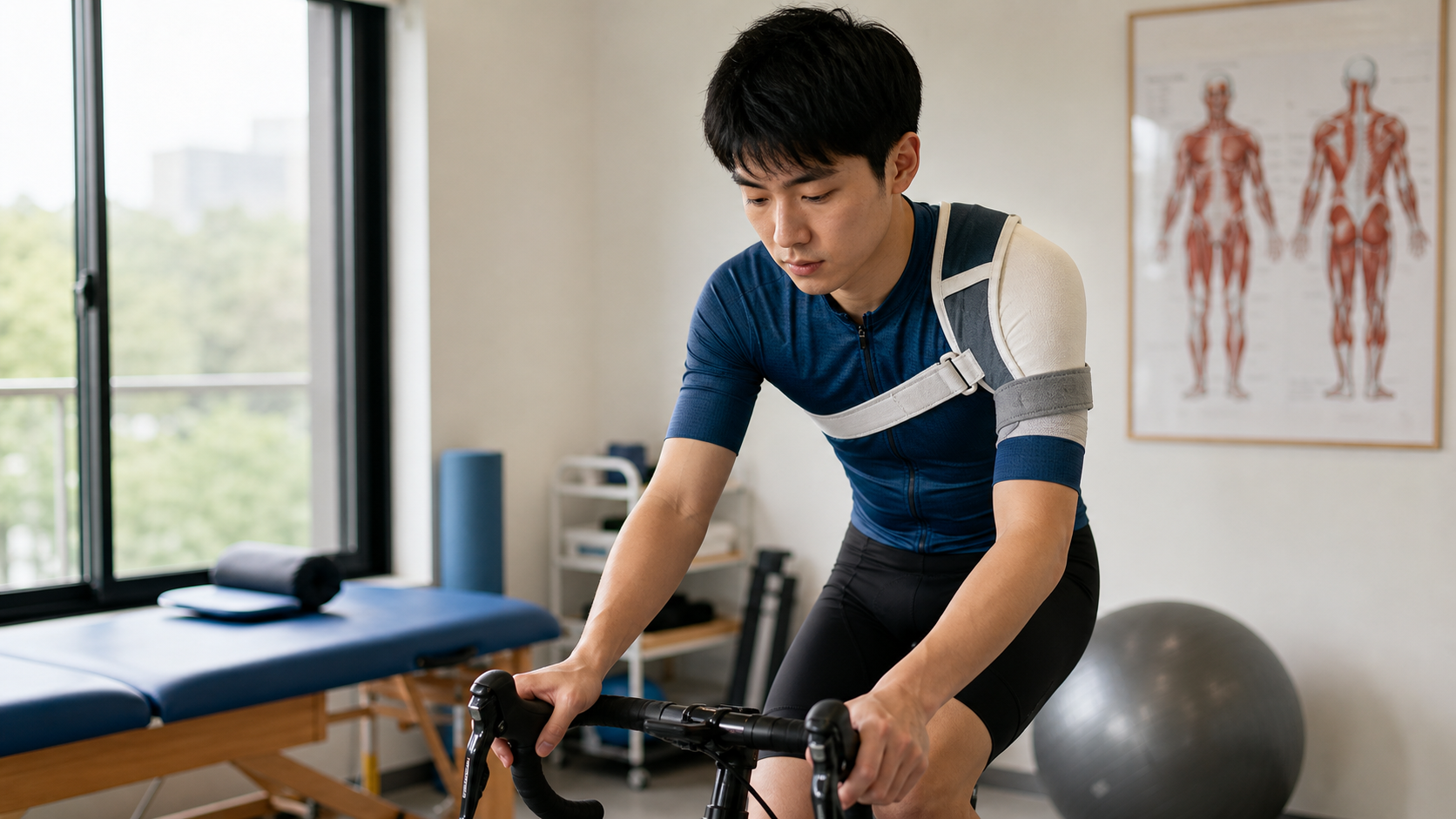
Introduction
Cycling accidents are a common cause of emergency trauma visits in Taiwan. According to statistics from the Taiwan Orthopaedic Association, clavicle fractures account for 2.6–5% of all adult fractures, and in cycling accidents, the proportion of clavicle fractures is as high as 15–20%. Wrist fractures (mainly distal radius fractures, Colles’ Fracture) are common when falling off a bike due to the instinctive outstretched-hand landing.
A post-fracture rehabilitation plan is not just “waiting for the bone to heal,” but a systematic process that progresses from protection to recovery to strengthening. Proper timeline planning allows cyclists to return to riding as quickly as possible while minimizing the risk of re-injury.
Clavicle Fracture: The Most Common Cycling Fracture
Fracture Mechanism and Classification
Direct impact on the shoulder when falling is the most common mechanism of clavicle fractures. According to the Neer classification:
- Group I (midshaft clavicle fracture, most common, accounting for 80%)
- Group II (lateral end fracture; displaced cases require surgical consideration)
- Group III (medial end fracture, less common)
Treatment Options
| Fracture Type | Treatment | Immobilization Duration |
|---|---|---|
| Non-displaced or minimally displaced | Conservative (sling) | 4–6 weeks |
| Moderately displaced (<1.5cm shortening) | Conservative or surgical | Depends on choice |
| Significantly displaced (>2cm shortening), open fracture | Surgical (plate/screws) | 2–4 weeks post-surgery |
Return-to-Riding Timeline for Clavicle Fractures
Weeks 1–2 (Acute Protection Phase)
- Sling immobilization to protect the fracture site
- With the orthopaedic surgeon’s approval, perform early movement of areas below the elbow (wrist, fingers) to prevent joint stiffness
- Cycling: Completely prohibited
Weeks 3–6 (Healing Phase)
- Begin passive shoulder range-of-motion exercises (assisted by a physical therapist)
- May attempt indoor stationary trainer riding (for non-displaced fractures, usually can be attempted at weeks 4–6, but requires physician evaluation)
- Note: Any risk of falling (real roads) should still be avoided
Weeks 6–10 (Strengthening Phase)
- After X-ray confirms fracture healing, begin progressive shoulder strengthening exercises
- Low-intensity riding on flat roads is permitted; avoid steep terrain and crowded environments
- Begin rotator cuff strengthening exercises to protect the shoulder joint
Weeks 10–16 (Full Return to Training)
- Fracture fully healed; normal training can resume
- Gradually return to climbing and descending training
- Surgical cases: typically return to training 2–4 weeks earlier than conservative treatment
Wrist Fracture (Distal Radius Fracture)
Fracture Mechanism
When falling, the instinctive outstretched-hand landing (FOOSH: Fall On Outstretched Hand) causes strong dorsiflexion of the wrist joint, leading to a distal radius fracture. The classic “Colles’ fracture” presents with a dinner fork deformity.
Treatment Options
| Fracture Severity | Treatment | Cast Immobilization Duration |
|---|---|---|
| Stable, non-displaced | Cast immobilization | 4–6 weeks |
| Displaced (reducible) | Reduction + cast | 6 weeks |
| Unstable | Surgical (plate/external fixator) | 4–6 weeks post-surgery |
Return-to-Riding Timeline for Wrist Fractures
Weeks 1–6 (Immobilization Phase)
- Cast or splint immobilization; finger exercises must be continued to prevent tendon adhesion
- Cycling: Completely prohibited (unable to grip the handlebars properly or brake in an emergency)
Weeks 6–10 (Restoring Range of Motion)
- After immobilization is removed, the focus is on restoring wrist extension and flexion range of motion
- Physical therapy: heat therapy + joint mobilization + active exercises
- Indoor stationary trainer riding may be attempted (must confirm the ability to grip the handlebars properly)
Weeks 10–16 (Progressive Strengthening)
- Begin wrist strengthening exercises (grip strength training, radial/ulnar deviation training)
- Assess whether grip strength is sufficient for emergency braking
- Wear a wrist brace while riding; avoid high-fall-risk terrain (gravel roads, wet surfaces)
Months 4–6 (Full Return to Training)
- Once wrist function is fully restored, unrestricted cycling is permitted
- Post-surgical cases must confirm complete fracture healing on X-ray
General Principles of Fracture Rehabilitation
| Principle | Description |
|---|---|
| Follow physician instructions | Do not shorten the immobilization period on your own; fracture healing takes time |
| Early movement of unaffected joints | Prevents stiffness in adjacent joints and accelerates overall recovery |
| Progress gradually | Return to training should not skip steps; each phase requires assessment |
| Maintain cardiovascular fitness | Low-impact aerobic exercise (swimming, running, depending on the affected area) during the injury period |
| Mental preparation | Fear of returning to riding is normal; consider seeking help from a sports psychologist |
Strategies for Preventing Future Falls
- Skills training: After returning to training, consider taking skills courses to rebuild confidence on corners and gravel roads
- Gear upgrades: Ensure your helmet is certified, and consider adding elbow and wrist guards
- Do not ride alone in the early return phase: Having a companion increases safety
Conclusion
Although fractures are frustrating, Taiwan has an excellent orthopaedic healthcare system, and with a systematic rehabilitation plan, the vast majority of cyclists can fully recover and return to riding. Patiently working through each rehabilitation phase will make your next ride stronger and safer.
Related Reading
- Preventing Cycling Fractures: Fall Risk Assessment and Protective Gear
- First Aid for Cycling Fractures: On-Site Management of Clavicle Fractures and Timing for Returning to Riding
- How to Make a Comeback from Injury: A Progressive Return-to-Training Plan for Cyclists
- Cycling Return-to-Training Plan: A Progressive Schedule for Returning to Riding After Injury
摔車後補裝備: 好市多新款單車安全帽& Specialized Romin 北高整路屁股都不痛的坐墊 | 一千元居然有MIPS | CT Yeh | 公路車
4 年前
靠單車減肥35公斤 心得分享與整理
7 年前
單車 一日北高 ( 雙城 ) 肥宅雙人瘋狂行 紀錄片 REACTO
10 年前
一日北高常見問題大集合 | 攻略 | 路線 | 訓練 | 補給 | 自行車 單車 | 一日雙城 | 雙塔 | TWB北高360 | 屁股痛
6 年前
碟煞公路車 銑面器 !? 原來銑完差這麼多! 降低蹭碟機率! | TIME 公路車 保養小記錄 | CT Yeh
3 年前
一日北高/長距離團騎 常見問題補充篇 / 組團或跟團的眉角 / 壯車友容易被瘦車友慢性拉爆 / 原來屁股痛可能是這個原因...? / 風場配速法 / 公路車 / CT Yeh
2 年前
高雄綠園道鐵路自行車道 / 外地人能輕鬆駕馭 還是整路崩潰? / 2025 全線開通 春節實地探索一次!(附GPS連結)/ 公路車 / CT Yeh
1 年前
風櫃嘴 | 全台最多大砲的單車路線 | 尋寶網攝影師告訴你怎麼擺拍起來才好看 | 熱門攝影地點巡禮
6 年前