Introduction
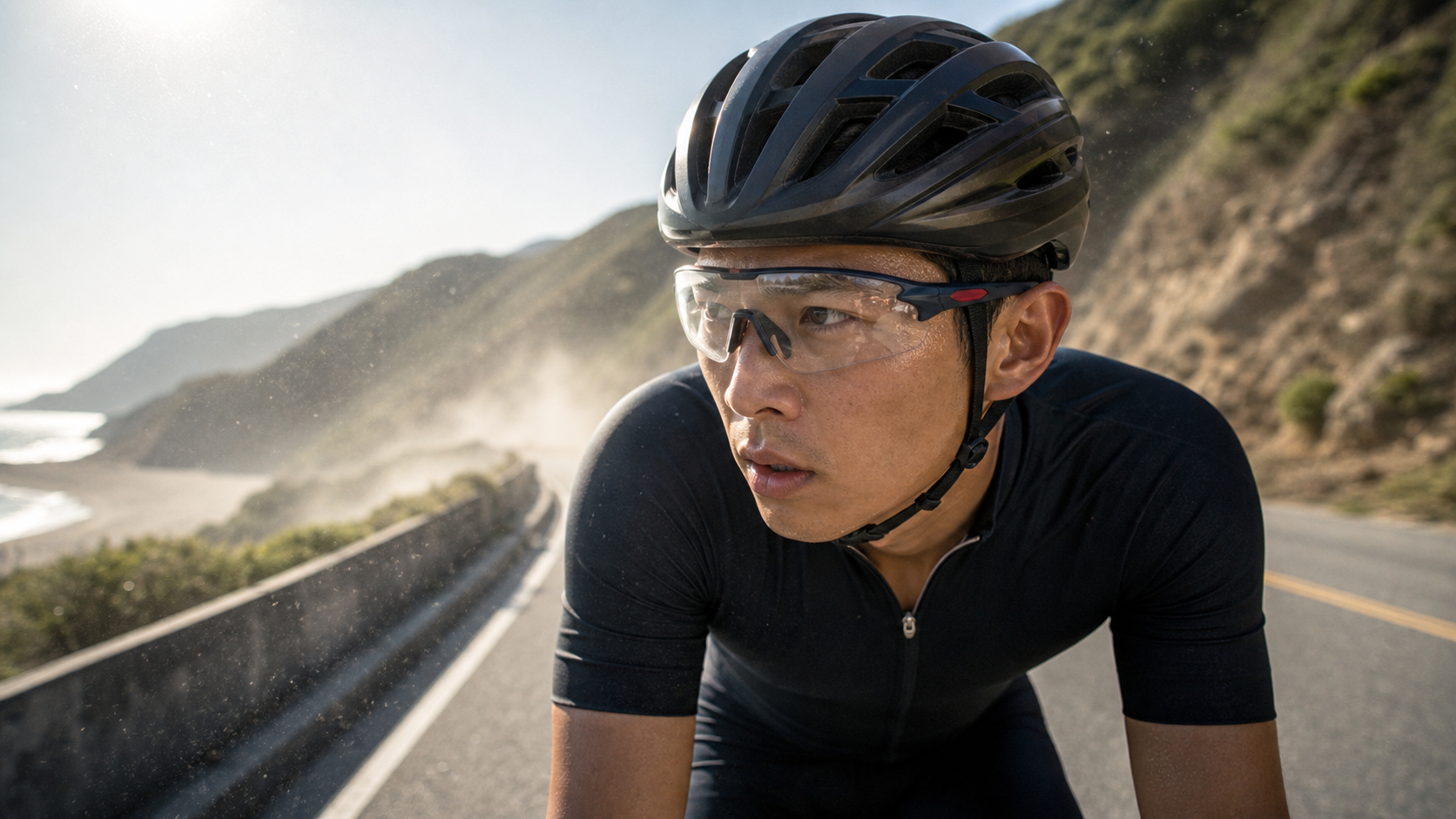
When cycling, speeds can reach 40–60 km/h, and even tiny grains of sand or flying insects can damage the cornea upon high-speed impact. Taiwan’s cycling environment has its own unique characteristics: intense subtropical UV radiation, dust kicked up from gravel roads in mountainous areas, sea salt spray along coastal routes, and Taiwan’s endemic biting midges (Forcipomyia taiwana) season. In such an environment, cycling glasses are no longer just an accessory—they are indispensable protective gear.
Four Major Threats to Your Eyes While Cycling
1. UV Radiation
UV damage to the eyes is cumulative:
- UVA: Penetrates to the lens, accelerating cataract formation
- UVB: Mainly affects the cornea and conjunctiva, causing photokeratitis (similar to “snow blindness”)
- Long-term exposure: Increases the risk of pterygium (commonly known as “fish eye”), frequently seen in Taiwanese ophthalmology clinics
Taiwan’s summer midday UV index ranges from 8–12, and is even higher in mountainous areas. Without UV protection, eyes may experience burning sensations and tearing after long rides.
2. Foreign Bodies
During high-speed riding, insects, dust, and plant debris can strike the eyes. Common injuries in Taiwan include:
- Corneal foreign body: Requires emergency removal at an ophthalmology clinic
- Conjunctival foreign body: Relatively minor, but repeated friction can cause conjunctival damage
3. Dry Eye
When cycling, eyes are exposed to wind for extended periods, significantly increasing tear evaporation. Even those without pre-existing dry eye syndrome may experience dry, burning eyes after long rides. Taiwanese ophthalmology statistics show that outdoor sports enthusiasts have a higher prevalence of dry eye syndrome than the general population.
4. Glare
Riding against the sun or on highly reflective surfaces (such as wet roads or the sea) can cause temporary visual impairment, compromising riding safety.
Key Specifications of Cycling Glasses Explained
UV Protection Levels
| Standard | Description | Recommendation |
|---|---|---|
| UV 400 | Filters UV light below 400nm (including UVA+UVB) | Minimum standard |
| UV 380 | Only filters below 380nm; UVA not fully blocked | Insufficient |
| No marking | UV protection cannot be confirmed | Avoid |
All cycling glasses should meet the UV 400 standard.
Lens Categories (EN ISO 12312-1 Standard)
| Category | Light Transmission | Suitable Conditions |
|---|---|---|
| Category 0 | 80–100% | Overcast, tunnels, dawn/dusk |
| Category 1 | 43–80% | Overcast or cloudy |
| Category 2 | 18–43% | Sunny (not intense light) |
| Category 3 | 8–18% | Intense sunlight |
| Category 4 | 3–8% | Extremely intense sunlight (ski slopes) |
For general riding in Taiwan, Categories 2–3 are recommended; for routes with many tunnels, prepare Categories 0–1 or use photochromic lenses.
Lens Materials
| Material | Weight | Impact Resistance | Optical Quality | Recommended Use |
|---|---|---|---|---|
| Polycarbonate | Light | High | Good | General cycling, racing |
| Nylon/TR90 | Medium | High | Good | Lightweight recreational styles |
| Glass | Heavy | Low | Excellent | Not recommended for cycling |
For racing or high-speed riding, impact-resistant lenses certified to ANSI Z87.1 or CE EN 168 are recommended.
Special Considerations for Taiwan’s Cycling Environment
Mountain Riding (Wuling, Hehuan Mountain)
- UV intensity at altitudes above 3,000m is 30–40% higher than at sea level
- Category 3 lenses + UV 400 are recommended; larger frame designs reduce peripheral light entry
Coastal Riding (West Coast, Taitung Coastline)
- Sea surface reflection is intense; polarized lenses are recommended to eliminate glare from the water
- Salt spray environment: choose hydrophilic coatings to prevent salt crystals from forming on lenses
Urban Commuting (Taipei, Taichung, Kaohsiung)
- Unpredictable sun and rain: photochromic lenses are recommended—they darken automatically outdoors and lighten indoors or in tunnels
- Air pollution: closed-frame designs reduce PM2.5 particle entry
Usage and Maintenance of Cycling Glasses
- Do not wipe with clothing or paper towels: fine fibers can scratch the lenses; use the included microfiber cloth
- Coating care: avoid organic solvents for cleaning; rinse with water and wipe with a microfiber cloth
- Frame adjustment: ensure the nose pads and temple tips fit snugly to prevent movement from affecting your field of vision
- Replacement cycle: replace lenses when visible scratches or coating delamination appear, to avoid compromising visual quality
First Aid for Eye Injuries
- Foreign body in the eye: do not rub with your hands; rinse thoroughly with plenty of water; if it cannot be flushed out, go to the ophthalmology emergency room
- Light burn: if you experience burning, tearing, or light sensitivity, gently apply a wet towel over the eye; seek medical attention if symptoms do not improve within 24 hours
- Corneal abrasion: if you experience sudden severe eye pain or blurred vision, go to the ophthalmology emergency room immediately
Practical Recommendations
- Cycling glasses are safety equipment, not accessories: wear them on every ride, regardless of distance
- Prepare spare lenses: use dark lenses on sunny days and light lenses on overcast days, or simply choose photochromic models
- Annual eye exams: active outdoor sports enthusiasts should have an eye health check-up once a year to assess cumulative UV damage
Conclusion
Your eyes let you see every beautiful road in Taiwan—they deserve the best protection. Choosing a pair of cycling glasses that meet the UV 400 standard, carry impact-resistance certification, and suit Taiwan’s cycling environment is a wise investment in your long-term vision health.
Related Reading
- Cyclists’ Vision Protection: A Guide to UV Rays, Flying Insects, and Goggle Selection
- Eye Protection for Cycling: Shielding Against UV Rays, Windblown Sand, and Insect Impacts
- Eye Protection for Riders: UV and Dust Defense for Outdoor Cycling in Taiwan
- Cycling Vision Protection: Choosing UV-Protective Lenses and Preventing Eye Fatigue
再快都跟的上!? 單車跟隨攝影機之王 HOVERAir X1 PROMAX 全面實測 / 唯一!8K畫質&自行車專用模式和跟蹤信標&前後避障 / DJI Neo 可參考/ 公路車 / CT Yeh
1 年前
碟煞公路車 銑面器 !? 原來銑完差這麼多! 降低蹭碟機率! | TIME 公路車 保養小記錄 | CT Yeh
3 年前
開箱) 近視車友 也可以很帥的 Envis Transform 太陽眼鏡開箱 翔鷹 配近視框超便宜秘訣
7 年前
#東眼山 #公路車 單車約騎 空拍 北 113 水蜜桃冰沙 Mavic Pro
9 年前
單車 一日北高 ( 雙城 ) 肥宅雙人瘋狂行 紀錄片 REACTO
10 年前
4K 東眼山 x 水蜜桃冰沙 百人單車約騎! 操完再吃冰 多爽快
7 年前
新玉門關 單車挑戰賽 多視角主集團衝刺菁華版 4K #公路車
5 年前
一日北高/長距離團騎 常見問題補充篇 / 組團或跟團的眉角 / 壯車友容易被瘦車友慢性拉爆 / 原來屁股痛可能是這個原因...? / 風場配速法 / 公路車 / CT Yeh
2 年前