Cycling and Osteoporosis: Bone Density Concerns in Low-Impact Exercise and Supplementation Advice
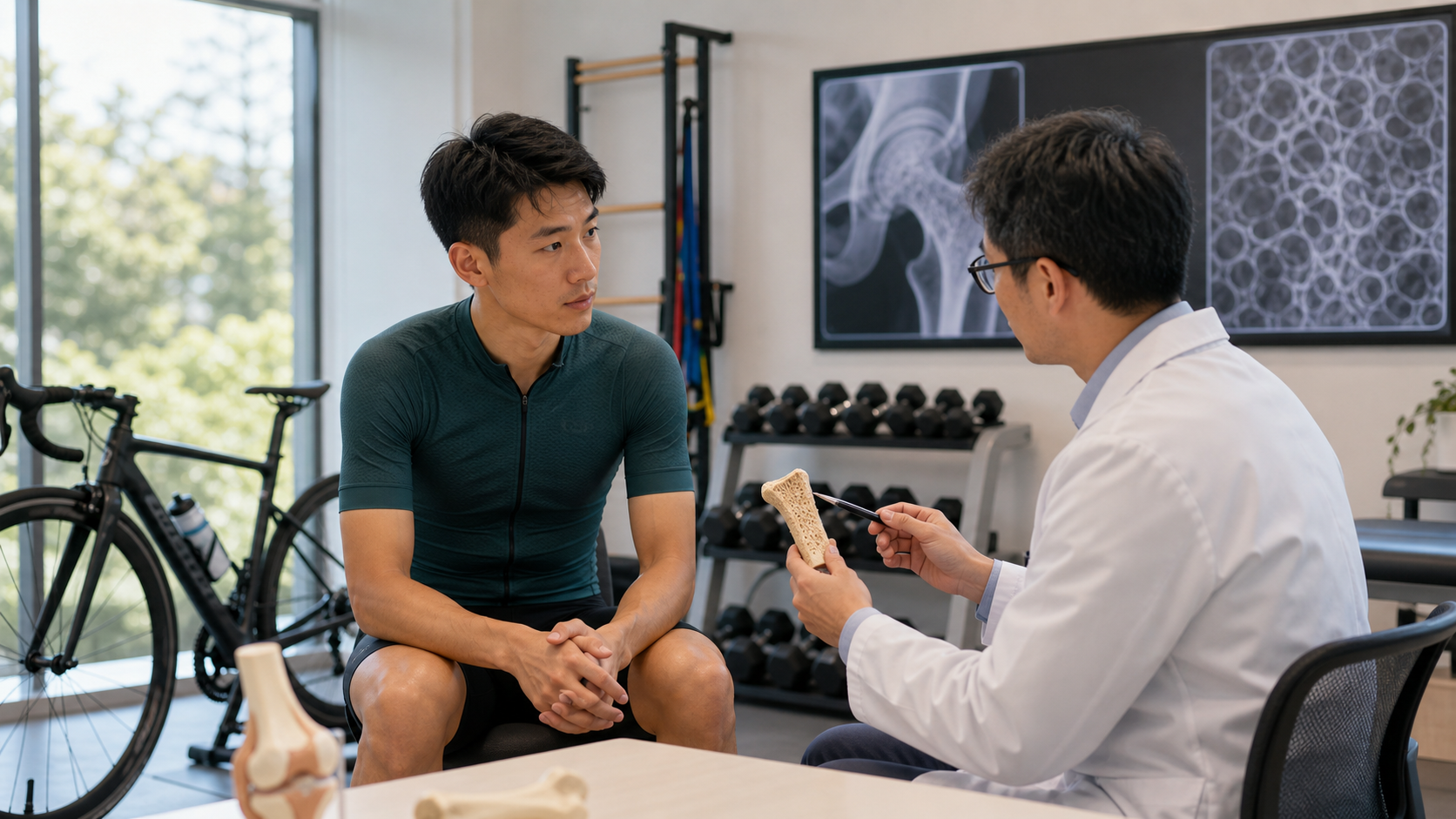
Introduction
“You ride so much, your bones must be in great shape, right?” — In fact, the opposite is true. A growing body of research shows that cyclists whose primary exercise is riding may have lower bone mineral density (BMD) than their sedentary peers of the same age, and even lower than those who never exercise. This counterintuitive fact has sparked widespread discussion in Taiwan’s sports medicine community in recent years, especially as the road cycling trend has surged, with many people devoting large amounts of time to riding while neglecting other forms of exercise.
Why Does Cycling Provide Limited Stimulus to Bones?
The Basic Principle of Bone Adaptation: Wolff’s Law
Bone formation and maintenance follow Wolff’s Law: bones adjust their density and structure in response to the mechanical loads they experience. Ground reaction forces and muscle pull forces are the most effective stimuli for bone.
Why Is Cycling’s Bone Stimulus Insufficient?
- When riding, you sit on the saddle, so the ground reaction force on your legs is nearly zero, and your leg bones receive no compressive force from body weight
- Although pedaling does create muscle pull on bones, the repetitive, low-impact nature has limited effectiveness in promoting bone density
- In comparison, the ground reaction force of running is approximately 2–3 times body weight, several times greater than cycling’s bone-stimulating effect
Research Data: Cycling and Bone Density
| Population | Lumbar Spine BMD | Femoral Neck BMD |
|---|---|---|
| General sedentary individuals | Baseline | Baseline |
| Long-distance runners | Above baseline | Above baseline |
| Swimmers | Near or slightly below baseline | Near baseline |
| Road cyclists | Below baseline | Below baseline |
| Professional road cyclists | Significantly below baseline | Significantly below baseline |
A 2012 study published in Osteoporosis International found that 50% of professional road cyclists had osteopenia, a rate far higher than that of the general population.
Taiwan-Specific Risk Factors
- Dietary habits: some cyclists who prioritize weight management consume insufficient calories, affecting bone metabolism
- Insufficient sun exposure: excessive sun protection and long hours on indoor trainers lead to vitamin D deficiency (vitamin D is crucial for calcium absorption)
- Additional risk for postmenopausal women: the decline in estrogen after menopause already reduces bone density, and the risk is even higher if weight-bearing exercise is also lacking
Supplementation Strategies: Four Aspects
1. Add Weight-Bearing Exercise
The most effective way to improve bone density. It is recommended to add at least 2–3 sessions of weight-bearing training per week:
| Exercise Type | Bone Stimulus Effect | Recommended Frequency |
|---|---|---|
| Running/Jogging | High | 2–3 times per week, 20–30 minutes each |
| Strength training (squats, deadlifts) | High | 2–3 times per week |
| Jump rope | Very high (pronounced impact) | 3 times per week, 10 minutes each |
| Hiking | Moderate | 1–2 times per week |
| Swimming | Low | Complements cardiovascular fitness; limited bone benefits |
2. Calcium Supplementation
Recommended daily calcium intake:
- Adults (25–50 years): 1,000 mg/day
- Women (postmenopausal): 1,200 mg/day
- Men (>70 years): 1,200 mg/day
Prioritize food sources:
- Milk (approximately 300 mg per cup)
- Tofu (approximately 130–200 mg per 100 g)
- Dried small fish (approximately 2,000 mg+ per 100 g)
- Black sesame seeds (approximately 88 mg per tablespoon)
Supplements: if dietary intake is insufficient, calcium carbonate (better absorbed with meals) or calcium citrate (can be absorbed on an empty stomach) can be used, with no more than 500 mg per dose (split doses are better absorbed).
3. Vitamin D Supplementation
Taiwanese research shows that even in Taiwan, where sunlight is abundant, many outdoor exercisers have vitamin D deficiency due to aggressive sun protection. The recommended daily dose of vitamin D3 (cholecalciferol) is 1,000–2,000 IU; if there is a significant deficiency (blood 25(OH)D < 20 ng/mL), higher doses can be taken under a physician’s guidance.
4. Protein Intake
Protein is a major component of the bone matrix (collagen). The recommended daily protein intake for cyclists is: 1.2–1.6 g/kg body weight. Post-exercise protein supplementation (20–40 g) supports bone metabolism.
When Should You Get a Bone Density Test?
Taiwan’s National Health Insurance covers bone density testing (DXA scan) for the following indications:
- Women aged 65 and above
- Men aged 70 and above
- Individuals aged 50 and above with a history of fractures
Cyclists with a long history of heavy riding (>5 years, >10 hours per week) who lack other weight-bearing exercise are advised to undergo a self-funded DXA scan (approximately NT$2,000–3,000) to understand their baseline bone status.
Practical Recommendations
- 80/20 Principle: 80% cycling, 20% adding running or strength training
- Squats twice a week: even bodyweight squats—20 reps, twice a week—provide meaningful stimulus to bones
- Don’t over-restrict your diet: bone metabolism requires adequate calories; strict low-calorie diets are a major enemy of bone density
Conclusion
The cardiovascular benefits cycling brings you are beyond question, but your bones need a different type of stimulus. Adding weight-bearing exercise and paying attention to calcium and vitamin D intake are key strategies for riding well into old age while keeping your bones strong.
Related Reading
- The Impact of Long-Term Cycling on Bone Density: Why Cyclists Need to Add Weight-Bearing Training
- Bone Density Issues in Cycling Training: A Review of Research on Low-Impact Exercise and Fracture Risk
- Osteoporosis Risk in Cyclists: The Skeletal Cost of Low-Impact Exercise
- The Bone Density Crisis for Cyclists: Why Pure Cyclists Need to Add Strength Training
靠單車減肥35公斤 心得分享與整理
7 年前
#公路車 #Fitting 靠人工智慧APP 幫你調整單車
6 年前
CT 喇低賽) 單車 比賽總是沒照片? 攝影師的觀點大公開 姿勢就是力量! 請加速1.25倍收看
7 年前
一日北高/長距離團騎 常見問題補充篇 / 組團或跟團的眉角 / 壯車友容易被瘦車友慢性拉爆 / 原來屁股痛可能是這個原因...? / 風場配速法 / 公路車 / CT Yeh
2 年前
「悲情男車友」創作單曲 爆笑MV / 公路車 / CT Yeh / 4K劇情版
7 個月前
一日北高常見問題大集合 | 攻略 | 路線 | 訓練 | 補給 | 自行車 單車 | 一日雙城 | 雙塔 | TWB北高360 | 屁股痛
6 年前
單車 一日北高 ( 雙城 ) 肥宅雙人瘋狂行 紀錄片 REACTO
10 年前
大家都在開箱的...單車用藍芽對講耳機真的有幫助嗎? SENA BiKom 20 長距離旅遊 & 海鷗繞圈賽 實際體驗心得 / 公路車 / CT Yeh
9 個月前