Introduction
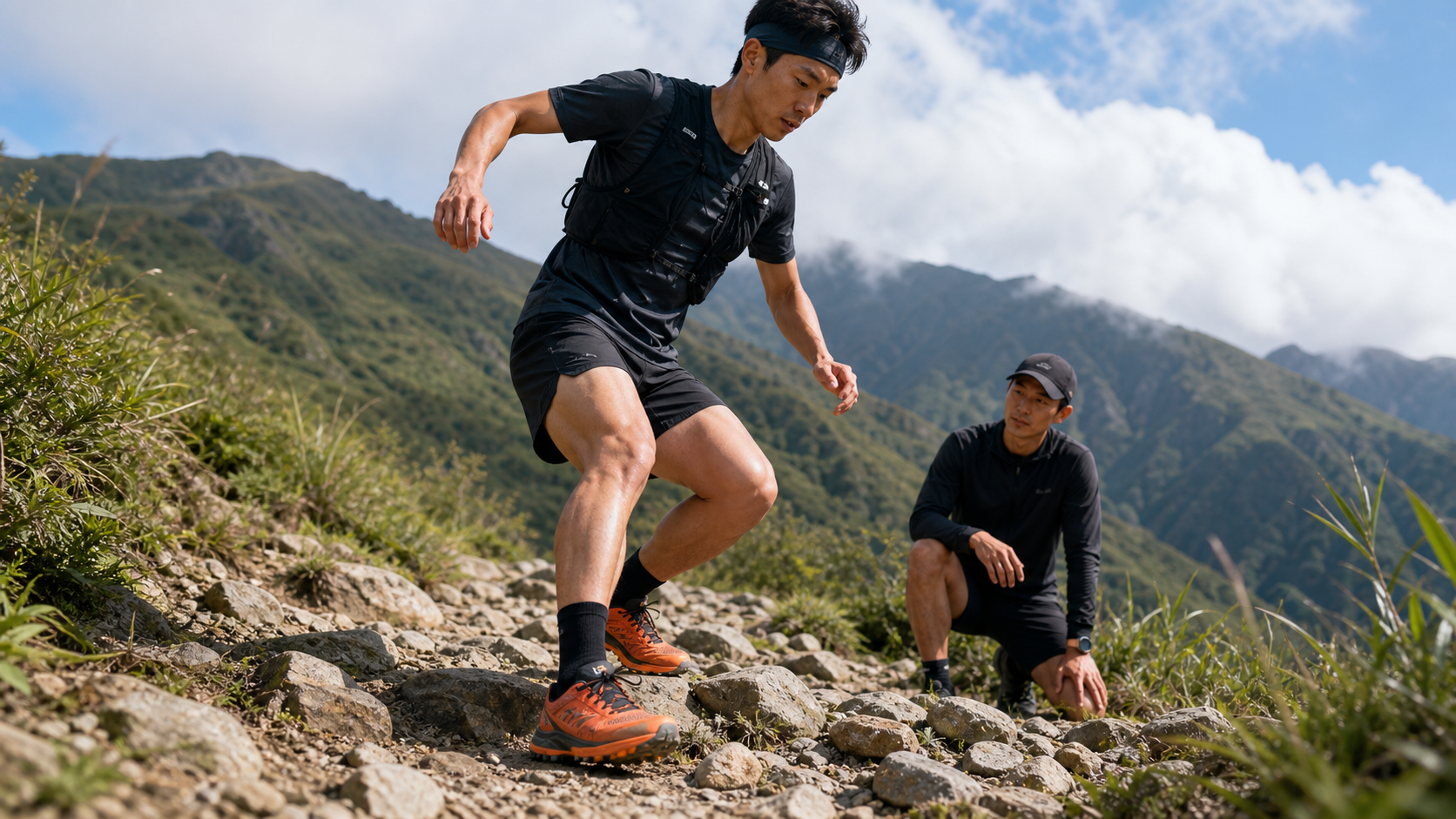
Taiwan boasts abundant trail running resources—the various mountain trails of Yangmingshan, Xueshan, and the Central Mountain Range attract a large number of trail running enthusiasts to take on the challenge every year. However, trail running places fundamentally different demands on the body compared to road running: uneven terrain forces every step to require immediate movement adjustments, the constant alternation between uphill and downhill places extremely high demands on the eccentric control of the quadriceps and glutes, and the instability of rocky mountain surfaces challenges ankle stability several times more than road running.
Without strength training tailored to the specific demands of trail running, runners are not only slower on the trails, but are also more likely to be forced out of races due to ankle sprains, muscle strains, or stress fractures. In the medical records of Taiwan’s mountain ultramarathon races, ankle sprains and knee injuries have consistently been the most common race injuries.
This article will design a systematic functional strength training program for trail runners, with a focus on ankle stability, multi-directional movement capacity, and neuromuscular efficiency for handling uneven terrain.
Analysis of Strength Demands in Trail Running
The biomechanical uniqueness of trail running dictates its specific training demands:
Primary demands of uphill running:
- Concentric power of the gluteus maximus and quadriceps
- Calf push-off strength and ankle dorsiflexion mobility
- Core forward-lean control (leaning forward on uphills without bending at the waist)
Primary demands of downhill running:
- Eccentric control of the quadriceps (resisting gravitational impact)
- Rapid ankle stabilization responses
- Pelvic stability (preventing pelvic drop that accelerates joint degeneration)
Primary demands of traversing terrain:
- Lateral ankle stability (peroneal muscles)
- Lateral control of the gluteus medius
- Rapid multi-directional gait adjustments
| Trail Terrain | Primary Muscles Used | Primary Injury Risk | Essential Strength Training |
|---|---|---|---|
| Uphill running | Glutes, quadriceps | Achilles tendon, knees | Lunges, calf raises |
| Downhill running | Quadriceps (eccentric) | Quadriceps fatigue, knee pain | Eccentric squats, step-downs |
| Rocky paths | Ankle stabilizer muscles | Ankle sprains | Peroneal training, Bosu |
| Muddy trails | Full-foot grip | Slips and falls | Foot strengthening, grip drills |
Functional Strengthening Training for the Ankle Joint
Systematic training of the peroneal muscles:
The peroneus longus and brevis are the first line of defense against ankle inversion (rolling the ankle), and they remain highly activated throughout trail running.
-
Resistance band peroneal training:
- Secure the resistance band to the inside of the foot (pulling inward), and perform eversion of the foot against the resistance
- 3 sets × 20 reps (each side), can be easily done in front of the TV
-
Tip-Toe Walk:
- Walk 20–30 meters on your toes to stimulate the entire calf complex and ankle stability
-
Ankle Alphabet Exercise:
- Seated or with the leg hanging, “write” A–Z in the air with your ankle
- Full-range multi-directional ankle control, especially suitable for runners with a history of sprains
-
Functional movements on unstable surfaces:
- Perform single-leg standing on sandbags, wobble boards, or natural rocks
- Optimal training transfer: performing these in real trail environments is more effective than gym simulations
Multi-Directional Functional Strength Movements
Lateral Bound:
- Jump laterally on one leg, landing and stabilizing on the other leg
- Simulates crossing ditches or making lateral obstacle avoidance moves in trail running
- 3 sets × 8 reps (each side), focusing on landing stability
Step-Up Jump:
- Quickly step up onto a step or log to train uphill explosive power
- Can be practiced on stone benches or steps in parks, at a height of 30–50 cm
- 3 sets × 8 reps (each leg)
Eccentric Step Down:
- Stand on a step and slowly lower your body on one leg (3–5 seconds), lightly touching the heel to the step below
- Strengthens eccentric control of the quadriceps; the best simulation training for downhill running
- 3 sets × 12 reps (each leg)
Farmer’s Carry on Uneven Ground:
- Carry weights in both hands (dumbbells, kettlebells) and walk on grass or gravel roads
- Trains core stability during dynamic walking and reinforces whole-body integration while carrying objects
Program Integration Recommendations
8-Week Training Plan Before the Trail Running Season (2 functional strength sessions per week):
- Weeks 1–3 (Foundation phase): Eccentric step downs, lunges, resistance band peroneal training, single-leg standing
- Weeks 4–6 (Strengthening phase): Add lateral bounds, Bosu ball lunges, step-up jumps
- Weeks 7–8 (Specific integration phase): Combine trail running with targeted exercises; functional training in real terrain
Practical Recommendations
- Training on the trails is the best functional training: One short (30–45 minute) slow trail run per week is itself the best functional training for trail running
- The role of footwear: Although the tread pattern of trail running shoes provides additional ground contact, it cannot replace the intrinsic stabilizing strength of the ankle joint
- The unique challenge of Taiwan’s trails: Taiwan’s trails feature many stone steps (non-natural tread surfaces), and long downhill stone-step sections place enormous eccentric loads on the quadriceps; eccentric step-down training should be intensified 6 weeks before a race
- Hydration and muscle fatigue: Dehydration in mountain environments accelerates the decline in ankle reaction time; adequate hydration is an invisible factor in injury prevention
Conclusion
The joy of trail running lies in the interaction with natural terrain, and the foundation for safely enjoying that joy is thorough functional strength preparation. Systematic training focused on ankle stability, multi-directional power, and eccentric control gives you more confidence and greater resistance to injury with every step on Taiwan’s mountain trails. A complete trail running preparation must include the commitment to this functional strength training.
Related Reading
- Strength Demands of Trail Running: Trail-Specific Strengthening for the Glutes, Quadriceps, and Calves
- Muscle Strengthening in Road-to-Trail Training: The Training Benefits of Uneven Terrain for the Calves
- Differences in Strength Training Between Trail Running and Road Running: Posterior Chain, Ankle Joint, Proprioception
- Core Stability Training for Trail Running: The Secret to Running Steadily on the Trails
大禹嶺 到 武嶺牌樓 全程前後實況錄影 | 北進武嶺 | 東進武嶺 | KOM | 訓練台 | 坡度分析 | Taiwan KOM Last 10 km HARD | 公路車
6 年前
大武山後門26%歡樂陡坡!JJSC南台灣單車行Day2 / 被颱風追著跑 / 公路車 / CT Yeh
2 年前
Never Stop 西進武嶺 前後雙機 完整全程錄影 訓練台 實境
8 年前
單車 梅山36灣 坡度介紹 路段介紹 空拍 (相關遊記影片,請參考說明或我的頻道喔,歡迎訂閱)
6 年前
單車 一日北高 ( 雙城 ) 肥宅雙人瘋狂行 紀錄片 REACTO
10 年前
太平山單車員工旅遊 | 這樣玩CP值最高!| 公路車
5 年前
Rouvy 元宇宙運動世界! 用VR 騎遍全台灣單車路線 武嶺 中社路 風櫃嘴
5 年前
2016 彰化經典百K - 風景宜人精華版
10 年前