Introduction
Many marathon runners in Taiwan have experienced this: after reaching the 30–35 km mark, they feel their “torso starting to sink,” “lower back getting tighter,” and “arms not wanting to swing.” This is not a psychological issue—it is the real physiological response after core muscle endurance is exhausted.
Core strength and core endurance are two distinctly different concepts. Core strength is the ability to generate maximum stabilizing force in a short period (such as a perfect plank), while core endurance is the ability to continuously maintain core stability during prolonged movement (such as maintaining good running form after completing 42.195 km). For marathon runners, the latter is far more important than the former.
Research shows that if the core muscles lose their stabilizing ability due to fatigue during the final 30% of a run (roughly the last 12–13 km of a marathon), running economy decreases by 3–8%, while the load on the knees and lower back increases significantly. This is precisely the window in which many runners sustain injuries in the latter half of a race.
The Difference Between Core Endurance and General Core Training
Traditional core training (planks, crunches) focuses primarily on static or short-duration dynamic movements, emphasizing maximum stabilizing ability in a rested state. Core endurance training, on the other hand, needs to simulate the prolonged fatigue conditions of running:
- Longer-duration movements: Extending planks from 30 seconds to 90–120 seconds or more
- Training under fatigue: Performing core work after running to simulate the fatigue state of the latter half of a race
- Combining dynamic and static movements: Not just holding a static position, but maintaining core stability during movement
- Incorporating cardiovascular demand: Adding aerobic components (such as core circuits) to maintain core control at elevated heart rates
| Training Type | Goal | Movement Duration | Running Application |
|---|---|---|---|
| General Core Strength | Maximum stabilizing force | Short (10–30 sec/repetition) | Quality of isolated movements |
| Core Endurance | Sustained stabilizing ability | Long (60–180 sec/repetition) | Maintaining posture in the latter stages of long runs |
| Functional Core Integration | Core control during movement | Dynamic (repetitive) | Core engagement in every running stride |
Specific Methods for Core Endurance Training
Progressive Long-Duration Planks:
Standard plank endurance building pathway:
- Weeks 1–2: 3 × 45 seconds, 30 seconds rest between sets
- Weeks 3–4: 3 × 60 seconds, 30 seconds rest between sets
- Weeks 5–6: 3 × 90 seconds, 45 seconds rest between sets
- Weeks 7–8: 3 × 120 seconds, 60 seconds rest between sets
- Goal: Ability to hold a perfect-form plank for 3 minutes (the core endurance target for most marathon runners)
Post-Fatigue Core Training:
This is the most effective method of core endurance training—scheduling core work after a run (when the body is already aerobically fatigued) to simulate the condition of the latter stages of a race.
Recommended post-run core circuit (complete the following movements consecutively with minimal rest):
- Plank for 60 seconds
- Side plank 30 seconds per side
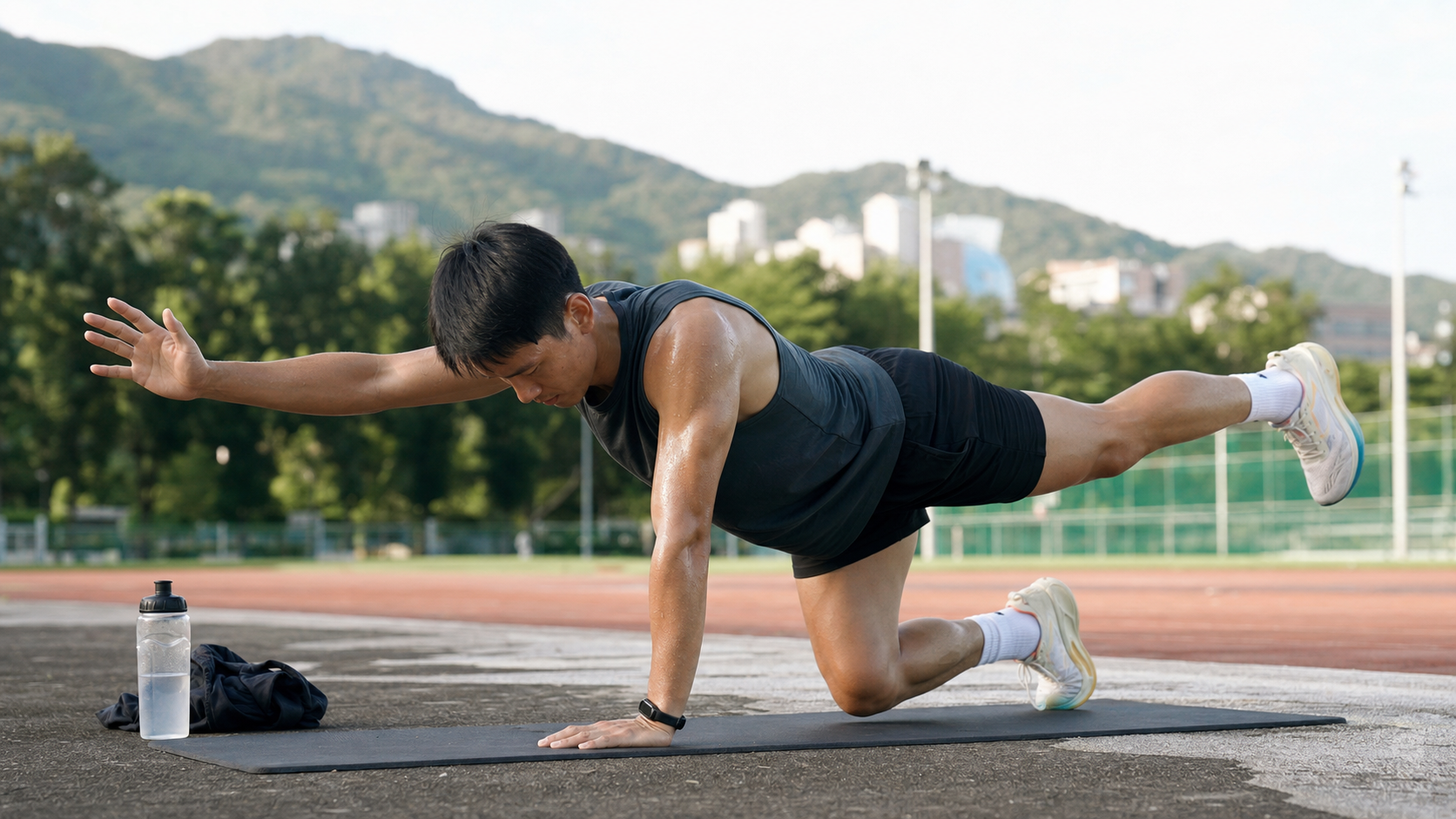
- Bird dog 10 repetitions per side
- Dead bug 10 repetitions per side
- Glute bridge 15 repetitions
→ Repeat the circuit for 2–3 rounds, resting 60 seconds between rounds
Dynamic Core Endurance Training:
- Plank Walk: In a plank position, “walk” your arms sideways 5 steps, then walk back, continuing for 45–60 seconds
- Shoulder Tap: In a plank position, alternately lift one hand to touch the opposite shoulder while keeping the pelvis stable, continuing for 45 seconds
- Mountain Climber: In a plank position, alternately drive your knees toward your chest, progressing from slow to fast, continuing for 30–45 seconds
Mindful Core Engagement Training During Runs:
A “core check-in” habit during long runs: every 10 minutes, consciously tighten your core for 5 seconds, relax, repeat 3 times, then continue running. This practice trains the neurological habit of actively engaging the core even when fatigued—a technique used by many elite runners.
Assessing Core Fatigue After Long Runs
How do you know if your core endurance is the limiting factor? Here are self-assessment methods:
- Photo method: Take side-view photos of your running form at the 10 km and 35 km marks of a long run, comparing changes in lumbar lordosis angle, shoulder height, and head position
- Post-run plank test: Perform a plank test immediately after each long run, recording the hold time to track long-term improvement
- Subjective assessment in the latter half of a race: During the final 10 km of a race, consciously observe whether your lower back feels tight or your arms feel reluctant to swing
Practical Recommendations
- 2 post-run core circuits per week: Perform these after easy runs or medium-long runs, not after long runs (recovery is the top priority after a long run)
- The final 5 km of a long run is real-world core endurance training: Deliberately keep your core engaged during this segment to train posture control under fatigue
- Sleep is key to core endurance recovery: Recovery of the deep core muscles (multifidus, transversus abdominis) is highly dependent on sleep; insufficient sleep directly impairs core endurance performance
- Have your form checked by a running form coach: Taiwan has an increasing number of coaches offering slow-motion running form analysis. A form assessment every six months can confirm whether your core endurance training is effectively translating into improved running form
Conclusion
Core endurance is the hidden key to performance in the latter stages of a marathon. It is not built by occasionally doing a few sets of planks—it requires systematic, long-duration training under fatigue. With 2 post-run core circuits per week, plus the core check-in habit during long runs, you will feel a more stable torso, more efficient stride, and less lower back discomfort in the latter stages of your race within 8–12 weeks—these are the real returns on your core endurance investment.
Related Reading
- Core Muscle Activation in Running: The Scientific Link Between Stability and Efficiency
- The Impact of Core Strength on Running Economy
- Strength Training for Runners: Sport-Specific Exercises for the Core, Glutes, and Legs
- Core Training for Runners: It’s Not About Building Abs, It’s About Building Stability
實景訓練台) 彰化經典百K 高強度喵團 90分鐘 跟著一起練功 2019 Indoor workout Changhua Classic 100 Taiwan
7 年前
Live) 備戰2019彰化經典百K 賽前攻略 (已完賽請看新影片
7 年前
西進武嶺 免費訓練分析服務 Intervals | 練不夠還是練過頭?你哪一種類型選手?AI模型告訴你! | 備戰神器 | 公路車 訓練 | CT Yeh
4 年前
一日北高/長距離團騎 常見問題補充篇 / 組團或跟團的眉角 / 壯車友容易被瘦車友慢性拉爆 / 原來屁股痛可能是這個原因...? / 風場配速法 / 公路車 / CT Yeh
2 年前
CT 喇低賽) 武嶺牽車 才是王道 西進牽車四小時內秘訣 攝手位置 如何判斷 防抽筋小秘訣
7 年前
[教學] Premiere 影片 手震 修正 教學 防抖 單眼 影像 GoPro 穩定 Video Stabilization
8 年前
Never Stop 西進武嶺 前後雙機 完整全程錄影 訓練台 實境
8 年前
一個測試有沒有認真練車的方法😂 #公路車
10 個月前