How to Choose a Bike Power Meter? Pros, Cons, and Price Comparison of Pedal-Based, Crank-Based, and Spider-Based Types
文章導覽
Complete Comparison of Road Bike Power Meter Types
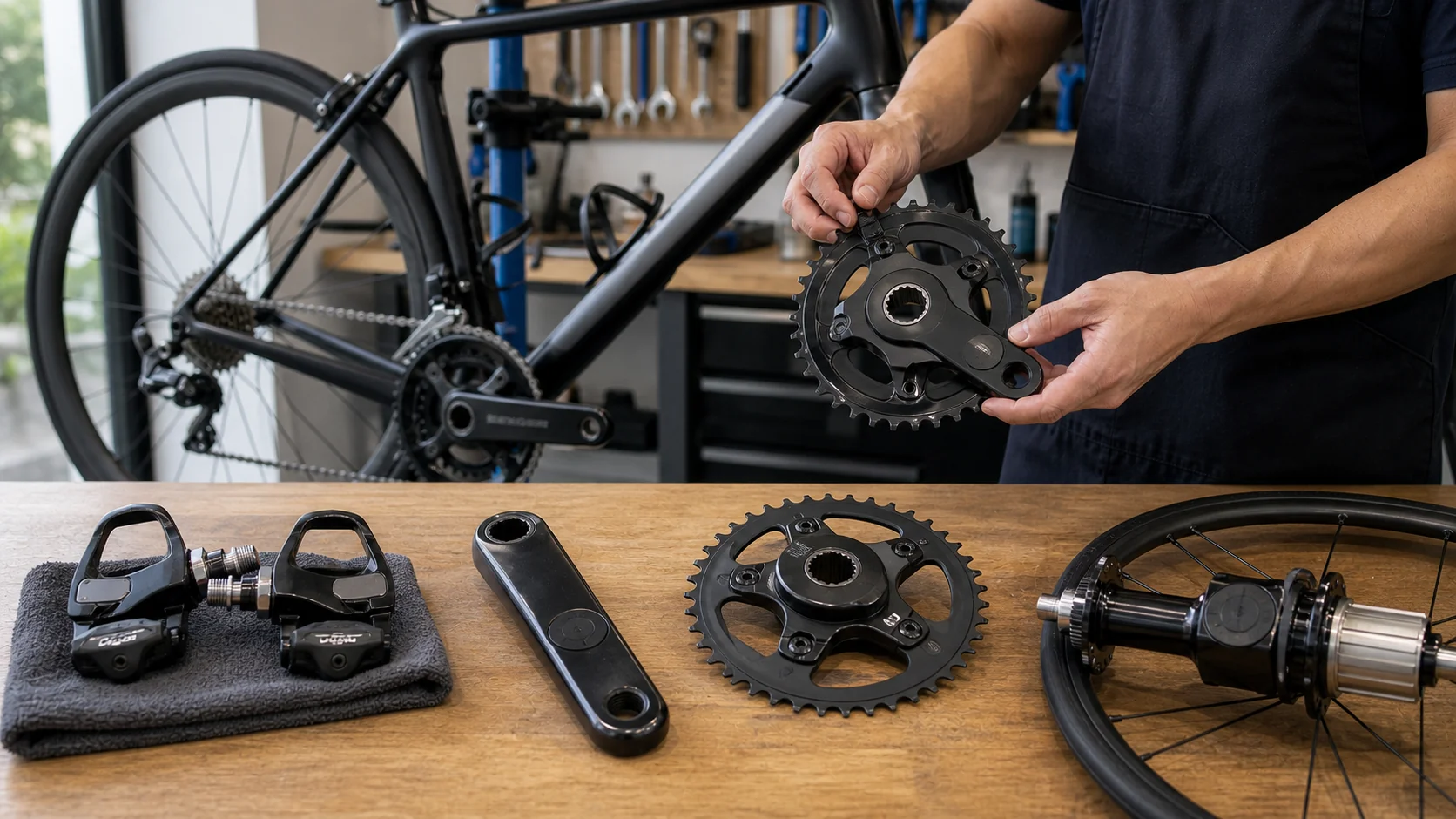
Power meters have become an essential tool for road cyclists training seriously. However, there is a wide variety of power meters on the market, from pedals, crank arms, and cranksets to hubs, each with different measurement principles and suitable use cases. This article will provide an in-depth analysis of the technical differences between each type from a component-level perspective.
Basic Principles of Power Measurement
At the core of every power meter is a Strain Gauge, which measures the tiny deformation of a material to calculate the applied force, and then combines it with angular velocity to derive the power value:
Power (W) = Torque (Nm) × Angular Velocity (rad/s)
The difference between various types of power meters lies in where the strain gauge is installed, which directly affects measurement accuracy, reliability, and user experience.
1. Pedal-Based Power Meters
Representative Products: Favero Assioma, Garmin Rally, Wahoo Speedplay Powrlink
Measurement Location and Principle
The strain gauge is installed inside the pedal spindle, measuring the bending moment and torque the spindle experiences during pedaling.
Technical Specification Comparison
| Product | Accuracy | Battery | Weight (Dual-Sided) | Cleat System | MSRP |
|---|---|---|---|---|---|
| Favero Assioma DUO | ±1% | Built-in rechargeable | Approx. 300g | Look Keo | NT$28,000 |
| Favero Assioma DUO-Shi | ±1% | Built-in rechargeable | Approx. 310g | Shimano SPD-SL | NT$32,000 |
| Garmin Rally RK200 | ±1% | Replaceable CR1/3N | Approx. 320g | Look Keo | NT$32,000 |
| Garmin Rally RS200 | ±1% | Replaceable CR1/3N | Approx. 336g | Shimano SPD-SL | NT$32,000 |
Advantages
- Easiest installation: Just swap the pedals; works on any bike
- Transferable between bikes: Moving between multiple bikes takes only minutes
- Dual-sided measurement is common: Most products offer independent left/right measurement
Disadvantages
- Limited pedal choice: Must use a specific brand’s cleat system
- Q-Factor impact: Some products increase the Q-Factor (distance between feet)
- Ground clearance: Pedal body size may affect lean angle when cornering
2. Crank Arm-Based Power Meters
Representative Products: Stages, 4iiii Precision, Shimano factory power crank arms
Measurement Location and Principle
The strain gauge is bonded directly to the inner or outer surface of the crank arm, measuring the tiny bending deformation of the crank arm during pedaling.
Technical Specification Comparison
| Product | Accuracy | Measurement Method | Added Weight | MSRP |
|---|---|---|---|---|
| Stages L (Single-Sided) | ±1.5% | Left leg | +15g | NT$10,000 |
| Stages LR (Dual-Sided) | ±1.5% | Left/Right independent | +30g | NT$35,000 |
| 4iiii Precision (Single-Sided) | ±1% | Left leg | +9g | NT$10,000 |
| Shimano FC-R9200-P | ±1.5% | Left/Right independent | Factory integrated | NT$45,000 |
Advantages
- Lightest weight: Only adds 9-15g for single-sided
- No impact on pedal choice: Can be used with any pedal
- Affordable single-sided options: Lowest entry barrier
Disadvantages
- Single-sided measurement assumption: Assumes left/right leg power output is symmetrical (calculated as x2), but in reality most people have asymmetry ranging from 48/52 to 45/55
- Crank compatibility: Not all cranks have corresponding products
- Temperature compensation: Crank arms are exposed, and larger temperature fluctuations require frequent calibration
3. Spider-Based Power Meters
Representative Products: Quarq DZero, SRAM AXS Power Meter, Power2Max NG
Measurement Location and Principle
The strain gauge is installed on the spider of the crankset, measuring the torque transmitted between the chainrings and the crank spindle. This is the measurement location closest to “total power output.”
Technical Specification Comparison
| Product | Accuracy | Compatible Systems | Weight | MSRP |
|---|---|---|---|---|
| Quarq DZero | ±1.5% | Multiple cranks | +60g | NT$28,000 |
| SRAM AXS PM Spider | ±1.5% | SRAM AXS only | Integrated | Bundled |
| Power2Max NG Eco | ±2% | Shimano/SRAM | +55g | NT$15,000 |
| Power2Max NG | ±1% | Multiple specifications | +55g | NT$25,000 |
Advantages
- Ideal measurement location: Closest to actual output, least affected by external forces
- No impact on pedals or cranks: Free choice of pedal system
- Excellent stability: Located inside the frame, less affected by temperature changes
Disadvantages
- Cannot distinguish left/right: Measures total torque, cannot display left/right power independently
- Complex installation: Requires disassembling the crankset, sometimes requiring special tools
- Specification lock-in: Different BCD (chainring bolt circle diameter) corresponds to different products
4. Hub-Based Power Meters
Representative Products: PowerTap G3 (discontinued)
Measurement Location and Principle
The strain gauge is installed inside the rear hub driver body, measuring the actual torque transmitted to the rear wheel.
Advantages
- Most realistic power output: Measures the power actually transmitted to the rear wheel
- No impact on front-end components: Complete freedom in choosing pedals, cranks, and chainrings
Disadvantages
- Drivetrain losses: Chain and cassette friction losses of approximately 2-4% are not accounted for
- Wheel lock-in: Changing wheels means losing power measurement capability
- Declining market: Almost no new products are being released
Accuracy and Consistency Analysis
For training purposes, consistency is more important than absolute accuracy. Here is the performance ranking of each type:
- Spider-Based: Least environmental impact, best consistency
- Pedal-Based: Significant technological advances in recent years, approaching spider-based levels
- Crank Arm-Based (Dual-Sided): Independent dual-sided measurement compensates for accuracy shortcomings
- Crank Arm-Based (Single-Sided): Left/right asymmetry creates systematic errors
- Hub-Based: Good consistency, but drivetrain losses are a constant source of deviation
Purchasing Decision Tree
Limited budget (< NT$15,000): Single-sided crank arm-based (4iiii or Stages) offers the best value
Seeking accuracy and convenience (NT$25,000-35,000): Dual-sided pedal-based (Favero Assioma DUO) offers the best cost-performance ratio
SRAM system users: Go straight for the AXS Power Meter Spider for the best integration
Multi-bike sharing needs: Pedal-based is the only reasonable choice
Top-tier needs: Shimano factory power crank arms or pairing with a high-end spider-based unit
Conclusion
There is no absolute right or wrong when choosing a power meter; the key lies in your budget, existing component system, and use case. For most Taiwanese cyclists, dual-sided pedal-based power meters strike the best balance between accuracy, convenience, and price, making them the most recommended entry-level choice.
Further Reading
- Power Meter Buying Guide: Comprehensive Comparison of Pedal, Crank, and Hub Types
- Power Meter Buying Guide: Evaluation of Pedal, Crank, and Hub Options
- 2025 Ultimate Power Meter Buying Guide: How to Choose Between Pedal, Crank, and Hub Types?
- In-Depth Analysis of Cycling Power Meter Pedals: Garmin Rally vs Favero Assioma vs Wahoo Speedplay