Introduction
The starting beaches of Taiwan’s triathlons and open-water swimming races often see waves of 0.5–2 meters in summer and autumn. For swimmers used to pools, the power of the waves often exceeds expectations the first time they step into the surf zone. Some get knocked over, some fight the waves head-on and exhaust themselves, while others cross easily and reach deep water while their rivals are still struggling. The difference lies in technique, not brute force.
This article breaks down surf-zone crossing, backwash utilization, and return-to-shore techniques to help you perform at your best on Taiwan’s wavy courses.
Understanding the Three Zones of the Waves
| Zone | Location | Characteristics | Strategy |
|---|---|---|---|
| Surf Zone | Shore to the break point | Churning whitewater, strongest energy | Cross quickly, avoid lingering |
| Transition Zone | Break point to chest-deep water | Intact wave shapes, chaotic currents | Time your jump or dive through |
| Open Water | Beyond chest-deep water | Regular swell, more stable | Standard freestyle, ride the wave rhythm |
Heading Out: Crossing the Surf Zone
Running in Shallow Water (Knee Deep)
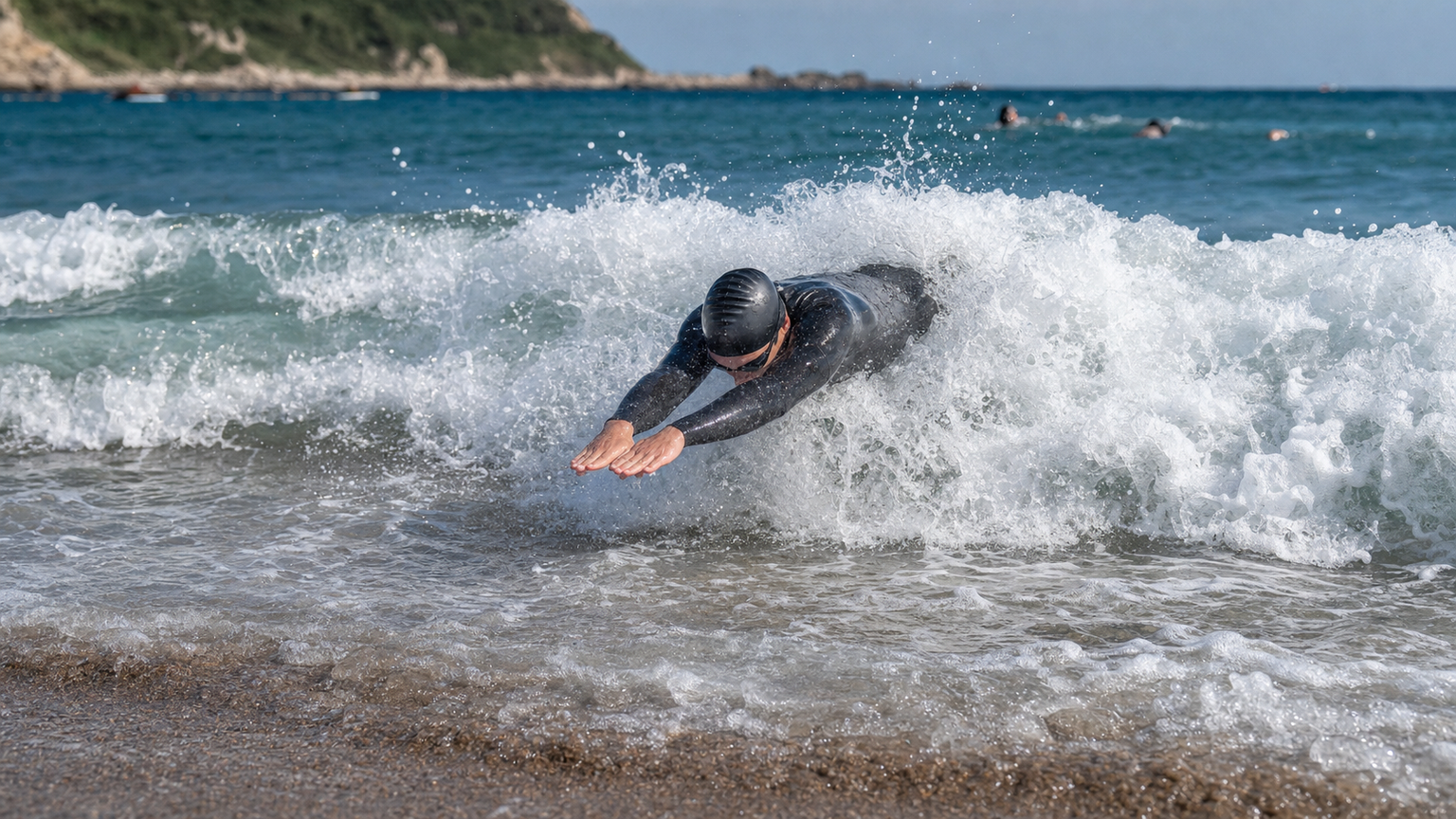
When the water is below knee depth, running is faster than swimming. The key is high-knee running—fast cadence rather than long strides—to reduce drag from your feet hitting the water. Lift your knees to hip height and lean forward in a sprint posture.
Dolphin Dive
When the water reaches between waist and chest depth, switch to dolphin dives:
- Read the wave and launch before the crest arrives
- Bring your hands together and spear into the water, following through as your body angles down toward the seabed
- Push off the bottom with your feet or kick to accelerate, passing beneath the wave
- Use buoyancy to rise naturally, lift your head to spot the next wave
- Repeat until the water is deeper than chest height
Key timing: Execute the dive at the “back” of the wave (the trough after it passes), which greatly reduces wave resistance.
Using the Backwash (Rip Current & Backwash)
Taiwan’s beaches often have localized backwash currents—seaward-flowing water created by reefs or sandbars. Before the race, observe the water surface. Signs of a backwash include:
- Slightly murkier surface with foam drifting seaward
- Smaller surf in that area (energy consumed by the backwash)
- Slightly darker water color (deeper channel)
Once you identify a backwash, starting in that channel can reduce outgoing resistance by 20–30%, a significant advantage in competitive racing.
Returning to Shore: Using the Waves for Speed
On the way back, you can ride the swell—a time-saving opportunity many swimmers overlook.
Timing the Wave
- When you feel your body being pushed forward (a swell arriving), increase your stroke rate to match the wave’s energy
- Adopt a “body surfing” position (arms extended forward) and let the wave carry you closer to shore
- Resume normal swimming immediately after the wave passes; don’t stop
Returning Through the Surf Zone
Once you enter the surf zone:
- Lift your head and keep watching for incoming swells behind you
- When you feel the push of a wave, flatten your body, extend your arms forward, and let the wave carry you
- When the water is waist-deep, stand up and run (don’t keep swimming)
- Move laterally to avoid being hit head-on by the next wave
Key Notes for Taiwan’s Locations
Kenting South Bay: Summer swells come mainly from the south, with mild conditions ideal for practicing basic crossing techniques. Watch for coral reef edges—check the bottom before dolphin diving.
Gongliao, Northeast Coast: Autumn and winter northeast monsoons bring stronger swell, with more regular but shorter-period waves. Use a “wait for the gap” strategy, advancing quickly through the lulls between wave sets.
Penghu: Summer conditions are relatively stable, but occasional counter-swells (caused by passing boats) require flexible responses.
Training Recommendations
- On-land practice: Simulate high-knee running and dolphin dive movements to build muscle memory
- Vertical kicking in the pool: Strengthen leg power to improve dolphin dive efficiency
- Low-wave sea training: Master techniques in conditions below 0.5 meters first, then progress to bigger waves
- Observation practice: Stand on the shore for 10 minutes before a race to study the wave patterns and find the best entry channel
Conclusion
Waves are not obstacles—they are forces you can harness. Mastering surf-zone crossing and backwash utilization not only saves energy but also builds a psychological edge in the critical starting phase. With Taiwan’s abundant coastal resources, practice swimming in waves and make the ocean your home turf.
Related Reading
- Open Water Wave Swimming Technique: Wave Rhythm Utilization and Energy Management
- Swimming in Waves: Techniques for Leveraging Wave Power and Coping Strategies
- Wave Swimming Skills: Dancing with the Waves Instead of Fighting Them
- Adapting to Waves and Currents in Sea Swimming: Technical Essentials for Taiwan’s Coasts
2023桃園團體繞圈賽 / 海鷗繞圈賽 | 全程空拍數據版 | 公路車 | CT Yeh
2 年前
一起升級!海鷗盃LSD團練...JJSC Zone2招待 騎到手抖 / 公路車 / CT Yeh
1 天前
西進武嶺 免費訓練分析服務 Intervals | 練不夠還是練過頭?你哪一種類型選手?AI模型告訴你! | 備戰神器 | 公路車 訓練 | CT Yeh
4 年前
備戰 戀戀197 賽前關門點分析 西濱團練 #公路車 4K高畫質
6 年前
2025 海鷗團體繞圈賽 網路直播 超激烈裁判長視角 / EIPC 李廷威、Waypoint 等眾多高手競爭 / feat. 卡密兒主持 / 海鷗繞圈賽
9 個月前
海豚島滑沙
11 年前
單車 梅山36灣 坡度介紹 路段介紹 空拍 (相關遊記影片,請參考說明或我的頻道喔,歡迎訂閱)
6 年前
2023桃園團體繞圈賽/環台賽等級拍攝/賽事精華/ 10人一隊缺一不可!50隊廝殺大場面 / 第三屆 海鷗繞圈賽 /公路車/CT Yeh
2 年前