Introduction
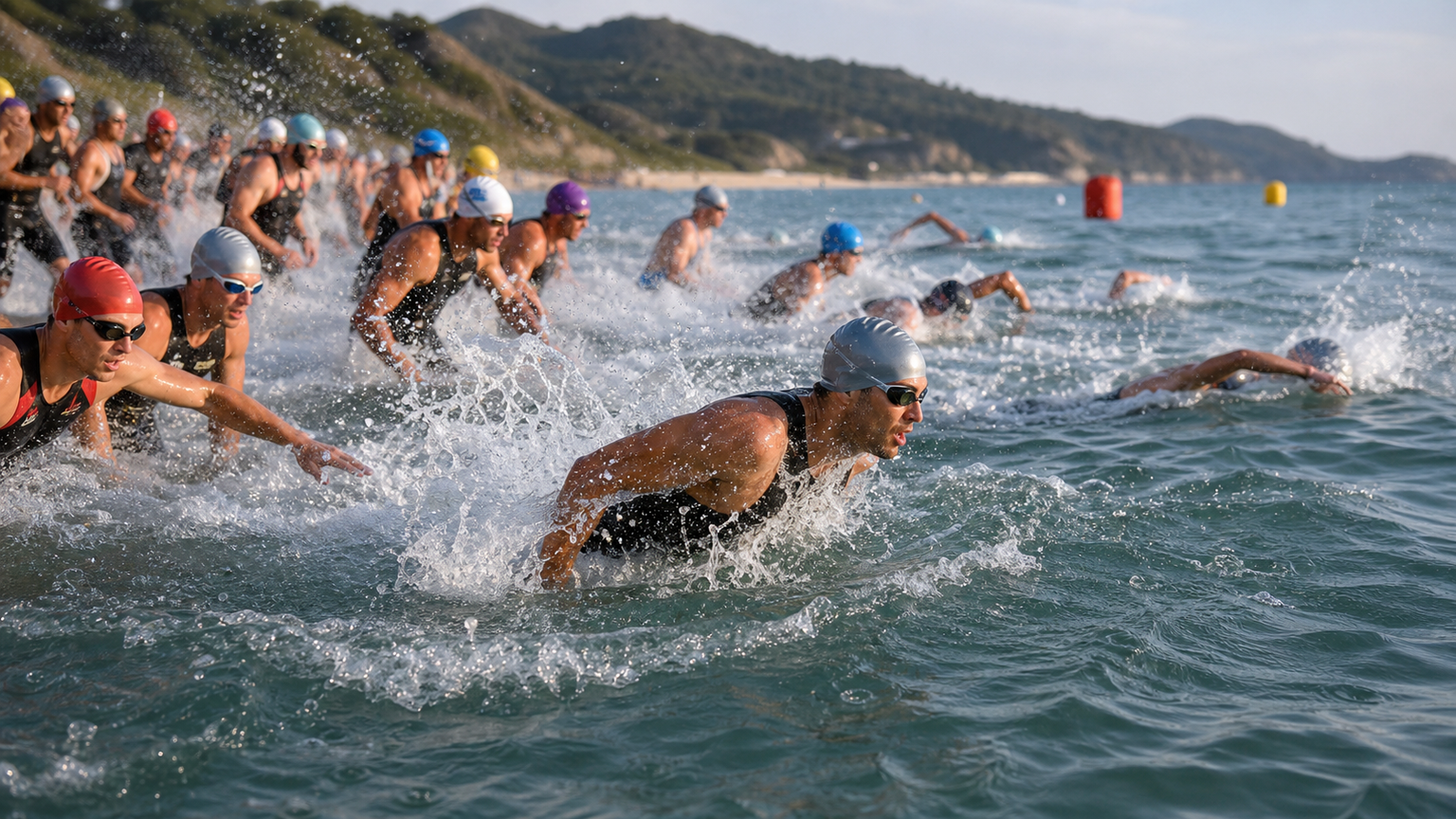
The start of an open-water race is often the most chaotic 2–3 minutes of the entire event. Dozens or even hundreds of athletes charge into the water at the same time, jostling, kicking, and fighting for the best line. For less experienced athletes, this period can be filled with panic; but for those with a strategy, it is a golden window to establish a favorable position and set the tone for the entire race.
This article provides a complete start-strategy framework, from pre-start positioning to establishing your pace after the first turn buoy.
Start Types and Response Strategies
| Start Type | Characteristics | Strategic Focus |
|---|---|---|
| Beach start (from shore) | Run into the water after the signal | Secure a front-row outside position; use dolphin dives to get through the surf quickly |
| Deep-water start (treading water) | Wait in chest-deep water | Confirm your position in advance; sprint immediately after the start |
| Dive start (from a pier) | Jump from an elevated platform | Choose a less crowded entry point |
| Rolling start (wave start) | Groups depart every 5–10 seconds | Calculate your pace to match the appropriate wave |
The Logic of Positioning
Your starting position is not about “the farther forward, the better.” Instead, it should be an optimal choice based on your own ability and goals.
The Advantage of the Front-Outside
For swimmers with above-average ability, the front-outside position (usually the right side; if the turn is to the left, choose the outside on the left) is ideal:
- The outside offers more open space and fewer collisions
- The arc distance is slightly longer, but it buys you clean water to swim in
- You can observe the movement of the entire pack and choose the right moment to cut in
The Trade-off of the Front-Middle
The front-middle offers the shortest route, but it comes with:
- Physical contact from all directions
- The highest chance of getting kicked in the legs or hit in the head
- Even if your swim speed isn’t enough, athletes behind you will “swim right over” you
Best suited for: Swimmers in the top 10% of the field, with strong mental toughness and no fear of contact.
The Conservative Strategy of the Back
For first-timers or weaker swimmers, starting at the back means falling behind early, but:
- There is almost no contact, allowing you to swim at your own pace
- You don’t waste energy in the chaos
- You have a chance to overtake overly nervous front-row swimmers in the middle segment
Handling Contact: Mental and Technical
Contact is almost unavoidable at the open-water start, and the right mindset is key.
When you get kicked:
- Don’t stop to check the injury (unless it’s serious)
- Briefly rotate your body to dodge, and keep your stroke going
- Maintain your breathing rhythm; don’t hyperventilate from the shock
When someone crowds your space:
- Don’t fight them head-on and waste both of your energy
- Shift one body width to the side and find clean water to keep swimming
- Remember: fewer collisions = more energy saved = a better result
When disrupted by someone’s wake:
- In a large pack, swimmers ahead create “drafting waves”; try swimming slightly behind and to the side of them (drafting effect)
- If disrupted by side waves, temporarily adjust your breathing rhythm to adapt
Establishing Pace: Pacing Control in the First 500 Meters
The adrenaline of the start often makes you swim far faster than your usual pace, only to crash hard at the 400–600-meter mark. Here are the key principles for establishing your pace:
- First 100 meters: Allow a slightly higher pace than your target (natural during the excitement phase), but don’t go all-out
- 100–300 meters: Actively slow down to your target pace and feel your breathing rate stabilize
- 300–500 meters: Confirm you’ve reached the “aerobic zone” (the feeling that you could easily hold a conversation), and lock in your rhythm
- After the first turn buoy: Reassess your position and energy levels, then decide whether to accelerate or maintain
Application to Taiwan Race Scenes
Taitung Donghe 226 Ironman: The water is open with moderate waves, making it suitable for starting on the right to take advantage of the clean water.
Penghu Fireworks Festival Triathlon: A pier start; immediately after entering the water you face a cross-current, so you need to first adjust your angle upstream.
Fulong Beach: A beach start, with about 30 meters from the start to the surf zone; your running rhythm after the start is critical.
Pre-Race Preparation Checklist
- The day before the race, confirm the color and number of turn buoys
- 30 minutes before the start, get in the water to warm up and feel the water temperature and wave conditions
- At the start line, confirm the direction of your sighting target (a landmark on shore)
- Confirm your goggles are properly anti-fogged and fit snugly without leaking
- Mental rehearsal: “There will be contact. That’s normal. I keep my rhythm.”
Conclusion
The open-water start is a dual test of technique and mentality. Strategically choosing your starting position, calmly handling contact, and establishing a steady pace in the first 500 meters—if you do these three things well, you’ll already be ahead of most of the field.
Related Reading
- Open-Water Start Chaos Strategy: How to Find Your Rhythm in the Crowd
- Open-Water Swim Start Strategy: Positioning and Pacing in a Mass Start
- Open-Water Triathlon Swim Start Strategy: Crowd Conflict Management and Sighting Techniques
- Open-Water Start and the Washing-Machine Zone Survival Guide: Tactics from the Shore Sprint to Escaping the Melee
戰略) Zwift Race 如何咬在第一集團 如何評估自己要開多少推力 (請開1.5倍速看)
7 年前
2025 海鷗團體繞圈賽 網路直播 超激烈裁判長視角 / EIPC 李廷威、Waypoint 等眾多高手競爭 / feat. 卡密兒主持 / 海鷗繞圈賽
9 個月前
CT 喇低賽) 武嶺牽車 才是王道 西進牽車四小時內秘訣 攝手位置 如何判斷 防抽筋小秘訣
7 年前
2023桃園團體繞圈賽 / 海鷗繞圈賽 | 全程空拍數據版 | 公路車 | CT Yeh
2 年前
一日北高/長距離團騎 常見問題補充篇 / 組團或跟團的眉角 / 壯車友容易被瘦車友慢性拉爆 / 原來屁股痛可能是這個原因...? / 風場配速法 / 公路車 / CT Yeh
2 年前
西進武嶺 免費訓練分析服務 Intervals | 練不夠還是練過頭?你哪一種類型選手?AI模型告訴你! | 備戰神器 | 公路車 訓練 | CT Yeh
4 年前
新屋團體繞圈賽 | 眾多菁英好手賽道奔馳 | 千瓦女子軍團 | 無敵交管狂獲好評 明年你一定不能錯過 | #公路車
5 年前
Live) 備戰2019彰化經典百K 賽前攻略 (已完賽請看新影片
7 年前