Introduction
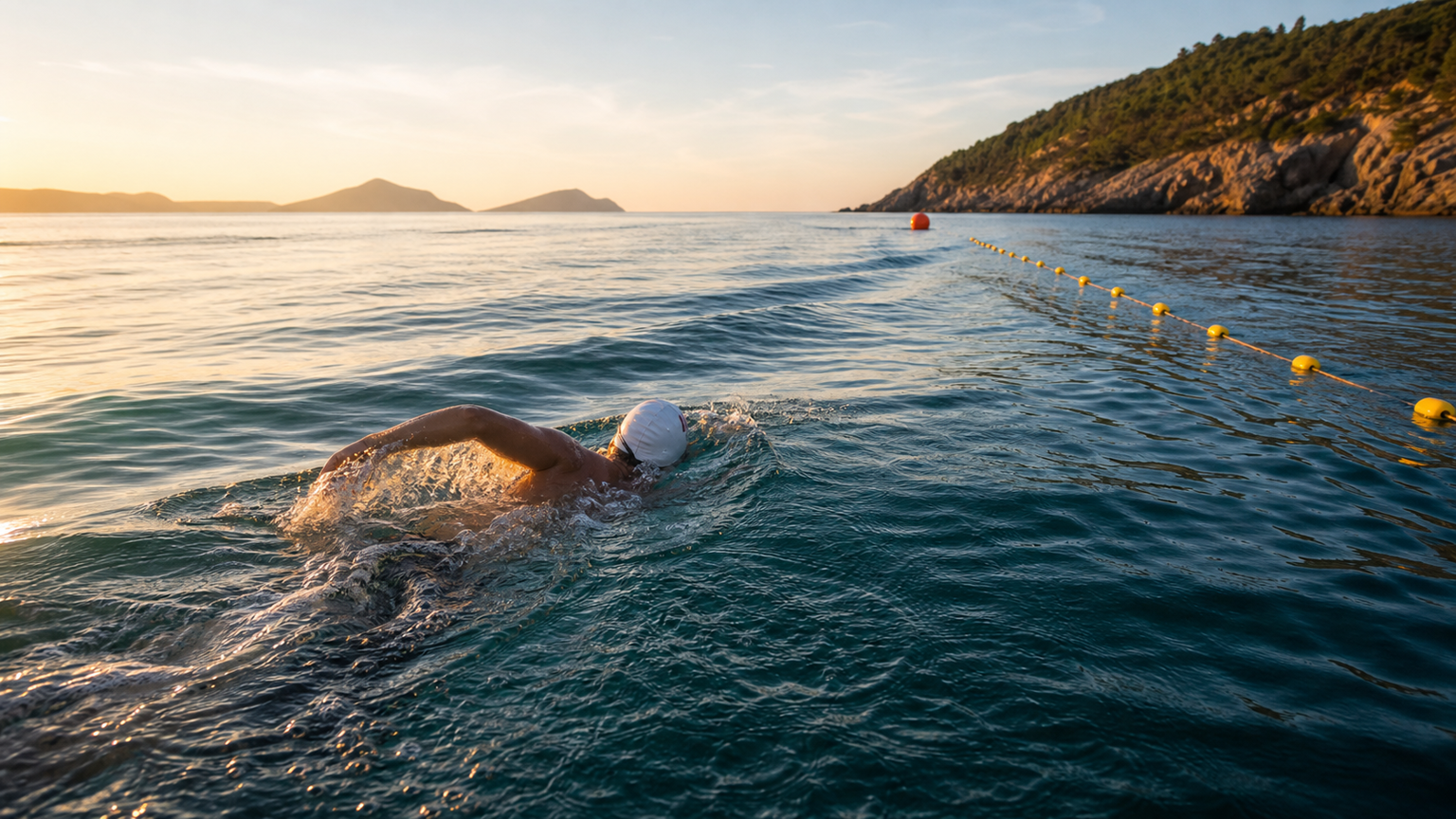
Water flows—a phrase with profound meaning for swimmers. In a still pool, technique and fitness are the only variables; but in Taiwan’s open waters—from the Kuroshio-influenced eastern seas to the Penghu Channel with its significant tidal range—currents can make you 30% faster or slower with the same effort.
Understanding tides and currents, and using them in race strategy, is one of the most underrated aspects of advanced open-water swimming technique.
Major Current Characteristics in Taiwan
| Region | Major Current | Characteristics | Impact Level |
|---|---|---|---|
| Eastern waters (Taitung, Hualien) | Kuroshio main stream | Flows northward, speed up to 1–3 knots | High (strong directional) |
| Penghu Channel | Taiwan Strait tidal current | Bidirectional with tides, speed 0.5–2 knots | Medium-High |
| Southern tip of Kenting | Taiwan Strait southern inlet flow | Northerly in summer, southerly in winter | Medium |
| Northeast coast | Coastal current | Follows monsoon direction, lower speed | Low-Medium |
Basic Concepts of Water Flow
Tidal Current vs. Ocean Current
Tidal Current is the rise and fall of seawater caused by the moon’s gravitational pull. Its direction and speed are predictable and can be forecast via tide tables. Due to the narrow topography of the Taiwan Strait, tidal effects are significant, especially in the Penghu Channel.
Ocean Current is a large-scale, sustained water flow, such as the Kuroshio that affects eastern Taiwan. Its direction is largely fixed, but speed varies seasonally.
Local Current is caused by topography, wind, and wave conditions. It is harder to predict and requires on-site observation.
How to Sense Water Flow
Before the race, you can read the current through the following methods:
- Observe floating objects: The tilt direction of buoy ropes directly indicates flow direction
- Drift test upon entry: After entering the water, stop swimming and feel which direction your body is being pushed
- Ask local lifeguards: The most direct and accurate source of information
- Check tide apps (such as Tide Chart, Taiwan Tide Forecast website): Know the tide times a week before the race
- Observe surface patterns: Areas with faster flow show subtle ripple direction on the surface
Strategies for Using Currents
Downstream Sections: Accelerate and Save Energy
When the current direction aligns with your swimming direction:
- Lower your stroke rate and let the current add propulsion—maintain the same speed while expending less energy
- You can appropriately speed up, using the downstream flow to overtake opponents
- Sighting frequency can be reduced (less course deviation)
Upstream Sections: Hug the Shore
When you must face a head current:
- Move toward shallower water or the shore: Nearshore currents are usually weaker (due to bottom friction deceleration)
- Lower your body position: Maintain a more horizontal posture in the water to reduce the cross-section being pushed off course
- Short, quick strokes: Increase stroke rate rather than power per stroke to maintain rhythm
Cross-Current Sections: Anticipate the Drift Angle
The most technically challenging situation is cross-current (side current). Swimming directly toward a target in a side current will push your actual path off course.
Solution: Upstream Correction Method
- Estimate current speed (a brisk walking pace is roughly 0.5 knots)
- Offset your target direction upstream by 10–20 degrees
- As you approach the target, feel the current straightening you out, arriving naturally at your goal
This follows the same correction principle as rowing and flying, requiring repeated practice to develop intuition.
Current Considerations in Course Planning
Some race courses are designed with currents in mind (e.g., having swimmers swim with the current on certain legs), but sometimes athletes can choose their route within the rules:
- Direction around buoys: In noticeable side currents, rounding the buoy from the upstream side reduces the distance you get pushed away
- Turnaround sections: At turning points where the flow direction changes, correct your angle in advance
- Final sprint section: If there’s a downstream current, this is the time to accelerate and attack
Key Taiwan Scenarios
Penghu Fireworks Festival Triathlon: The race usually falls around the lunar calendar period when tidal range is large. Be sure to check the day’s high and low tide times beforehand, and understand whether the swim leg falls during flood or ebb tide—the directional speed difference can exceed 1 knot.
Northeast Coast: In summer, prevailing southwest winds create a northward drift along the coast; in winter, the northeast monsoon produces a southward flow. Adjust your starting direction correction according to the season.
Training Recommendations
- Before each open-water training session, record and feel the day’s current direction and strength
- Practice “stationary drifting”: after entering the water, close your eyes and relax for 30 seconds, then record drift distance and direction
- Build your own race-site current notes, accumulating flow data from various waters
Conclusion
Water flow is the fairest and most unfair variable in open-water swimming. Prepared athletes turn it into an advantage; unprepared athletes are quietly dragged down by it. In Taiwan’s rich and diverse marine environment, developing the habit of reading currents before a race is an important step in evolving from “finishing” to “competing.”
Related Reading
- Tides and Currents: How to Use Natural Forces to Improve Open-Water Swimming Efficiency
- Reading Open-Water Currents: Ride the Downstream, Survive the Upstream
- Reading Open-Water Currents: How to Use Sea or River Flow Direction to Save Effort
- Using Tides in Open Water: The Impact of Taiwan Strait Tides on Open-Water Crossings
備戰 戀戀197 賽前關門點分析 西濱團練 #公路車 4K高畫質
6 年前
2025 海鷗團體繞圈賽 網路直播 超激烈裁判長視角 / EIPC 李廷威、Waypoint 等眾多高手競爭 / feat. 卡密兒主持 / 海鷗繞圈賽
9 個月前
2023桃園團體繞圈賽 / 海鷗繞圈賽 | 全程空拍數據版 | 公路車 | CT Yeh
2 年前
一日北高前的西濱集訓 | 跟著11小時軍團 | 300W踩不動的大逆風 | 輪車破風差幾瓦?
6 年前
Live) 備戰2019彰化經典百K 賽前攻略 (已完賽請看新影片
7 年前
大武山後門26%歡樂陡坡!JJSC南台灣單車行Day2 / 被颱風追著跑 / 公路車 / CT Yeh
2 年前
西進武嶺 免費訓練分析服務 Intervals | 練不夠還是練過頭?你哪一種類型選手?AI模型告訴你! | 備戰神器 | 公路車 訓練 | CT Yeh
4 年前
虎豹潭!日本老師來台一日約騎 台灣車友熱情招待私房路線 / CT Yeh
20 天前