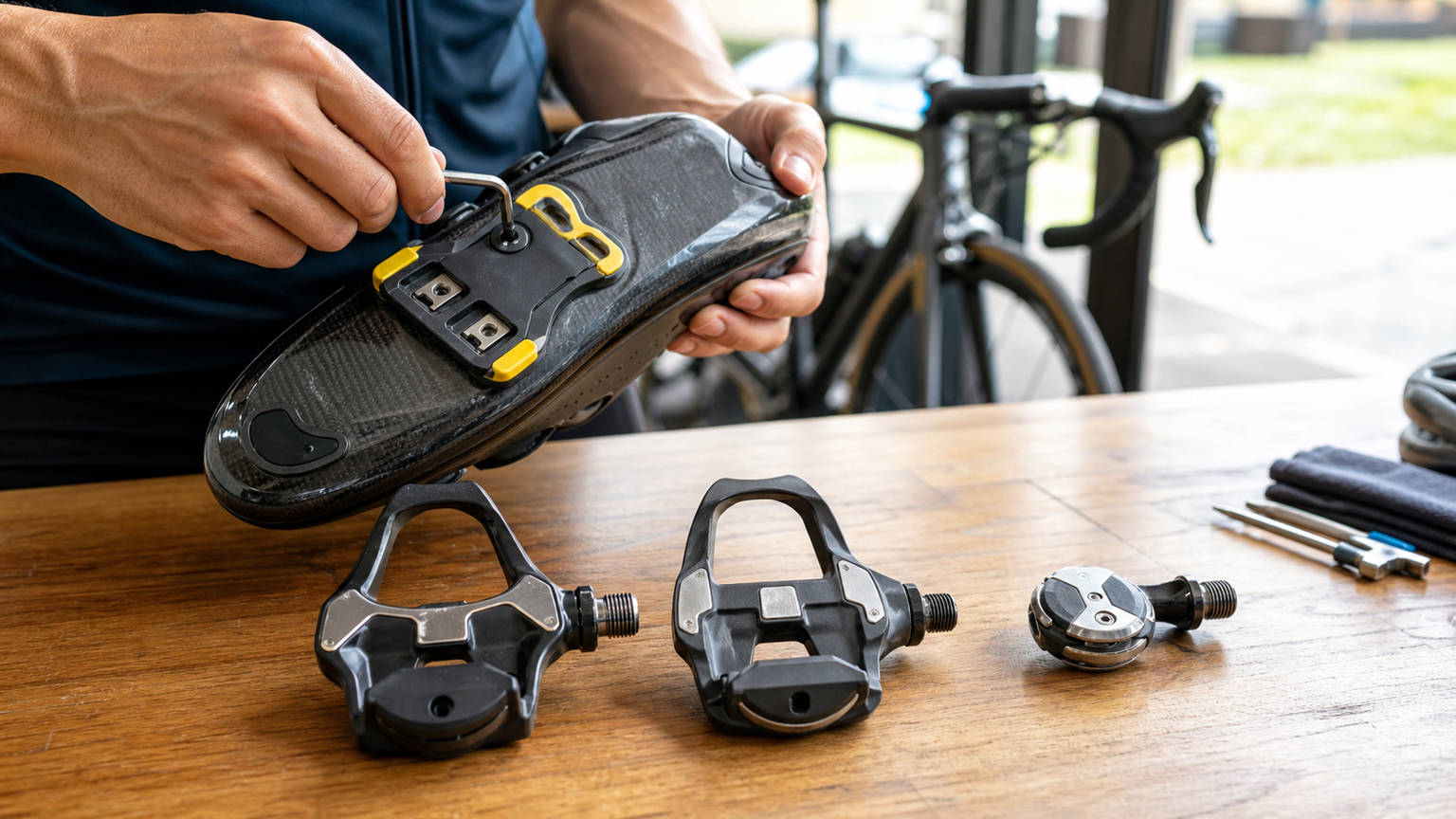
Introduction
Clipless shoe systems are one of the most intimidating hurdles for road bike beginners—what happens if you get stuck? Will your ankles get injured? Which system suits Taiwan’s roads best? These questions deter many interested riders. But in reality, once you get used to a clipless shoe system, the improvement in pedaling efficiency is very noticeable, especially on climbs and long-distance rides. The efficiency gained from pulling and pushing through the pedal stroke lets you go faster and farther with the same effort. This article walks you through the three major clipless shoe systems.
Basic Specifications of the Three Systems
| System | Pedal Surface Area | Float Angle | Release Tension | Target Users |
|---|---|---|---|---|
| Shimano SPD-SL | Large | 0°/2°/6° (three cleat options) | Adjustable | Most widespread, beginner-friendly |
| Look KEO | Large | 0°/4.5°/9° (three color cleats) | Adjustable | French elegance fans, riders with ankle issues |
| Speedplay Zero | Small | ±15° (largest range) | Adjustable | Riders with knee/ankle issues, high-cadence riders |
| Speedplay Nano | Extremely small | ±15° | Adjustable | Time trials, ultra-lightweight builds |
Shimano SPD-SL: The Most Popular Entry-Level Choice
SPD-SL is the highest market-share road pedal system globally and the easiest option to find parts for at bike shops in Taiwan:
Advantages
- Low entry barrier: The yellow standard cleat offers 6° of float, suitable for most people’s natural foot position
- Easy maintenance: Every bike shop in Taiwan stocks cleats and spare parts
- Affordable pricing: The entry-level R540 pedal costs around NT$1,200–1,500, the lowest among competitors
- Reliable release: Years of design refinement make the release action intuitive with a short learning curve
Disadvantages
- Large pedal surface, not ideal for rough mountain roads (prone to striking the ground)
- Three-hole cleat standard; cleat mounting angle cannot be adjusted (only fore-aft position can be changed via the shoe’s adjustment plate holes)
- Cleat wear over long-term use affects engagement precision and requires periodic replacement
Look KEO: French Craftsmanship in Pedaling Feel
Look is the inventor of the clipless pedal system (introducing the first road pedal in 1984), and the KEO series carries on that tradition of French precision:
Key Features
- Three-color float system: Red 0° (fixed), Gray 4.5°, Black 9° (maximum float)—intuitive selection
- Large pedal contact area: Slightly larger arch support surface than SPD-SL, offering greater comfort on long rides
- Generous float: The black cleat’s 9° float angle is especially suited for riders with knee issues or duck-footed ankles
- Craftsmanship: The carbon spring blade system in the KEO Blade series is highly regarded among competitive riders
Disadvantages
- Fewer service points for the Taiwan distributor, making parts less convenient to obtain
- Some pedal models are heavier
- Cleat installation requires more precise alignment
Speedplay: Maximum Freedom, Knee-Friendly Choice
Speedplay (now a Wahoo brand) is renowned for its “dual-sided entry” and “maximum float angle,” making it a popular choice among pro riders and those with physical discomfort:
Key Features
- Dual-sided entry: Both sides of the pedal accept engagement, very convenient for riders who like to clip in quickly
- ±15° ultra-wide float: The largest float angle in the industry, allowing natural knee tracking—ideal for riders with knee issues
- Adjustable fore-aft position: Cleats can be finely adjusted fore-aft for precise fitting to address knee problems
- Ultra-lightweight: The Speedplay Nano pedal weighs only about 138g (including cleats), making it one of the lightest systems
Disadvantages
- Cleats use a four-hole design, requiring special shoe soles or adapters
- Regular lubrication is essential maintenance, otherwise the pivot feel degrades
- Steeper learning curve; initial pedaling habits need adjustment
- Fewer sales points in Taiwan, with limited after-sales service
Buying Recommendations for Taiwan Riders
- Beginners: Shimano SPD-SL (yellow cleat)—lowest entry barrier, easiest maintenance in Taiwan
- Riders with knee issues: Look KEO black cleat (9° float) or Speedplay Zero, seeking maximum float angle
- Long-distance riders (Wuling/round-island tours): Look KEO or SPD-SL with an appropriate float angle, prioritizing comfort
- Competition-oriented: Choose a system after Bike Fitting confirms your foot type, to avoid injury from incorrect pedaling angles
Practical Tips
- Choose your clipless system after Bike Fitting, confirming knee tracking direction before deciding on float angle needs
- Beginners should practice clipping in and out in an empty parking lot before heading onto the road
- Cleats need replacement every 2,000–5,000 km; worn cleats compromise release safety
- Taiwan has many steep descents—ensure your release tension is set appropriately; too tight may prevent timely unclipping in a fall
- Shoes for the three systems are mutually incompatible; switching systems requires new shoes as well
Conclusion
There is no absolute best answer when choosing a clipless system—body structure, riding goals, and after-sales service convenience are all important considerations. For most riders in Taiwan, Shimano SPD-SL’s ubiquity and maintenance convenience make it the safest first choice; if you have specific physical needs, the large float angles of Look KEO or Speedplay are worth considering. Remember: the ultimate purpose of clipless shoes is to make you ride more efficiently and comfortably—choosing the right system is the real upgrade.
Related Reading
- Cycling Shoe Buying Guide: Differences Between Clipless Systems (Look vs Shimano SPD-SL vs Speedplay)
- In-Depth Comparison of Road Pedal Systems: SPD-SL vs LOOK vs SPEEDPLAY
- Pedal Showdown: SPD-SL, Look Keo, Speedplay
- Complete Guide to Clipless Shoes and Pedal Systems: How to Choose Between SPD-SL, Look, and Speedplay
超開放的自行車錶!可以玩遊戲裝APP!?/ SRAM合併的 Hammerhead Karoo深入開箱!/ 即時爬坡偵測 / 全球導航地圖 / Garmin Bryton / CT Yeh
1 年前
2026 車錶排行榜!誰是最多車友正在使用?練家子最愛哪款?🏆 (2萬名車友數據) / 公路車 / CT Yeh
5 個月前
訓練台體驗) 2019台北自行車展 三大家 訓練台體驗 Tacx Neo Flux 2 Xepdo Apx Wahoo Kickr
7 年前
Nepest NOVA 碳條輪組:輕量、空力、舒適一次滿足!/ 公路車 / CT Yeh
7 個月前
#公路車 #Fitting 靠人工智慧APP 幫你調整單車
6 年前
來都來了!改好改滿 / CS大導輪 + BB 可以省幾瓦? / 同場加映 TIME XPRO卡踏 / #公路車 #ceramicspeed / CT Yeh
1 年前
SRAM FORCE E1 首發!/ 改成短腿了 / 煞車升級有感嗎? / TIME ADH 變速大升級 / 公路車 / CT Yeh
1 年前
碟煞公路車 銑面器 !? 原來銑完差這麼多! 降低蹭碟機率! | TIME 公路車 保養小記錄 | CT Yeh
3 年前