Introduction
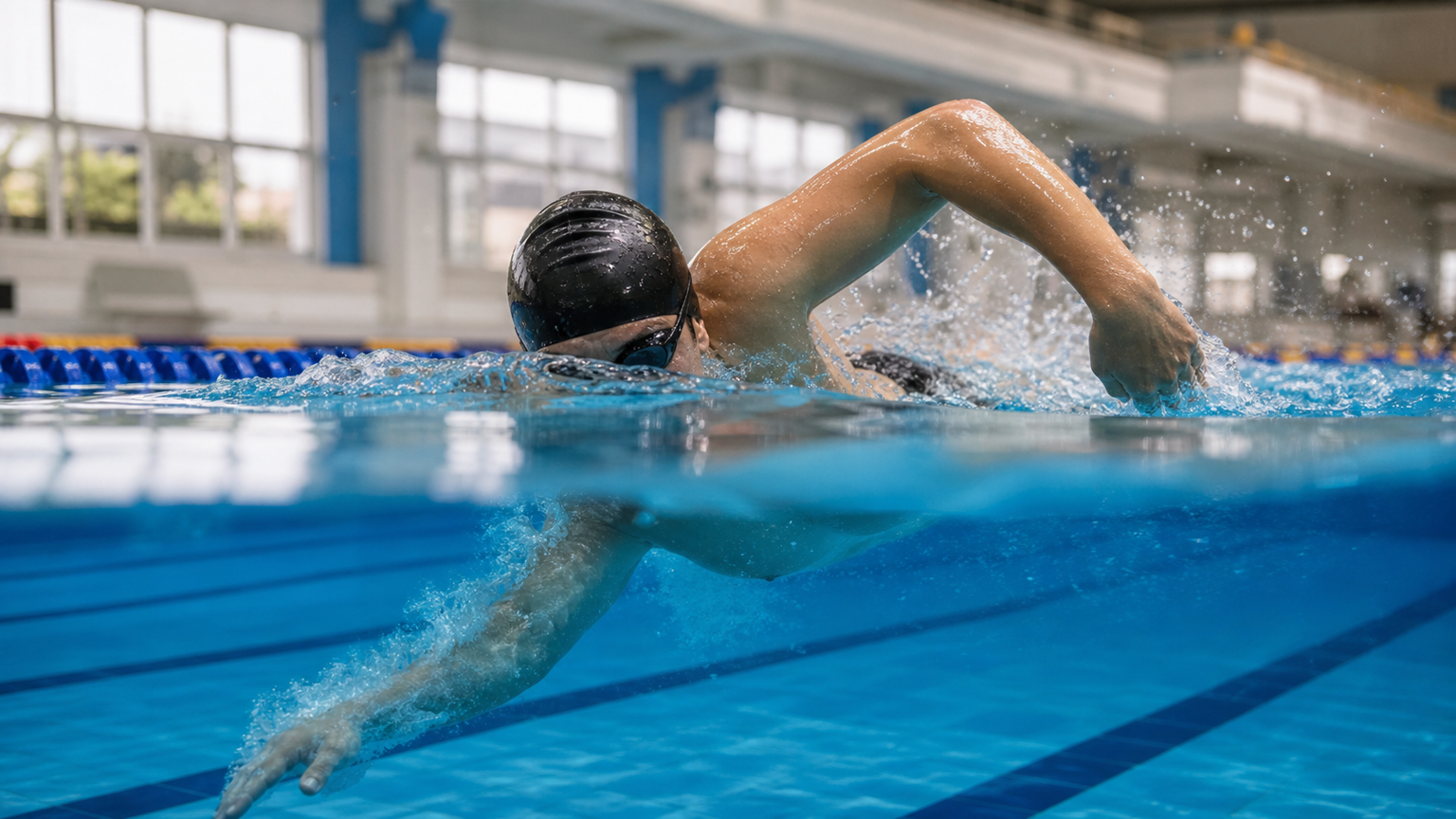
At university swim team training sessions across Taiwan, one of the most frequently corrected movements is “dropping the elbow”—where the elbow sinks in the water, preventing the entire arm from generating effective propulsion. The High Elbow Catch has been recognized over the past decade as a core technique in competitive swimming. Combined with a reinterpretation of the S-shaped pull path, it can significantly enhance propulsion efficiency with every stroke. This article breaks down the three key phases of the freestyle stroke from a biomechanical perspective.
The Biomechanics of High Elbow Entry
The so-called “high elbow” refers to maintaining the elbow in a position higher than the hand during the Catch phase, allowing the forearm to act as a vertical “paddle surface” that maximizes the area applying force against the water. According to fluid dynamics research, the combined paddle surface area of the forearm and hand is 2.5 times that of the hand alone, making the difference in propulsion efficiency quite significant.
Detailed Breakdown of the Three Stroke Phases
| Phase | Key Points | Common Mistakes | Correction Direction |
|---|---|---|---|
| Entry | Lead with the middle finger, arm extends naturally to the front of the shoulder line | Crossing the midline on entry causes a snaking body roll | Imagine inserting the hand into the water directly in front of the shoulder |
| Catch | Bend the elbow 90–120°, forearm vertical and facing backward | Elbow drops (dropped elbow) | Feel the resistance of the hand “grabbing” the water before pushing |
| Pull/Push | Push from the waist to the outside of the thigh | Exiting the water too early, incomplete pull | Rotate the thumb outward to exit only after the hand passes the thigh |
The Modern Interpretation of the S-Shaped Pull
In the 1970s, Counsilman proposed the famous S-shaped pull theory, suggesting that the hand should trace an S-shaped path through the water, using lift for propulsion. However, research after the 2000s (Maglischo et al.) pointed out that overemphasizing the S-shape results in inconsistent thrust direction. Modern recommendations include:
- Slight inward sweep: Sweep slightly inward from the entry point toward the body’s midline, with a range not exceeding 15 cm
- Straight-line pull: After the catch is complete, push backward in a nearly straight line, emphasizing “pressing backward” over “drawing an arc”
- Acceleration at exit: The momentary acceleration at the end of the pull (near the thigh) is the key to generating primary propulsion
Practical Training Methods for Taiwan’s Pools
Recommended Training Combinations
- Single-arm stroke: Hold a pull buoy between the legs, swim using only one arm for 4×50m, focusing on feeling the high elbow catch
- “Wall push” catch drill: Stand at the pool edge, push against the wall with one hand, simulate the high elbow bent-arm angle, and feel where the muscles activate
- Paddle training: Use paddles to amplify the feel of the water, so incorrect hand positions immediately produce resistance feedback
- Underwater video comparison: Have a teammate film from the side of the pool with a waterproof camera, analyzing elbow position frame by frame
Common Training Error Warnings
- Overly deliberate S-shaped movement slows down stroke tempo and is detrimental to short-distance sprinting
- In the early stages of high elbow training, the anterior deltoid and rotator cuff muscles fatigue easily, so dry-land strength training should be incorporated
- Taiwanese swimmers often develop muscle memory from being taught the S-shape from a young age; when correcting, it is recommended to establish the new movement pattern at slow speeds first
Practical Recommendations
It is recommended to schedule 2 dedicated technique sessions per week, with 800–1000 meters of pure technical volume each session, not chasing speed but focusing on movement quality. Combined with monthly underwater video analysis, this can effectively track your progress curve. Swimming training centers in various Taiwanese cities (such as Taipei Municipal Swimming Pool and the National Sports Training Center in Taichung) already have underwater camera equipment available for application.
Conclusion
The high elbow catch is not an isolated skill but the starting point of the entire freestyle kinetic chain. When catch efficiency improves, distance per stroke (DPS) increases, and speed naturally rises at the same stroke rate. Mastering this core technique is the first step toward breaking through in swimming speed.
Related Reading
- The “High Elbow Entry” Technique in Freestyle Stroke: The Impact of Elbow Angle on Pull Efficiency
- Freestyle High Elbow Catch: The Core Key to Water Feel Technique
- Freestyle High Elbow Catch: The Most Important Stroke Technique
- A Complete Breakdown of the Freestyle High Elbow Catch: The Mechanical Secrets from Entry to Pull
CT 喇低賽) 武嶺牽車 才是王道 西進牽車四小時內秘訣 攝手位置 如何判斷 防抽筋小秘訣
7 年前
抖肩舞 台灣x日本交流版 (台灣 vs 前橋) 赤城山登山賽 coincidance
8 年前
一起升級!海鷗盃LSD團練...JJSC Zone2招待 騎到手抖 / 公路車 / CT Yeh
2 天前
西進武嶺 免費訓練分析服務 Intervals | 練不夠還是練過頭?你哪一種類型選手?AI模型告訴你! | 備戰神器 | 公路車 訓練 | CT Yeh
4 年前
#公路車 #西進武嶺 配速配瓦實驗 坡度分析 四小時內攻略 建大盃 NeverStop #西進武嶺攻略
6 年前
西進武嶺 自製新版AI配速表產生器 x 賽前攻略 抱佛腳! 沒有功率計也可以產生配速表嗎?有什麼其他眉角賽前要注意的呢? | 西進武嶺 / 東進武嶺 KOM 攻略 | 公路車 | CT Yeh
4 年前
JJSC一槍北港 百K團實錄!跟團技巧分享 ft. Roden / 中部練車新選擇 / 開箱全台最便宜早餐店!/ 公路車 / CT Yeh
1 年前
超激烈!2025 南庄仙山KOM 賽事精華 / 男菁英A x 女菁英A / 公路車 / CT Yeh
9 個月前