Introduction
Every road racing season in Taiwan, from the Taipei Marathon to the Tanaka Marathon, many runners experience a sharp, knife-like burning pain on the outside of the knee after races or during intensive training periods. In about nine out of ten cases, this pain comes from Iliotibial Band Syndrome (ITBS), a common sports injury with an incidence rate as high as 12% among long-distance runners.
What is the Iliotibial Band?
The iliotibial (IT) band is a thick, ligament-like band of connective tissue that extends from the pelvis to the lateral side of the tibia, responsible for stabilizing lateral movements of the knee joint. While running, the knee joint repeatedly flexes and extends with each stride, causing the IT band to rub back and forth over the lateral femoral condyle. This accumulates micro-inflammation and eventually leads to pain.
Analysis of Common Causes
- Rapid increase in mileage: Weekly increases exceeding 10% mean the IT band cannot adapt to the load
- Excessive downhill running: On Taiwan’s mountain trails like Yangming Mountain and Shitou Mountain, the knee flexion angle increases during descents, aggravating friction
- Weak gluteus medius: Insufficient hip strength causes lateral sway in gait, leading to compensatory tightness in the IT band
- Worn shoe soles: Severe wear on the outside of running shoes causes excessive pronation or supination of the foot
- Leg alignment factors: Individuals with bow legs (genu varum) are anatomically more prone to IT band compression
Common High-Risk Groups
| Group | Primary Risk Factors | Recommended Focus |
|---|---|---|
| Trail running beginners | Downhill impact, unstable terrain | Control downhill speed, strengthen glutes and legs |
| Runners in marathon preparation | Weekly long runs >30km | Strictly adhere to the 10% incremental increase principle |
| Female runners | Wider pelvis, larger Q angle | Strengthen gluteus medius training |
| Sedentary office workers | Chronically tight hip flexors and IT band | Daily stretching, reminders to avoid prolonged sitting |
Self-Assessment and Diagnosis
The Noble Compression Test is a simple method to identify ITBS at home: lie on your back with the knee bent at 90 degrees, press your thumb about 2 cm above the lateral femoral condyle. If this produces sharp pain or pain similar to what you experience while running, ITBS is highly suspected.
It is worth noting that ITBS pain typically appears about 15–20 minutes after starting a run, subsides with rest, and returns when running again—this “time bomb” characteristic is a classic symptom of ITBS.
Phased Rehabilitation Plan
Phase 1: Acute Phase (Weeks 1–2)
- R.I.C.E. treatment: Ice, elevate the affected limb, 15 minutes per session, 3–4 times daily
- Suspend running: Switch to swimming or water running to maintain aerobic fitness
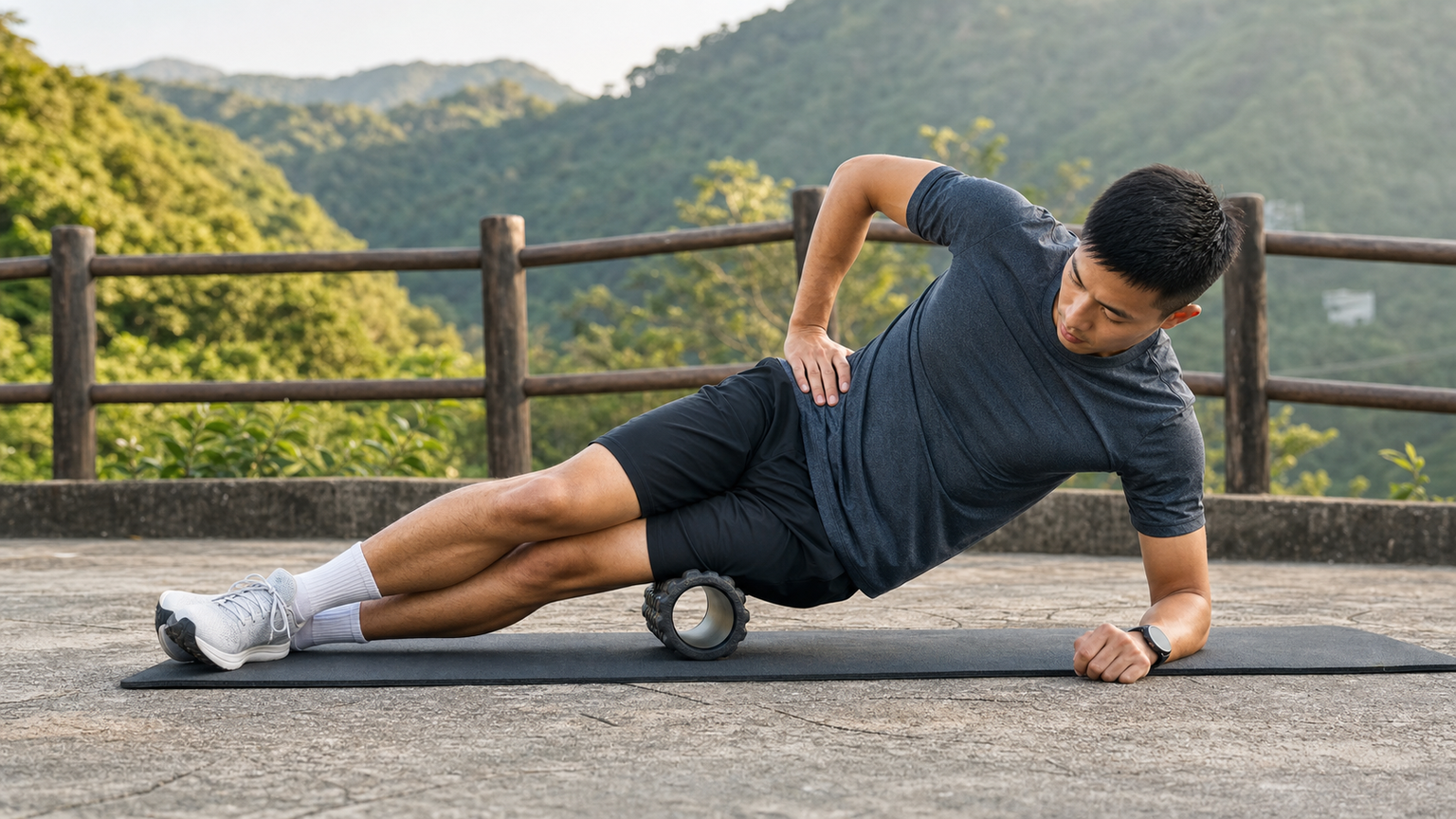
- Fascial release: Use a foam roller to slowly roll along the outside of the thigh, 2–3 minutes per session
- Anti-inflammatory medication: Use NSAIDs under a doctor’s guidance if necessary, for no more than 7 days
Phase 2: Strengthening Phase (Weeks 3–6)
The focus of this phase is to identify and correct the underlying weaknesses causing ITBS:
- Gluteus medius strengthening: Side-lying clamshells, lateral band walks, single-leg bridges, 15 reps per set, 3 sets
- Gluteus maximus training: Squats, Romanian single-leg deadlifts
- IT band stretching: Standing cross-leg stretch, hold for 30 seconds each time, 3 times daily
- Low-impact cardio: Indoor cycling (pay attention to seat height, avoid full knee extension)
Phase 3: Return-to-Training Phase (From Week 7)
- Start with walking + run-walk intervals, no more than 20 minutes per session
- Only continue if pain remains at 0–2 (on a 10-point scale)
- Increase weekly mileage by no more than 10%
- Avoid downhill running until completely symptom-free for at least 2 weeks
Practical Prevention Strategies
- Shoe replacement cycle: Taiwan’s hot, humid summers cause midsole compression to accelerate; it is recommended to replace running shoes every 500–600 km
- Don’t skip warm-ups: 5 minutes of dynamic warm-up before running (leg swings, lateral lunges) is far more effective than static stretching
- Diversify training: Add 1–2 sessions of cycling or swimming per week to reduce cumulative load on the IT band
- Regular physical assessments: Perform a single-leg squat test monthly to observe whether the knee collapses inward (knee valgus)
- Running form: Avoid a crossover gait; keep the foot landing point directly beneath the center of gravity
Conclusion
Although ITBS is frustrating, as long as you identify the true cause and patiently follow the rehabilitation process, most runners can return to the road within 4–8 weeks. Taiwan’s road racing calendar is packed, and many people push through the pain and keep training, only turning an acute problem into a chronic one. Remember: a short rest is for running longer in the long run—that is the true wisdom of a runner.
Related Reading
- Iliotibial Band Syndrome (IT Band Syndrome): The Most Common Lateral Knee Pain in Long-Distance Running
- Runner’s Knee (Iliotibial Band Syndrome) Complete Guide: Causes, Diagnosis, Treatment, and Prevention
- Runner’s Knee (Iliotibial Band Syndrome): Complete Guide to Causes, Preventive Training, and Taping Techniques
- Iliotibial Band Syndrome (ITBS): A Complete Management Manual for Lateral Knee Pain in Runners
一日北高常見問題大集合 | 攻略 | 路線 | 訓練 | 補給 | 自行車 單車 | 一日雙城 | 雙塔 | TWB北高360 | 屁股痛
6 年前
一日北高/長距離團騎 常見問題補充篇 / 組團或跟團的眉角 / 壯車友容易被瘦車友慢性拉爆 / 原來屁股痛可能是這個原因...? / 風場配速法 / 公路車 / CT Yeh
2 年前
西進武嶺 免費訓練分析服務 Intervals | 練不夠還是練過頭?你哪一種類型選手?AI模型告訴你! | 備戰神器 | 公路車 訓練 | CT Yeh
4 年前
iPhone內建一秒變長腿🤣 車友必備#cycling
2 年前
摔車後補裝備: 好市多新款單車安全帽& Specialized Romin 北高整路屁股都不痛的坐墊 | 一千元居然有MIPS | CT Yeh | 公路車
4 年前
Never Stop 西進武嶺 前後雙機 完整全程錄影 訓練台 實境
8 年前
白沙屯媽祖進香在家走!UREVO 坡度自調走步機 / 可連接訓練遊戲APP MyWhoosh / 邊看直播邊走起來 / CT Yeh
11 個月前
單車 一日北高 ( 雙城 ) 肥宅雙人瘋狂行 紀錄片 REACTO
10 年前