Introduction
The Achilles tendon is one of the strongest tendons in the human body, connecting the calf muscles to the heel bone. During the push-off phase of running, it withstands tensile forces up to 6–8 times body weight. However, this “tendon of power” is also a high-risk area for runner injuries. Achilles tendinopathy accounts for 11% of all running injuries, with a particular predilection for male runners over 35 years of age.
Distinguishing the Two Types
Correctly identifying the type is crucial for treatment strategy:
| Type | Pain Location | Characteristics | Management Direction |
|---|---|---|---|
| Midportion tendinopathy | 2–6 cm above the heel bone | Thickened to touch, with nodules | Primarily load-based training |
| Insertional tendinopathy | At the heel bone attachment | Bone spurs may be present | Avoid excessive dorsiflexion |
Insertional Achilles tendinopathy has unique treatment considerations: the traditional “heel lower than the step” eccentric stretching may actually worsen pain, so the two types must be distinguished.
Warning Signs of Chronicity: From Tendinitis to Tendinopathy
Many runners mistakenly believe Achilles tendinitis is purely “inflammation” that can be resolved with rest and anti-inflammatory medication. As a result, it recurs repeatedly and eventually progresses to chronic tendinopathy—at which point the tendon structure has undergone degenerative changes, collagen fibers are disorganized, and traditional anti-inflammatory treatment is largely ineffective. This is why “starting appropriate load training as early as possible” is more important than rest alone.
Conservative Treatment in the Acute Phase
Pain Management (Weeks 1–2)
- Reduce volume by 50%: Lower training intensity and switch to swimming or cycling
- Ice application: Apply ice for 15 minutes after activity, not heat (heat may worsen swelling during the acute phase)
- Temporary use of a heel lift: 5–10 mm in height to reduce Achilles tendon tension; can be placed in both house slippers and running shoes
- Avoid barefoot walking: Especially first thing in the morning; repeated stretching of the heel on foot strike is one of the culprits behind chronicity
Eccentric Training Program (Weeks 3–12)
The core is the Alfredson Protocol, currently the most evidence-supported rehabilitation program for Achilles tendinopathy:
For midportion tendinopathy:
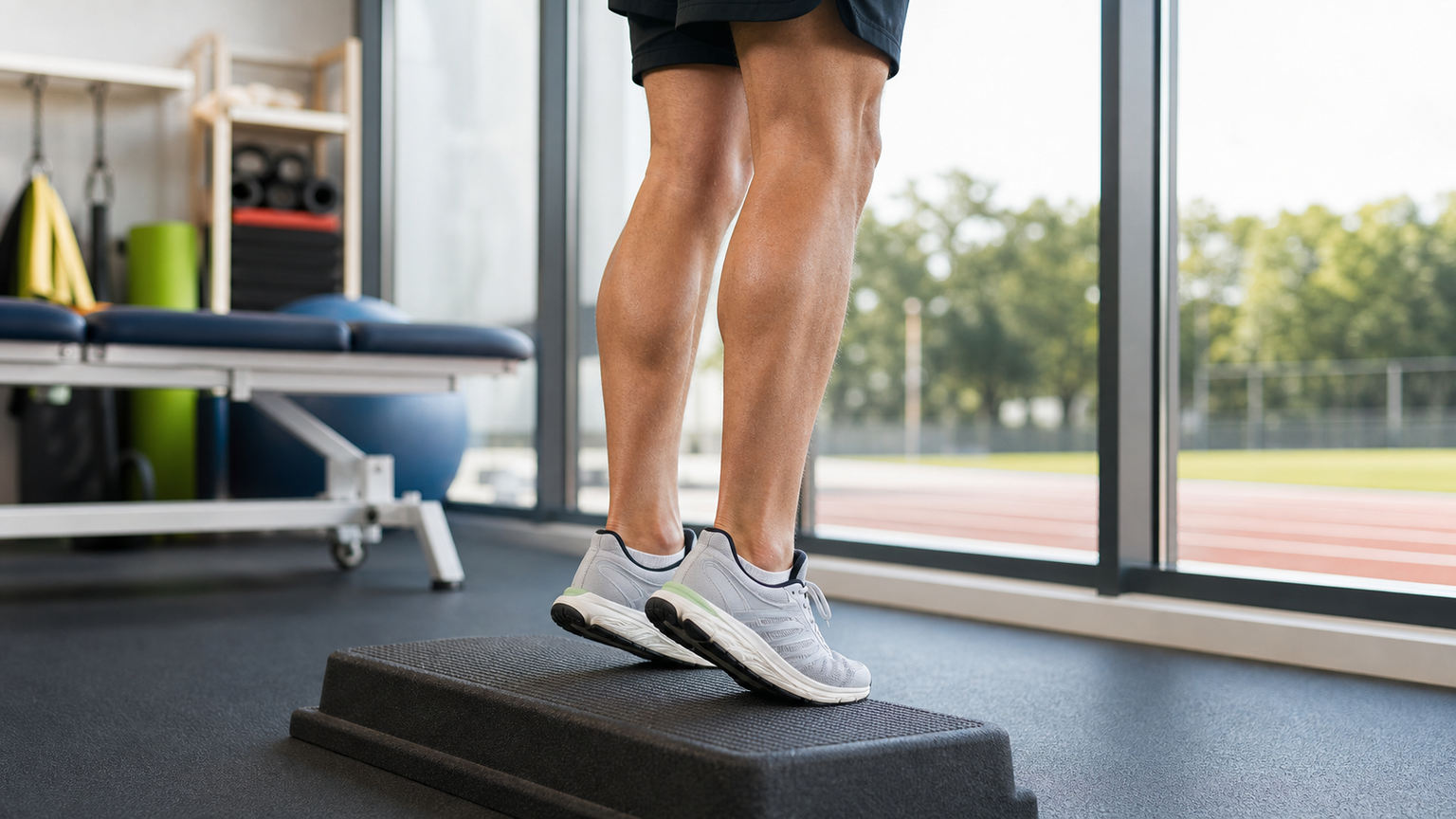
- Stand on the edge of a step, rise up on both feet, then shift to one foot
- Slowly lower the heel below the step level (eccentric contraction)
- Return to the starting position using both feet (using both feet avoids concentric fatigue)
- Perform 3 sets × 15 repetitions daily for 12 weeks, even with mild pain (< 5/10), continue
Initial pain may be noticeable; this is normal. Only if pain exceeds 5/10 or swelling worsens the next day should you reduce intensity.
Progressive loading (after 8 weeks):
- Add resistance bands to increase load
- Single-leg hopping: start with light hops, gradually increase height and speed
- Jump rope: start with 10 minutes as a baseline, add 5 minutes each week
Adjunctive Treatment Options
- Extracorporeal shock wave therapy (ESWT): Significantly effective for chronic tendinopathy that has not responded to conservative treatment for more than 3 months; available in the orthopedics and rehabilitation departments of major hospitals in Taiwan
- Platelet-rich plasma (PRP) injection: More controversial; some studies show limited efficacy. Consider only if shock wave therapy has also failed
- Corticosteroid injection: Not recommended for direct injection into the Achilles tendon due to the risk of tendon rupture
Return-to-Running Criteria
Before returning to running, the following functional criteria must be met:
- Single-leg eccentric calf raise: 25 repetitions, pain < 2/10
- Single-leg hopping: 10 consecutive hops, pain < 2/10
- Treadmill jogging for 5 minutes: pain < 3/10, with no worsening the next day
Progressive return-to-running principles:
- Week 1: Run-walk intervals (run 1 min / walk 2 min), totaling 20 minutes, 3 times per week
- Week 2: Change run-walk ratio to 2:1, totaling 25 minutes
- After week 4: Increase weekly mileage by the 10% rule
Prevention and Long-Term Maintenance Recommendations
- Daily maintenance: Use a foam roller to release the calves for 3 minutes, and ice the Achilles tendon for 10 minutes after training
- Shoe selection: Running shoes should have sufficient heel drop (8–10 mm recommended); avoid heavy use of barefoot or minimalist shoes in the short term
- Summer precautions: With Taiwan’s high summer temperatures, going out to run without adequate warm-up leaves the tendon less pliable in its low-temperature state—a risk factor for Achilles tendon injury
- Post-run stretching: Distinguish between the soleus (knee-bent stretch) and gastrocnemius (straight-leg stretch), performing 30 seconds × 3 sets for each
Related Reading
- Achilles Tendinitis: The Heel Problem Runners Fear Most
- Achilles Tendinitis in Running: Causes, Diagnosis, and Progressive Rehabilitation
- The Golden Treatment Protocol for Achilles Tendinitis: The Scientific Basis of Eccentric Training and a Complete Execution Guide
- Achilles Tendinitis: A Complete Management Guide for Cyclists and Runners
CT 喇低賽) 武嶺牽車 才是王道 西進牽車四小時內秘訣 攝手位置 如何判斷 防抽筋小秘訣
7 年前
一日北高/長距離團騎 常見問題補充篇 / 組團或跟團的眉角 / 壯車友容易被瘦車友慢性拉爆 / 原來屁股痛可能是這個原因...? / 風場配速法 / 公路車 / CT Yeh
2 年前
Never Stop 西進武嶺 前後雙機 完整全程錄影 訓練台 實境
8 年前
西進武嶺 免費訓練分析服務 Intervals | 練不夠還是練過頭?你哪一種類型選手?AI模型告訴你! | 備戰神器 | 公路車 訓練 | CT Yeh
4 年前
Canyon 公路車斷把手 五年老車特規還能修嗎? 維修保養全記錄 feat. 501單車監理站 | 公路車 | CT Yeh
4 年前
台灣旅行團參加 第7回まえばし赤城山ヒルクライム大会 雙視點
8 年前
摔車後補裝備: 好市多新款單車安全帽& Specialized Romin 北高整路屁股都不痛的坐墊 | 一千元居然有MIPS | CT Yeh | 公路車
4 年前
iPhone內建一秒變長腿🤣 車友必備#cycling
2 年前