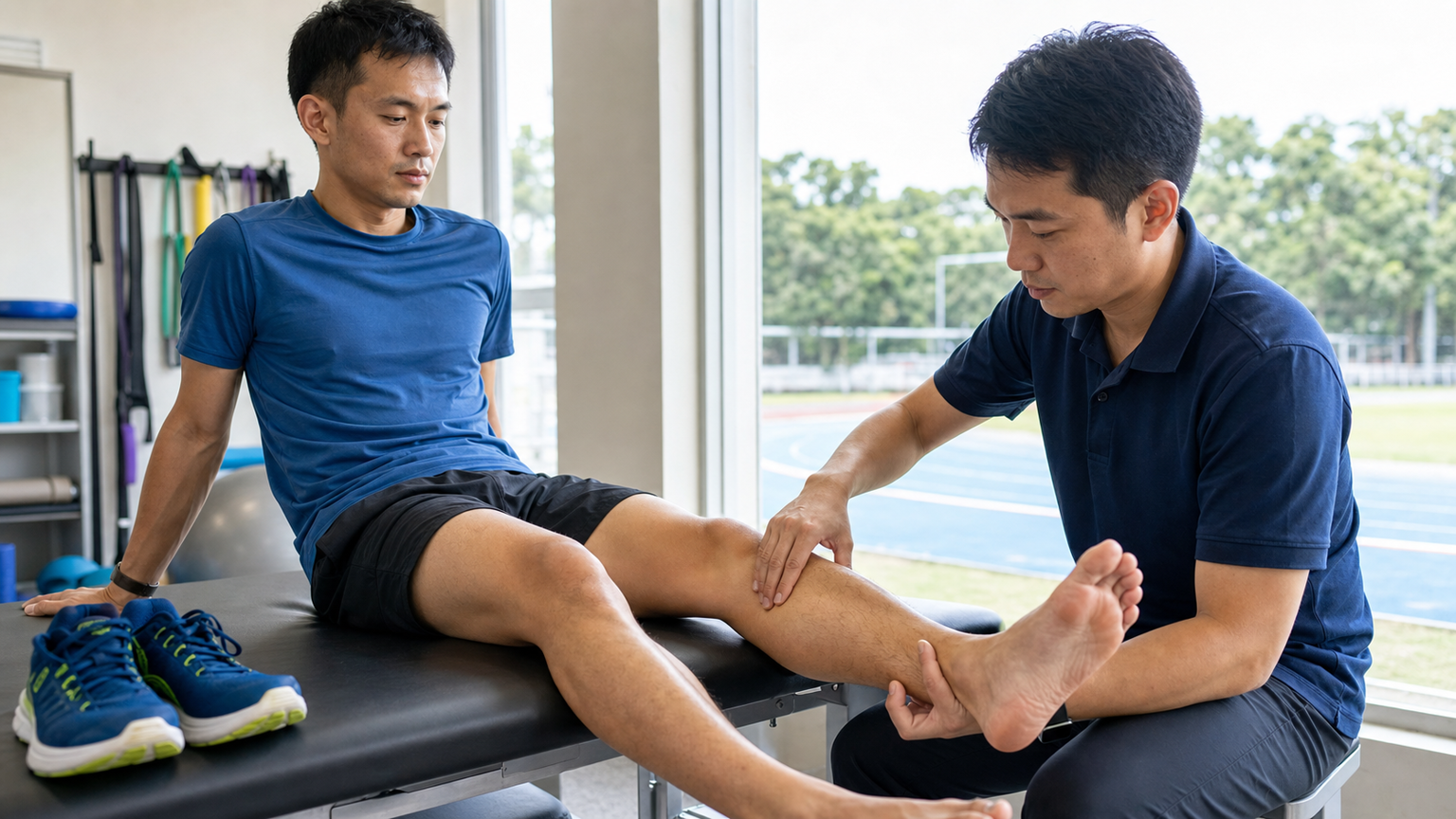
Introduction
A stress fracture is a fatigue crack in bone caused by repetitive cyclic loading. Unlike a traumatic fracture, there is no single, clear injury event—it accumulates quietly, much like “metal fatigue.” Among runners, stress fractures account for 15–20% of all injuries, most commonly occurring in the tibia, metatarsals, navicular bone, and femur.
Marathon training culture is prevalent in Taiwan, and many runners dramatically increase their training volume 2–3 months before a race. Bone adaptation cannot keep pace with training intensity, creating the perfect environment for stress fractures.
High-Risk vs. Low-Risk Sites
The severity of stress fractures varies greatly by location:
| Site | Risk Level | Rationale | Recommended Management |
|---|---|---|---|
| Posteromedial tibia | Low | Compressive fracture, adequate blood supply | Can run after 6–8 weeks of rest |
| Metatarsals (2nd–4th) | Low–Moderate | Most can be treated conservatively | Non-weight-bearing for 4–8 weeks |
| Calcaneus | Low | Spongy bone, heals faster | Reduce volume for 6 weeks |
| Femoral neck (compression side) | High | Difficult healing, risk of osteonecrosis | Stop running immediately; surgery may be required |
| Anterior tibial cortex | High | Tension-side fracture, poor healing | Non-weight-bearing, consider surgery |
| Navicular bone | High | Poor central blood supply, prone to non-union | Non-weight-bearing for 6–8 weeks, possible surgery |
| Base of 5th metatarsal (Jones Fracture) | High | High rate of non-union | Often requires surgical fixation |
Key to Early Recognition
Typical Symptom Pattern
The pain from a stress fracture follows a characteristic timeline:
- Early stage: Pain only appears during high-intensity training (late in long runs) and completely resolves with rest
- Middle stage: Pain occurs even with low-intensity running, and even walking becomes uncomfortable
- Late stage: Persistent pain at rest, with nighttime pain appearing
Clinical Differentiation Techniques
- Focal point tenderness: Pressing a specific fixed point on the bone surface with a finger elicits severe pain (unlike the diffuse distribution of muscle pain)
- Tuning Fork Test: Strike a 128Hz tuning fork and place it near the bone; if it worsens the pain, a fracture is suspected
- Hop Test: Hopping 10 times consecutively on the affected leg elicits severe pain
Imaging Diagnosis
| Method | Timing | Accuracy | When to Use |
|---|---|---|---|
| X-ray | Only visible 2–3 weeks after symptoms | Low (approximately 50%) | To rule out complete fracture |
| Bone scan | High sensitivity, but low specificity | Moderate | Rapid screening |
| MRI | Can detect early (within 24 hours of symptom onset) | Highest | Standard diagnostic tool |
Conclusion: If there is high clinical suspicion of a stress fracture but the X-ray is normal, an MRI should be arranged rather than waiting for the X-ray to show “obvious abnormalities.”
Recovery Timeline and Return-to-Running Plan
Low-Risk Sites (Posteromedial tibia, metatarsals)
Weeks 1–2: Stop running completely; switch to swimming (non-impact)
Weeks 3–6: Once pain-free, switch to aqua jogging or elliptical training
Weeks 7–8: If pain-free for more than 4 weeks, begin run-walk training
After week 9: Increase weekly mileage by no more than 10% per week
High-Risk Sites (Navicular, femoral neck, anterior tibial cortex)
All running and high-impact activities must stop immediately, and:
- Visit a sports medicine or orthopedic specialist to determine whether immobilization (cast or surgery) is needed
- Navicular and femoral neck fractures typically require 8–12 weeks of non-weight-bearing
- During rehabilitation, maintain fitness with water-based exercise or upper-body training
- Imaging confirmation of complete fracture healing (MRI or CT scan) is a prerequisite for returning to running
Risk Factors and Prevention
High-Risk Group Assessment
- Female Athlete Triad: If two or more of the following are present—inadequate energy intake, irregular menstruation, low bone mineral density—the risk of stress fracture increases 6-fold
- Vitamin D deficiency: Although Taiwan has abundant sunshine, many runners use thorough sun protection and may actually have low vitamin D levels; regular blood testing is recommended
- Low bone density: Those at risk for osteoporosis may develop fractures even at normal training volumes, regardless of age
Prevention Strategies
- Adequate nutritional intake: Female runners especially need to ensure calcium (1,200 mg daily) and vitamin D (1,000–2,000 IU daily)
- Progressive training: When adding mileage, follow the 10% rule and schedule a “cutback week” (reduce mileage by 30%) every 4 weeks
- Cross-training: Regularly incorporate swimming and cycling to allow bones to adapt to different loading patterns
- Adequate sleep: Bone remodeling primarily occurs during deep sleep; 7–8 hours per night is a basic requirement for runners
Conclusion
Stress fractures are the injury for which runners most need to “know when to stop.” Pain is the body’s alarm system—pushing through it will only turn a fatigue crack into a complete fracture, costing months of inability to walk. Learning to recognize early warning signs and respecting the recovery timeline is the key to staying healthy over the long arc of a running career.
Related Reading
- Recognizing and Preventing Running Stress Fractures: Considerations for High-Risk Groups
- Bone Density and Stress Fractures in Female Runners: Prevention Starts Now
- Early Warning Signs of Stress Fractures: The “Silent Bone Crack” Every Runner Should Know
- Running Stress Fractures: Red Flag Recognition, Bone Health, and Staged Return
一日北高/長距離團騎 常見問題補充篇 / 組團或跟團的眉角 / 壯車友容易被瘦車友慢性拉爆 / 原來屁股痛可能是這個原因...? / 風場配速法 / 公路車 / CT Yeh
2 年前
摔車後補裝備: 好市多新款單車安全帽& Specialized Romin 北高整路屁股都不痛的坐墊 | 一千元居然有MIPS | CT Yeh | 公路車
4 年前
CT 喇低賽) 武嶺牽車 才是王道 西進牽車四小時內秘訣 攝手位置 如何判斷 防抽筋小秘訣
7 年前
Never Stop 西進武嶺 前後雙機 完整全程錄影 訓練台 實境
8 年前
爬陡坡被爆胎的車友跑步超車 #cycling #里佳部落
9 個月前
一日北高常見問題大集合 | 攻略 | 路線 | 訓練 | 補給 | 自行車 單車 | 一日雙城 | 雙塔 | TWB北高360 | 屁股痛
6 年前
#公路車 #Fitting 靠人工智慧APP 幫你調整單車
6 年前
FTL 與 SYB 車隊專訪 西進武嶺 實用攻略分享! 2小時 如何練?!你不知道的眉角!新手準備武嶺必看 EP1 | 實力派女車友 | 精華版 | 公路車 | CTYeh
4 年前