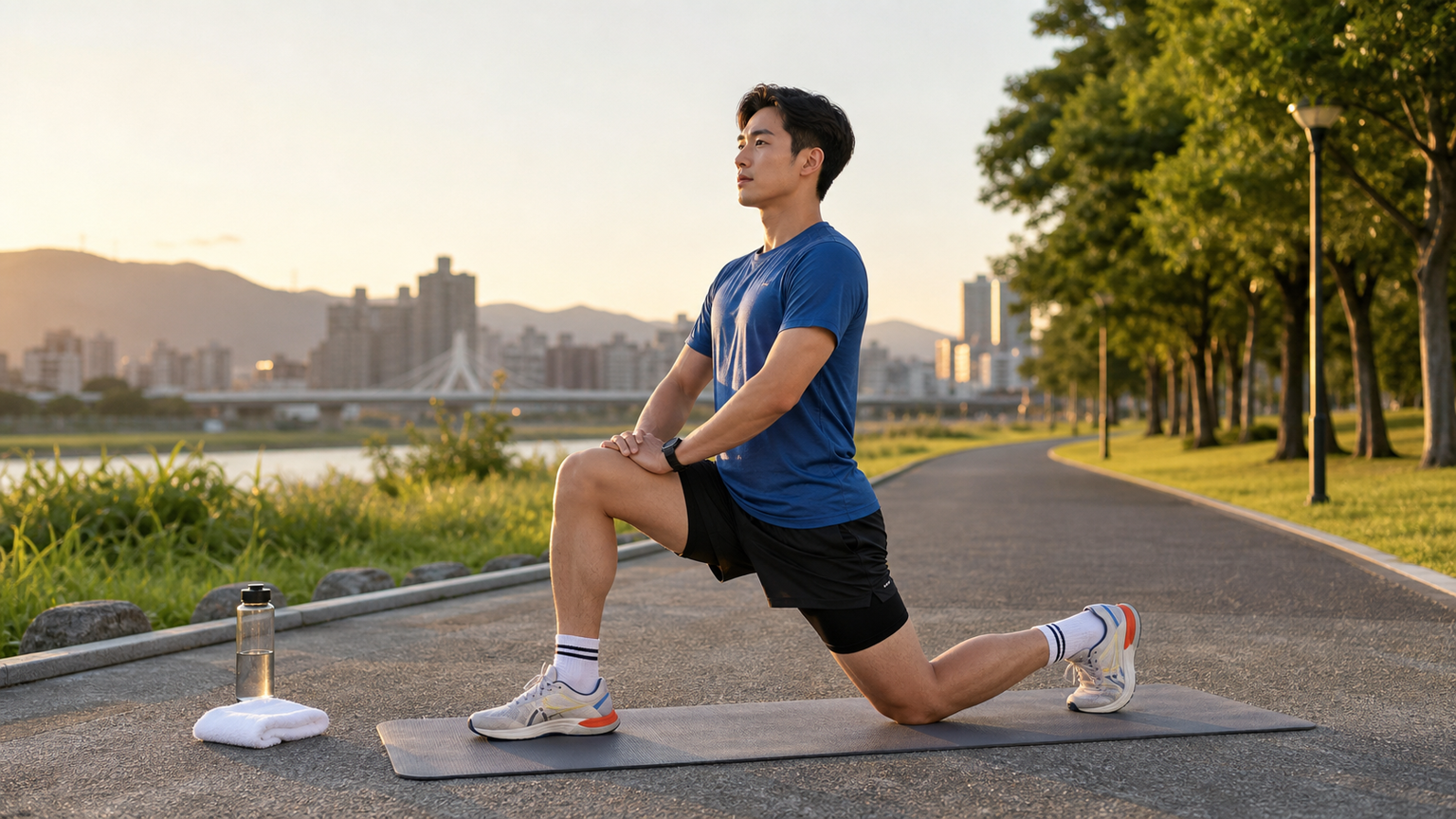
Introduction
Many runners in Taiwan spend 8–10 hours a day sitting in an office, then head to the riverside park for a run after work. Prolonged sitting keeps the hip flexor group (primarily the iliopsoas) in a shortened state, and combined with repeated contraction during running, this leads to chronic tightness over time. Not only does it affect running efficiency, but it is also a hidden source of lower back pain and hip pain.
Anatomy and Function of the Hip Flexors
The hip flexor group mainly includes:
- Iliopsoas: Composed of the iliacus and psoas major muscles, it is the most powerful hip flexor, connecting the lumbar spine → pelvis → lesser trochanter of the femur
- Rectus Femoris: Part of the quadriceps, it crosses both the hip and knee joints
- Tensor Fasciae Latae (TFL): Small but strong, connected to the iliotibial band, and also involved in hip flexion
With every stride during running, the lead leg requires powerful hip flexion. However, if the hip flexors are overly tight, they impede full hip extension in the late swing phase, leading to a shortened stride and reduced running efficiency, while also compensatorily increasing lumbar lordosis (arched lower back).
Why Taiwanese Runners Are Especially Prone to Tightness
| Lifestyle Habit | Impact on Hip Flexors |
|---|---|
| Prolonged sitting at work | Iliopsoas chronically shortened, losing full range of motion |
| Commuting by scooter | Hip joint maintained at 90 degrees of flexion for extended periods |
| Hiking activities | Repeated contraction on uphill sections, lacking eccentric lengthening |
| No stretching after running | Muscles cool and tighten post-training, tightness accumulates day by day |
Assessing Hip Flexor Flexibility
Thomas Test
How to perform:
- Lie on your back at the edge of a bed, with both legs hanging off the side
- Pull one knee toward your chest and hold it in place
- Observe whether the other thigh rests flat against the bed surface
Interpreting the results:
- Hanging thigh lies flat against the bed: Normal
- Hanging thigh lifts up: Tight iliopsoas
- Hanging knee cannot flex to 90 degrees: Tight rectus femoris
- Hanging lower leg drifts outward: Tight tensor fasciae latae
This assessment can be performed at home on your own. It is recommended to assess every 4–6 weeks to track improvement.
Complete Stretching Prescription
Daily Foundational Stretches (Can Be Done During Work Breaks)
-
Half-Kneeling Hip Flexor Stretch
- Back knee on the ground, front foot planted in a lunge position
- Keep your torso upright, push your hips forward, and feel the stretch in the front of the hip on the rear leg
- Hold for 30–45 seconds, 3 times per side, 2–3 rounds per day
- Variation: Place the back knee on a pad and reach the same-side arm overhead to add a lateral torso stretch
-
Couch Stretch
- Elevate the rear foot against a wall or couch, front foot planted in a lunge position
- Keep your torso upright, brace your core, and feel a deep stretch in the front of the thigh
- This is a more intense version, suitable for after prolonged office work
- Hold for 60–90 seconds, 2 times per side
-
Supine Single-Leg Hanging Stretch
- Lie on your back at the edge of a bed, pull one knee to your chest, and let the other leg hang naturally
- Use gravity for a passive stretch; very relaxing, ideal before bed
- 2 minutes per side
Advanced Mobility Drills
- Hip Swing: Hold onto a stable support and swing one leg forward and backward in a large range of motion for 20 reps to dynamically release the hip flexors
- Goblet Squat with Reach: Hold a kettlebell/water bottle and squat down, pausing at the bottom for 5 seconds while reaching in various directions to improve hip mobility in all planes
Strengthening the Antagonist: Glute Training
Stretching is only half the solution; tight hip flexors are often accompanied by gluteus maximus inhibition (Gluteal Amnesia). Therefore, strengthening the glutes is equally crucial:
- Glute Bridge: Lie on your back with knees bent, drive your hips up with force, hold at the top for 2 seconds, 3 sets × 15 reps
- Single-Leg Glute Bridge: An advanced version requiring greater glute control
- Prone Hip Extension: Lie face down, keep the knee straight, and lift one leg about 15 cm, feeling the gluteus maximus contract, 3 sets × 12 reps
Practical Tips: Incorporating Stretching into Taiwanese Life
- While waiting at red lights during your commute: Scooter riders can gently push the pelvis forward while stopped for a mini hip flexor stretch
- While watching TV: Sit in a kneeling or half-kneeling position instead of prolonged sitting on the couch
- 5 minutes during your lunch break: Do half-kneeling stretches next to your office chair, 30 seconds per side, alternating 3 times
- Never skip post-run stretching: Perform 5 minutes of hip flexor stretches immediately after every run, when muscles are warm for the best effect
- Set reminders: Use your phone to remind yourself to stand up and walk around every 90 minutes to break the cycle of prolonged sitting
Conclusion
Tight hip flexors are a “cumulative” problem that also requires “day-by-day” improvement. Given the typical lifestyle of Taiwanese runners, occasional stretching after training alone is not enough. Hip flexor maintenance must be integrated into daily life habits. Keeping the hip joints flexible is what allows every stride to be freer and more efficient, while also protecting the lumbar spine and knees from compensatory injuries.
Related Reading
- The Impact of Tight Hip Flexors on Running Form and a Stretching Prescription
- Tight Hip Flexors While Running: Causes, Effects, and Complete Stretching Methods
- Hip Flexor Training for Runners: The Key Muscle Group for Preventing Running Injuries
- Hip Flexor Training for Runners: The Relationship Between Leg Lift Strengthening and Stride Length
一日北高/長距離團騎 常見問題補充篇 / 組團或跟團的眉角 / 壯車友容易被瘦車友慢性拉爆 / 原來屁股痛可能是這個原因...? / 風場配速法 / 公路車 / CT Yeh
2 年前
實景訓練台) 彰化經典百K 高強度喵團 90分鐘 跟著一起練功 2019 Indoor workout Changhua Classic 100 Taiwan
7 年前
iPhone內建一秒變長腿🤣 車友必備#cycling
2 年前
一日北高常見問題大集合 | 攻略 | 路線 | 訓練 | 補給 | 自行車 單車 | 一日雙城 | 雙塔 | TWB北高360 | 屁股痛
6 年前
Live) 備戰2019彰化經典百K 賽前攻略 (已完賽請看新影片
7 年前
2025 海鷗團體繞圈賽 網路直播 超激烈裁判長視角 / EIPC 李廷威、Waypoint 等眾多高手競爭 / feat. 卡密兒主持 / 海鷗繞圈賽
9 個月前
西進武嶺 免費訓練分析服務 Intervals | 練不夠還是練過頭?你哪一種類型選手?AI模型告訴你! | 備戰神器 | 公路車 訓練 | CT Yeh
4 年前
台北闊瀨陡坡 騎旅 / 日本單車雜誌編輯車友臨時加入!/ 髮香才是最強的 / feat. 北迴歸線小隊 / 公路車 CT Yeh
6 個月前