Introduction
Goggles are the most personal piece of equipment for a swimmer, and also the most often casually chosen. In a pool environment, slight leaking or fogging is only a minor annoyance; but in open water, an ill-fitting pair of goggles can cause you to lose navigational ability, reduce your sense of psychological security, and even affect your performance in an entire race.
This article starts from the specific demands of open water and systematically introduces the logic behind goggle selection and maintenance methods.
Open Water Goggles vs. Pool Goggles
| Feature | Pool Goggles | Open Water Goggles |
|---|---|---|
| Lens field of view | Narrower (90–120°) | Wider (120–180°) |
| Frame design | Tight fit, waterproofing first | Comfortable wear, no pressure over long periods |
| Lens color | Clear (indoor lighting) | Amber/Gray (outdoor bright light) |
| Seal area | Small (eye socket only) | Larger (facial seal) |
| Suitable duration | Short training sessions | Long durations (45–120 minutes) |
Lens Color Selection Guide
Lens color is the most important selection dimension for open water goggles, because outdoor lighting conditions are complex and variable:
- Clear/Light Yellow: Best for low-light conditions (cloudy days, early morning, evening), highest visibility
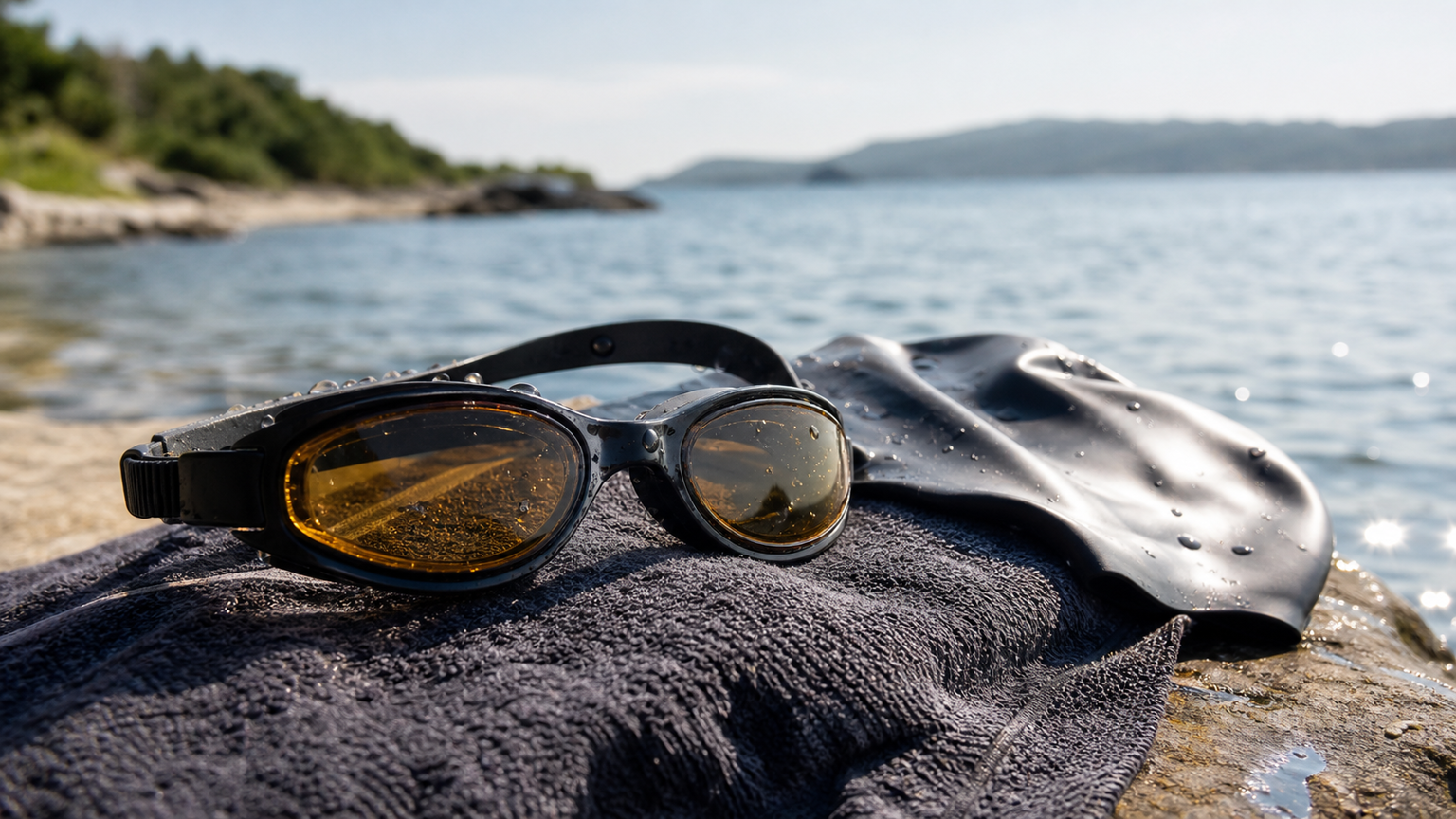
- Amber/Copper: Best all-around choice, enhances contrast, particularly effective on glistening water surfaces
- Gray/Smoke: Most comfortable under intense sunlight, reduces overall brightness, suitable for Taiwan’s summer seas
- Mirror: Highest level of light blocking, but slightly darker field of view, used for strong backlight situations
- Blue/Green: Visually cool, but contrast enhancement is not as effective as amber
Taiwan open water recommendation: Amber or gray are the most versatile choices, especially under the intense summer sun in Penghu and Kenting, where gray lenses can significantly reduce glare discomfort.
Frame Fit Testing Method
The fit test is the most important step before purchase. The correct method is as follows:
- Without using the strap, press the goggles onto your eye sockets with your hands only
- Release your hands and feel how naturally the goggles adhere to your eye sockets
- Lower your head to simulate a swimming position and observe whether the goggles remain sealed
- If the goggles naturally adhere for at least 3–5 seconds, the fit is good
Common causes of leaking:
- The silicone gasket on the frame edge does not match your facial contours
- The nose bridge is adjusted too wide or too narrow (non-fixed nose bridges must be carefully adjusted)
- The strap being too tight actually deforms the frame and reduces the seal
- Sunscreen applied around the frame (any oily substance will break the seal)
The Importance of Field of View
In open water swimming, a wider field of view offers the following benefits:
- Peripheral vision: Allows you to sense the position of nearby swimmers, reducing collisions
- Sighting efficiency: Enables faster scanning for course buoys when lifting your head
- Bottom perception: Allows you to see the bottom terrain earlier when returning to shore in shallow water
Most open water goggles use slightly outward-curved lens designs (spherical lenses) to increase the horizontal field of view.
Anti-Fog Treatment and Maintenance
Fogging is the most common cause of interrupted vision while swimming, and proper maintenance can greatly reduce this problem:
What NOT to do
- Do not touch the inside of the lens with your fingers: Finger oils will permanently damage the anti-fog coating
- Do not dry-wipe with cloth: Friction will scratch the anti-fog layer
- Do not expose to direct sunlight: High temperatures accelerate the aging of the anti-fog coating
Proper Maintenance Steps
- Rinse gently with clean water after swimming (do not rub)
- Air dry naturally or pat dry gently (do not wipe dry)
- Store in a hard goggle case to avoid pressure
- Reapply anti-fog spray (commercially available anti-fog solution) every 2–3 months
Pre-Race Anti-Fog Treatment
- Baby shampoo method: Apply a thin layer of baby shampoo to the inside of the lens, rinse off most of it (leaving a very thin layer), effective for 30–60 minutes
- Saliva method: Spit on the inside of the lens before a race, gently spread it, then rinse. An ancient method for emergency use that still has some effect
- Anti-fog spray: The most reliable method, use according to product instructions before the race
Strap Adjustment Tips
Both overly tight and overly loose straps can cause problems:
- Too tight: Pressure on the eye sockets, deep red marks after swimming, headaches during prolonged wear
- Too loose: Unstable, shifts and leaks when diving or hit by waves
Correct tightness: The goggles naturally conform to your face, with the strap only slightly taut—no need to cinch it down hard.
A dual-strap design (two straps, upper and lower) is more suitable for open water than a single strap, providing better hold in wavy conditions.
Taiwan Race Scenario Recommendations
Backlit races (west-facing early morning starts in Penghu): Choose mirror or dark gray lenses to avoid navigational difficulties caused by direct sunlight.
Northeast coast winter training: When fog is heavier, clear or light yellow lenses improve visibility.
Low underwater visibility (when the water is turbid with sediment along the Taitung coast): Lens color matters little; the key is the fit, ensuring no leaking distracts your attention.
Conclusion
A suitable pair of goggles won’t make you swim faster, but an unsuitable pair will definitely make you swim slower. Spend an extra 10 minutes testing the fit before purchasing, choose a lens color suited to Taiwan’s outdoor lighting, and establish proper maintenance habits—so vision issues can permanently disappear from your race checklist.
Related Reading
- Triathlon Goggle Selection: Differences in Field of View and Seal Between Open Water and Pool Goggles
- The Science of Goggles, Swim Caps, and Accessories: Engineering Trade-offs in Visibility, Field of View, and Anti-Fog
- The Complete Goggle Buying Guide: Full Testing of Anti-Fog, UV Protection, and Frame Fit
- The Complete Goggle Buying Guide: Frame Shape, Anti-Fog Coating, and Prescription Lens Options Explained
[教學] Premiere 影片 手震 修正 教學 防抖 單眼 影像 GoPro 穩定 Video Stabilization
8 年前
3C心得) 電腦用 43吋 4K 螢幕 適合嗎 ! BDM4350UC 長期使用心得 剪接影片 修圖 Premiere Davinci Lightroom
7 年前
雷達尾燈 雷不雷? 邁金L508 智慧雷達尾燈 情境考驗實測 | 同場加映 2千元等級的專業車錶 C406 Pro | 公路車 | CT Yeh
3 年前
近視雷射三個月後悔嗎?單車族/工程師必看,Smart TransPRK 術後血淚史與後遺症全公開 / CT Yeh
4 個月前
開箱) 近視車友 也可以很帥的 Envis Transform 太陽眼鏡開箱 翔鷹 配近視框超便宜秘訣
7 年前
首發 Garmin Edge 850 車錶 深入開箱!? / 公路車 / CT Yeh
10 個月前
趣味單車配件:多功能智慧尾燈 / 有方向燈 可app編輯圖案!? / GRC x Lumii 聯名款 / 公路車 CT Yeh
9 個月前
單車高張力拍攝神器 Antigravity A1 全景空拍機! / CT Yeh
1 個月前