文章導覽
Introduction
The Penghu Fireworks Festival Triathlon attracts hundreds to over a thousand athletes each year to compete in the unique marine environment of the Penghu archipelago. Unlike races along Taiwan’s main island coast, Penghu’s strait topography, tidal range, and ocean currents have their own distinct characteristics. Without prior understanding, athletes may find themselves in trouble during the swim leg; with proper preparation, however, these features can be leveraged for significant tactical advantages.
This article provides a practical preparation guide based on the geographical characteristics of Penghu’s waters. (Race details may vary each year; please refer to the organizer’s official announcements.)
Penghu Waters Hydrology Basics
Tidal Characteristics of the Taiwan Strait
Penghu is located in the center of the Taiwan Strait and is influenced by the following hydrological factors:
- Tidal range: Penghu’s tidal range is approximately 1.5–2.5 meters, classified as moderate; tidal current direction changes noticeably between flood and ebb tides
- Current direction: During flood tide (rising water level), seawater flows northeast into the Taiwan Strait; during ebb tide, it flows southwest out
- Current speed: Maximum tidal current can reach 1–2 knots (50–100 cm/s), significantly affecting swimming speed
- Kuroshio branch: A more distant ocean current with limited influence on the waters within Penghu Bay
Penghu Bay Topographic Effects
The main Penghu Island, Xiyu, Zhongtun, and other islands form the semi-enclosed Penghu Bay, creating special effects:
- Water flow inside the bay is gentler than in the open sea
- Vessel traffic may generate localized waves
- Coral reef topography creates uneven water depths, affecting localized current conditions
Current Strategy for the Swim Leg
Pre-Race Preparations
| Preparation Item | Method | Importance |
|---|---|---|
| Check race-day tide times | Central Weather Administration tide forecasts | Highest |
| Understand flood/ebb current directions | Ask local lifeguards or fishing associations | High |
| Observe buoy directions on-site | Enter the water the day before to confirm | High |
| Understand the swim course direction | Review the organizer’s course map | High |
Strategies for Using the Current
- If the race occurs during flood tide (rising water, current flowing northeast): if the swim course heads northeast, you gain a favorable following current; for segments heading southwest, adjust your angle accordingly
- If the race occurs during ebb tide (falling water, current flowing southwest): reverse the directional logic, applying the same principles
- During current reversal periods (approximately 30 minutes before or after high or low tide): current speed is minimal, creating a “calm window” that many athletes schedule their swim during
Start Position Analysis
Regardless of the specific race’s start design, the following are general principles for starting in Penghu waters:
Differences Between Pier and Beach Starts
Pier/Boardwalk start (used in some Penghu races):
- Water is immediately deep enough after entry, allowing direct swimming
- No need to deal with breaking waves
- However, disorientation is easy in the first few seconds after entry (no standing-up transition; vision suddenly goes underwater)
Beach start:
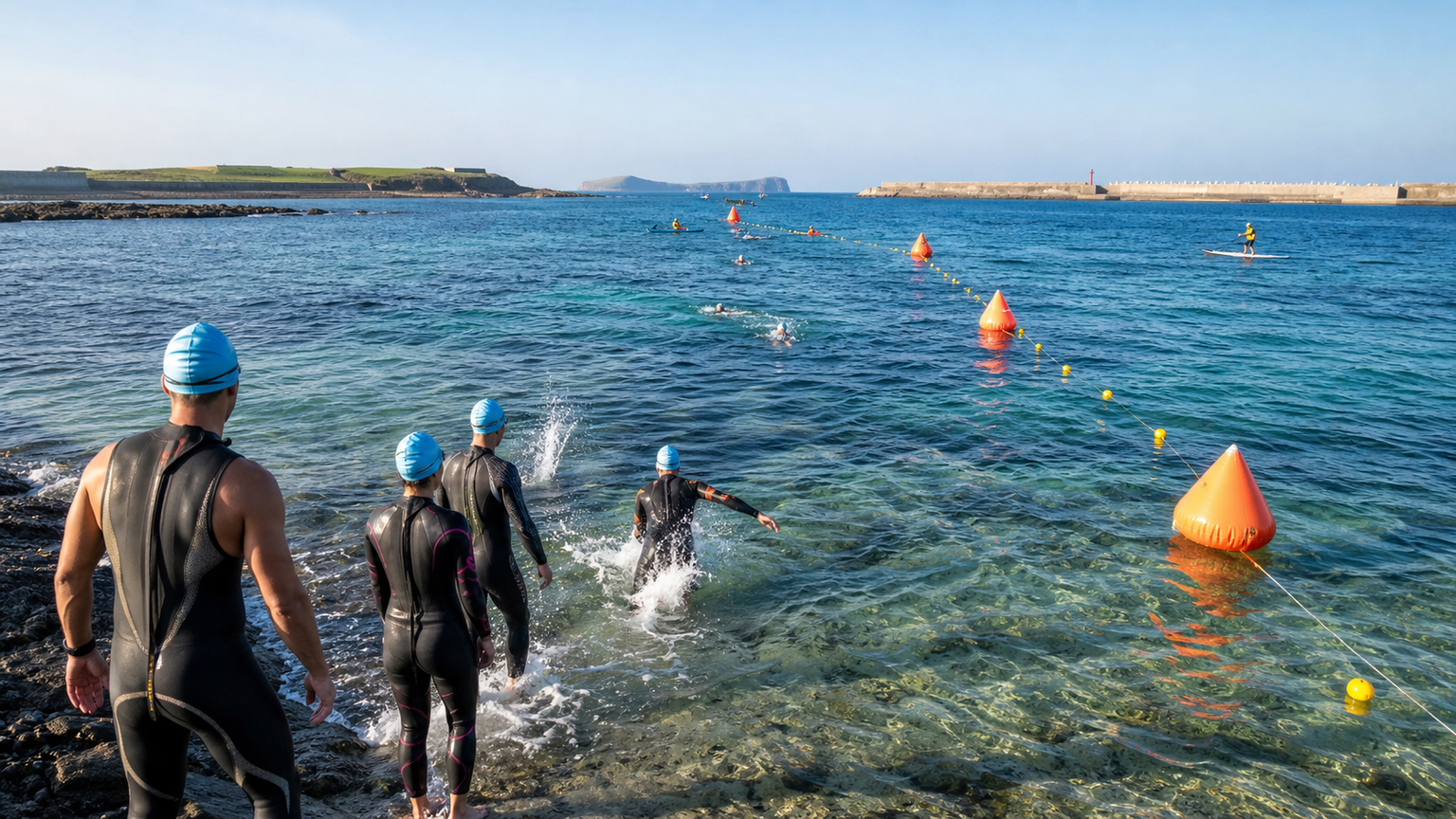
- Requires running through shallow water first
- If waves are present, you must navigate through breaking surf
- But the visual transition is more natural
Correcting for Cross-Currents
The most common challenge when starting in Penghu waters is lateral currents. Correction principles:
- Observe the angle of buoy ropes (this is the most direct indicator of current direction)
- At the swim start, rotate your body 10–20 degrees to face “upstream”
- Let the current “carry you back” to your target direction
- Confirm you remain on course with each sighting
Penghu’s Unique Environmental Challenges
Underwater Visibility
Penghu’s seawater clarity is renowned across Taiwan, with underwater visibility typically excellent (5–10 meters or more). The advantage is lower psychological stress during swimming, with less anxiety from not being able to see the bottom.
Sun Glare
Penghu’s summer sunlight is intense, and the open strait offers no shade. For morning races facing east, sunrise backlight can cause severe visual interference. Recommendations:
- Use dark gray or mirrored lens goggles
- Confirm the race start direction in advance and practice sighting against backlight during training
Wind Effects
Penghu has the strongest winds in Taiwan (annual average exceeding 5 m/s); summer winds are relatively weaker but can still reach force 3–5. Wind-generated chop and surface agitation can affect sighting, requiring advance adaptation.
Pre-Race Day Preparation Schedule
- Morning: Attend the organizer’s open-water warm-up session (most races arrange one)
- Key observations: Buoy positions, current direction, water temperature feel
- Afternoon: Re-check the next day’s tide data to confirm tidal conditions during race time
- Evening: Confirm goggle seal, wetsuit condition (if needed), and T1 strategy
Conclusion
The swim leg of the Penghu Fireworks Festival Triathlon is a stage for well-prepared athletes to showcase their open-water skills, but it can become a nightmare for those who arrive unprepared. Spending an extra day studying tide data, observing current directions, and familiarizing yourself with the course will allow you to swim your personal best in these beautiful waters of the Taiwan Strait.
Related Reading
- Penghu Fireworks Festival Swimming Event Guide: A Complete Analysis of This Island Race
- Penghu Cross-Strait Swim: Channel Challenge of Strong Winds and Rough Seas, Plus Race Prep Tips
- The Complete Penghu Triathlon Experience: An Unforgettable Journey of Pushing Limits in an Island Paradise
- Swim Conditions in Taiwan’s Triathlons: Technical Differences Between Open-Sea and Lake Swimming