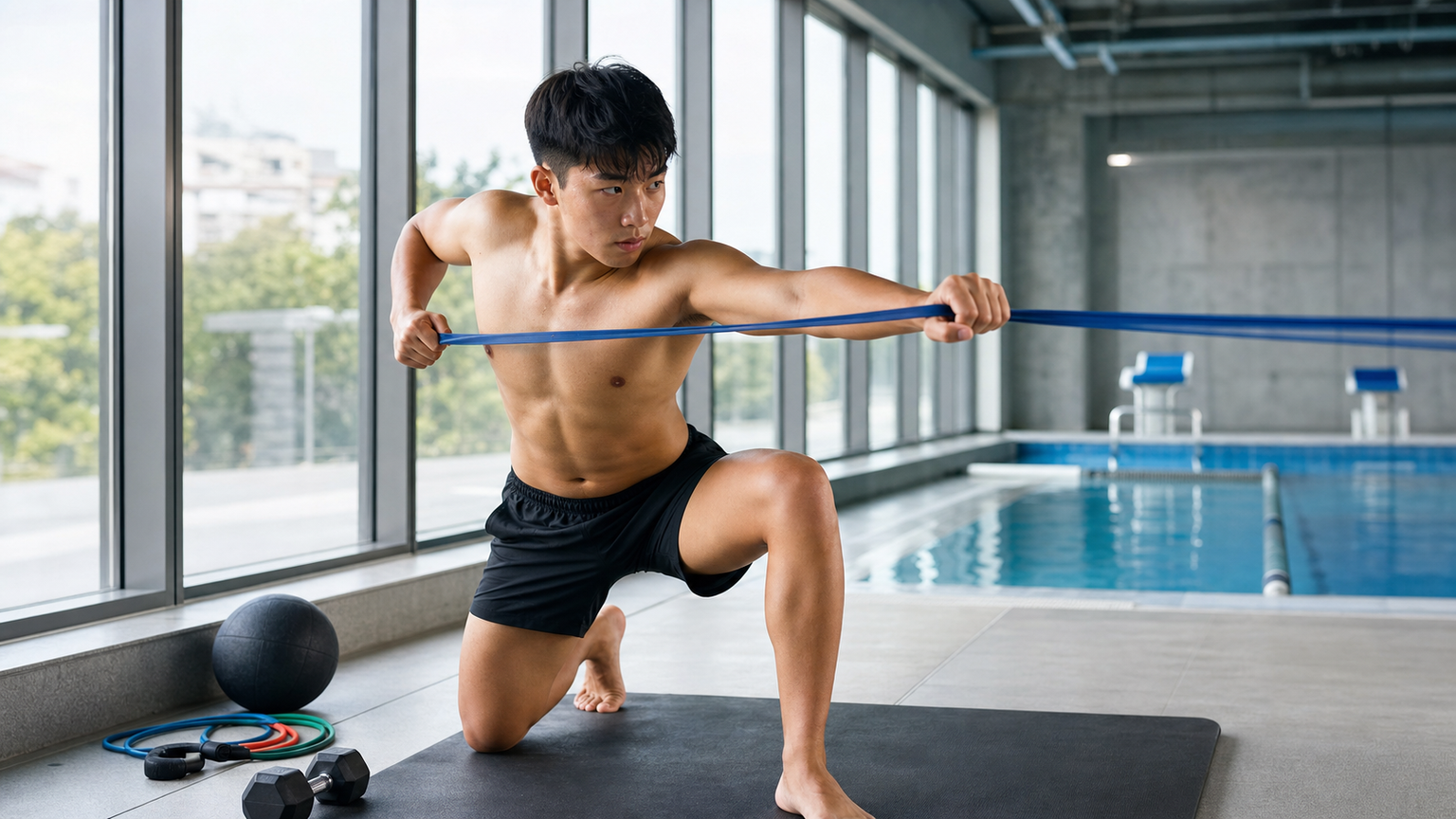
Introduction
Many Taiwanese swimmers believe that “swimming is best trained by swimming,” and that dry-land training is merely an optional extra. However, the training systems of modern competitive swimming have long established dry-land training as an indispensable component. Research shows that, with the same swimming training volume, swimmers who added dry-land strength training improved their freestyle performance by an average of 2.4% after three months—seemingly small, yet at the competitive level, this is a critical difference.
Primary Muscle Groups Used in Swimming
Understanding which muscle groups swimming requires is essential for designing a targeted dry-land workout plan:
| Stroke | Primary Muscles | Key Supporting Muscles |
|---|---|---|
| Freestyle | Latissimus dorsi, anterior deltoid | Rotator cuff, core muscles |
| Backstroke | Latissimus dorsi, posterior deltoid | Middle/lower trapezius, glutes |
| Breaststroke | Quadriceps, pectoralis major | Adductors, psoas major |
| Butterfly | Latissimus dorsi, pectoralis major, core | Glutes, erector spinae |
Core Principles of Dry-Land Training for Swimming
- Movement Specificity: Dry-land movements should mimic the movement paths and force-generation patterns used in the water as closely as possible
- Core First: All propulsive force must be transmitted through a stable core; core training takes priority over limb training
- Avoid Excessive Hypertrophy: Excess muscle mass increases body weight and may be counterproductive to swimming speed; focus on strength and power
- Dry-Land Volume Should Not Exceed Water Volume: Dry-land training is supplementary, not the main focus; fatigue management is crucial
Four-Week Dry-Land Training Plan
Weeks 1–2: Foundation Phase (3 sessions/week, 45–60 minutes each)
Core Foundation:
- Plank: 3 sets × 30–45 seconds
- Dead Bug: 3 sets × 10 reps (each side)
- Bird Dog: 3 sets × 10 reps (each side)
Upper Body Push/Pull:
- Resistance Band Lat Pulldown (stroke simulation): 3 sets × 12 reps
- Push-ups: 3 sets × 15 reps
- TRX Row (simulating backstroke pull): 3 sets × 12 reps
Lower Body:
- Squats: 3 sets × 12 reps
- Glute Bridge: 3 sets × 15 reps
- Resistance Band Frog Kick (simulating breaststroke kick): 3 sets × 12 reps
Weeks 3–4: Intensification Phase (4 sessions/week, 50–70 minutes each)
Dynamic Core:
- Rotational Medicine Ball Throw: 3 sets × 8 reps (each side)
- Rings/TRX Crunch: 3 sets × 10 reps
Upper Body Power:
- Fast Resistance Band Stroke Simulation: 4 sets × 8 reps (emphasizing speed)
- Medicine Ball Chest Pass (simulating breaststroke pull): 3 sets × 8 reps
- Dumbbell Shoulder Press: 3 sets × 10 reps
Lower Body Power:
- Jump Squat: 4 sets × 6 reps
- Single-Leg Bounds (simulating start wall push-off): 3 sets × 8 reps (each leg)
- Nordic Hamstring Curl: 3 sets × 5 reps (eccentric control)
Practical Challenges of Dry-Land Training for Taiwanese Swimmers
- Facility Limitations: Many pools do not provide dry-land training space, requiring swimmers to find a gym elsewhere
- Time Constraints: University swim teams already spend long hours in morning and evening training; dry-land training requires an additional hour
- Training Supervision: Most swim coaches are not strength-training specialists, making it difficult to ensure movement quality
Suggested Solutions
- Use resistance bands at home for light dry-land training (no gym required)
- Perform 15–20 minutes of core training immediately after swim practice to reduce additional time costs
- Stop heavy dry-land training 4 weeks before the National Intercollegiate Athletic Games or major competitions; maintain only core and resistance band work
Shoulder Joint Protection Training
Swimmer’s Shoulder is the most common sports injury among Taiwanese swimmers, making preventive training in dry-land sessions crucial:
- Resistance Band External Rotation: 2 sets × 15 reps daily
- Scapular Retraction: 2 sets × 15 reps daily
- Side-Lying Dumbbell External Rotation: 2 sets × 12 reps daily
Practical Recommendations
The biggest mistake in dry-land training is “doing too much, going too heavy.” For swimmers new to dry-land training, the first month should focus on light weights and high-quality movement, ensuring correct muscle activation before gradually increasing intensity. Major sports centers across Taiwan (such as Chung Hua University’s gymnasium and municipal sports centers in various cities and counties) all have suitable dry-land training facilities.
Conclusion
Dry-land training is a swimmer’s secret weapon—it strengthens muscle groups that water training cannot fully stimulate, improves force-transfer efficiency, and effectively prevents sports injuries. Integrating dry-land training into your regular training plan is an important step from being an amateur swimmer toward reaching a competitive level.
Related Reading
- Dry-Land Training for Swimmers: Bridging Land Training and In-Water Performance
- Muscle Adaptations in Swimming: Prioritizing Development of the Latissimus Dorsi, Deltoids, and Core
- Why Swimmers Need Land-Based Strength Training
- A Complete Land Training Plan for Swimmers: A Shoreline Guide to Resistance Bands, Core, and Flexibility
西進武嶺 免費訓練分析服務 Intervals | 練不夠還是練過頭?你哪一種類型選手?AI模型告訴你! | 備戰神器 | 公路車 訓練 | CT Yeh
4 年前
CT暗黑廚房) 車友必備 宇宙無敵鮮蚵湯 幫助訓練恢復 天然食補 好市多 超肥鮮蚵 破PR
7 年前
一日北高/長距離團騎 常見問題補充篇 / 組團或跟團的眉角 / 壯車友容易被瘦車友慢性拉爆 / 原來屁股痛可能是這個原因...? / 風場配速法 / 公路車 / CT Yeh
2 年前
實景訓練台) 彰化經典百K 高強度喵團 90分鐘 跟著一起練功 2019 Indoor workout Changhua Classic 100 Taiwan
7 年前
一個測試有沒有認真練車的方法😂 #公路車
10 個月前
一起升級!海鷗盃LSD團練...JJSC Zone2招待 騎到手抖 / 公路車 / CT Yeh
1 天前
Zwift 元宇宙單車世界 如何與全世界同步騎車運動
6 年前
單車AI教練!全新 ChatGPT4o 幫你分析訓練成果!排武嶺課表,分析騎車姿勢! 太神了! / 公路車 / CT Yeh / feat. 緯緯
2 年前