Introduction
The high temperature and humidity conditions of Taiwan’s summer pose a major challenge for runners. Every year from June to September, heat injury cases occur at major road races and training venues across the island, ranging from mild heat cramps to heat stroke requiring immediate emergency care—threats that runners in Taiwan cannot afford to ignore. In particular, southern cities such as Tainan and Kaohsiung often experience apparent temperatures exceeding 40°C in summer, and a single moment of carelessness can lead to serious consequences.
Classification and Recognition of Heat Injuries
Four Levels of Heat Injury
| Type | Symptoms | State of Consciousness | Skin Condition | Urgency |
|---|---|---|---|---|
| Heat Cramp | Sudden severe muscle cramping (often in calves, thighs) | Normal | Normal or moist | Low |
| Heat Syncope | Sudden fainting, often occurring after stopping exercise | Brief loss | Pale, profuse sweating | Medium |
| Heat Exhaustion | Dizziness, nausea, weakness, profuse sweating, headache | Normal or mildly confused | Pale, cold and clammy | Medium–High |
| Heat Stroke | Core body temperature > 40°C, confusion, no sweating | Loss or severe confusion | Red, hot and dry, or still sweating | Extremely High (Emergency) |
Key Distinction: The biggest difference between heat exhaustion and heat stroke lies in state of consciousness and core body temperature. Patients with heat stroke are confused and unable to communicate, and must be treated immediately as a medical emergency.
On-Site Emergency Response
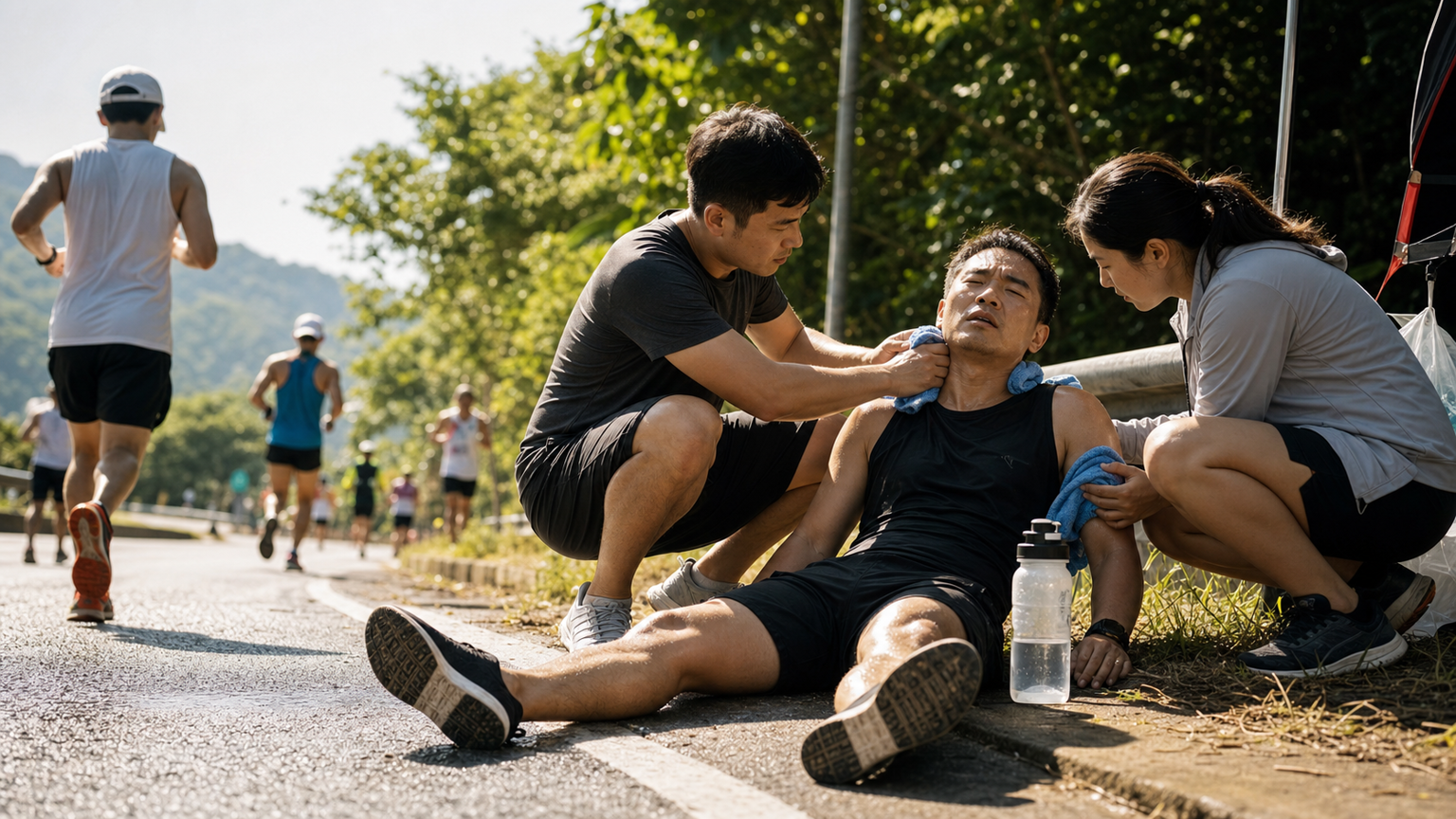
On-Site Management of Heat Exhaustion
- Immediately move to a shaded area: Transfer to an air-conditioned or shaded environment
- Lie flat with legs elevated: Promote blood return to the heart and prevent fainting
- Replenish electrolyte drinks: If conscious, administer orally in small, frequent amounts (do not chug large volumes at once)
- Physical cooling: Apply cold, wet towels to the neck, armpits, and groin (areas with concentrated major blood vessels)
- Monitor symptoms: If there is no improvement within 30 minutes or the state of consciousness changes, call 119 immediately
Emergency Management of Heat Stroke (Every Second Counts)
The golden rule for heat stroke is: Cool first, transport second
- Call 119 immediately, and begin cooling without waiting for rescue
- Cold water immersion: If a tub or pool is available on site, immerse the patient up to the neck in cold water (most ideal)
- Ice packs on major blood vessels: Place ice packs generously on the carotid arteries, armpits, and groin
- Continuous water spraying and fanning: Evaporative cooling is highly effective
- Goal: Lower body temperature below 38.5°C within 30 minutes
- Do NOT: Administer fever-reducing medication (such as ibuprofen), or force fluids (the patient may no longer be able to swallow)
Scientific Strategies for Summer Running in Taiwan
Heat Acclimatization
Research shows that after regularly training in hot conditions for 10–14 days, the body undergoes significant physiological adaptations:
- Plasma volume increases by 10%, improving cardiac output efficiency
- Sweating efficiency improves, enhancing thermoregulation
- Electrolyte loss rate decreases
Heat Acclimatization Plan for Runners in Taiwan:
- Days 1–3: Run only before 6:00 AM or after 6:00 PM to reduce direct sun exposure
- Days 4–7: Gradually shift some training to hotter periods (4–5 PM), but reduce intensity by 30%
- Days 8–14: Easy runs can be performed during hotter periods to allow full adaptation
Hydration Strategy
- Pre-run hydration: Drink 500mL of water 2 hours before running; drink 250mL 30 minutes before running
- During-run hydration: Replenish 150–200mL every 15–20 minutes; switch to electrolyte drinks for exercise exceeding 60 minutes
- Post-run hydration: For every 1kg of body weight lost, replenish 1.5L of fluid (including plain water and sodium-containing beverages)
- Caution: Do not overhydrate (risk of hyponatremia); use thirst as the hydration cue
Application of the WBGT Index
Wet Bulb Globe Temperature (WBGT) is the international standard for assessing the safety of running in hot environments:
| WBGT | Safety Level | Recommendation |
|---|---|---|
| < 18°C | Safe | Normal training |
| 18–23°C | Caution | Increase hydration, monitor symptoms |
| 23–28°C | Alert | Reduce intensity by 20–30% |
| 28–32°C | Dangerous | Maintenance jogging only, shorten distance |
| > 32°C | Extreme Danger | Stop outdoor running |
The weather bureaus of all counties and cities in Taiwan provide real-time WBGT data; runners are advised to check before heading out in summer.
Special Attention for High-Risk Groups
- Individuals with hypertension or heart disease: The cardiac load is heavier in hot environments; high-intensity training should be avoided in summer
- Those taking diuretics or certain cardiovascular medications: These reduce thermoregulatory capacity and require extra caution
- Overweight individuals: Relatively insufficient heat dissipation surface area means core temperature rises faster
- Those with insufficient sleep from the previous night: Lack of sleep significantly reduces heat tolerance
Conclusion
Heat injuries are preventable—the key lies in respecting environmental conditions and not fighting the weather. Summer running in Taiwan is indeed challenging, but through a scientific heat acclimatization plan, proper hydration strategies, and switching to indoor treadmill training during extreme weather, you can still maintain training consistency through the summer and prepare safely for the autumn and winter marathon season in the second half of the year.
Related Reading
- Heat Injury in Taiwan’s Summer Running: Prevention and Emergency Management of Heat Stroke and Heat Exhaustion
- High-Temperature Heat Stroke Warnings and Rescue: The Red Line Guide for Runners’ Summer Training
- Heat Exhaustion and Heat Stroke in Road Running: Safety Guidelines for Taiwan’s Summer Road Races
- Heat Injury Prevention for Cycling: Heat Stroke and Heat Exhaustion Risks of Summer Riding in Taiwan
CT暗黑廚房) 車友必備 宇宙無敵鮮蚵湯 幫助訓練恢復 天然食補 好市多 超肥鮮蚵 破PR
7 年前
台灣旅行團參加 第7回まえばし赤城山ヒルクライム大会 雙視點
8 年前
單車 一日北高 ( 雙城 ) 肥宅雙人瘋狂行 紀錄片 REACTO
10 年前
TBA 北高360 逆風爆熱再送空汙 苦行挑戰賽全記錄 4K沈浸式臨空畫質| 公路車 | CT Yeh
3 年前
[防寒衣體驗] 鐵人魂 三鐵 防寒衣試穿會 於松運 深水游泳池 鯨魚池
8 年前
一日北高/長距離團騎 常見問題補充篇 / 組團或跟團的眉角 / 壯車友容易被瘦車友慢性拉爆 / 原來屁股痛可能是這個原因...? / 風場配速法 / 公路車 / CT Yeh
2 年前
2019 夏季KOM 5小 完賽心得 準備攻略 東進武嶺 夏季登山王之路 Taiwan KOM Challenge
7 年前
水金九不厭五分 10度寒流冷到不願停!feat. 卡卡 / 公路車 / CT Yeh
6 個月前