Introduction
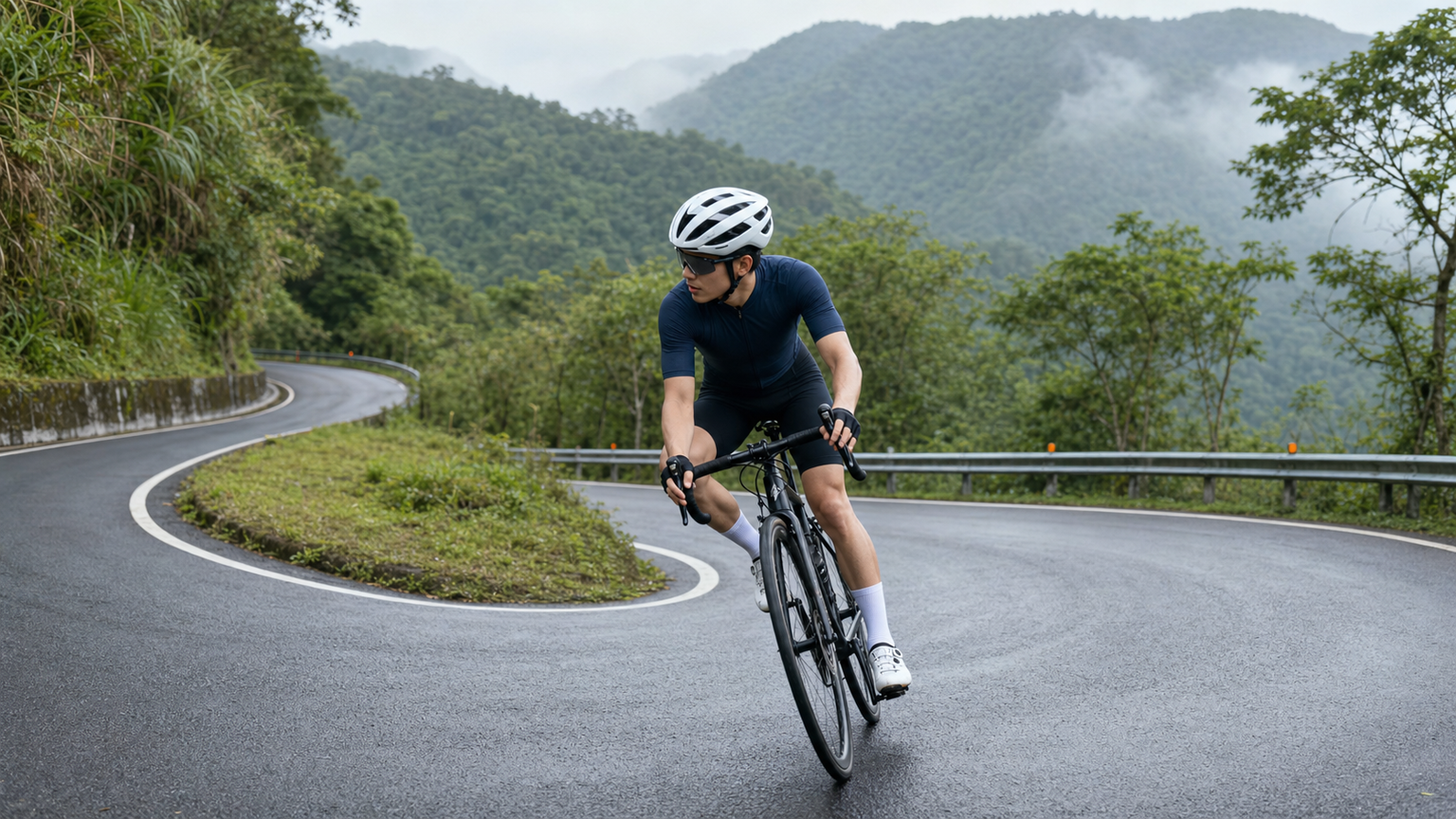
Many riders spend a great deal of time practicing climbing, yet overlook the importance of descending technique. In fact, downhill sections on Taiwan’s mountain roads are high-risk zones for accidents—wet pavement, hairpin turns, falling rocks, and trucks, combined with muscle fatigue after climbing, make descending a skill that demands serious study. The long descents of the Beiyi Highway and the treacherous hairpins on the western approach to Wuling are perfect stages to test your descending skills.
Physiological Transition After Climbing
When you finish climbing and enter a descent, your body needs to switch modes quickly:
- Muscle fatigue: Your quadriceps and glutes have been heavily taxed during the climb, reducing your stability in controlling the bike on the descent
- Hand fatigue: Prolonged gripping can numb your palms, affecting braking sensitivity
- Core fatigue: After a long climb, your core muscles are fatigued, diminishing your ability to control your center of gravity
- Distracted focus: The sense of relief upon reaching the summit lowers your alertness
It is recommended to do the following on the easier gradient before the descent (or during a brief rest at the summit):
- Mobilize your wrists and fingers to restore grip strength
- Adjust your riding position to ensure your core is engaged
- Rehydrate to prevent dehydration from impairing your judgment
- Confirm your brakes are functioning properly (squeeze them to feel the resistance)
Weight Management: The Core Skill of Descending
Basic Descending Weight Position
When descending, your center of gravity should shift backward, opposite to the forward-leaning posture used when climbing:
- Move your hips toward the rear of the saddle, or even slightly hover behind it
- Keep your arms slightly bent, with elbows absorbing road vibrations
- Bend your knees slightly, acting as shock absorbers for terrain undulations
- Look toward the exit of the corner, not at the ground in front of your front wheel
Weight Transfer in Corners
Corners are the most dangerous part of a descent. Proper cornering technique:
| Cornering Element | Correct Approach | Common Mistake |
|---|---|---|
| Speed before the corner | Brake before entering the corner; avoid braking mid-corner | Braking hard mid-corner can lock the wheels and cause a slide |
| Outside pedal | Press the outside pedal to its lowest point (6 o’clock position) | Inside pedal too low, striking the ground and causing a crash |
| Knee direction | Press the outside knee slightly toward the outside of the corner | Both legs parallel, losing lateral stability |
| Vision | Look toward the corner exit early | Staring at the apex, making the line too tight |
| Center of gravity | Lower slightly, letting the hips separate slightly from the saddle | Overly upright stance, center of gravity too high |
Braking Rhythm: The Art of Front and Rear Coordination
Front and Rear Brake Ratio
Many people use only the rear brake when descending, thinking it is safer, but this is actually a misconception:
- The front brake provides 60–70% of braking power, while the rear brake provides only 30–40%
- In an emergency, using only the rear brake extends stopping distance by 1.5–2 times
- Correct method: apply both brakes simultaneously, with about 70% force on the front and 30% on the rear
However, adjustments are needed on wet pavement:
- Taiwan’s mountain roads become extremely slippery in the rain; reduce the force on both brakes in such conditions
- Lean more toward the rear brake (50:50) to avoid locking the front wheel
- Enter corners slower and more conservatively
Intermittent Braking (Feathering)
Continuously squeezing the brakes on a long descent can overheat the brake discs or pads, reducing braking performance (known as “fade”). The correct approach is “intermittent braking”:
- Squeeze and release, giving the braking system time to cool down
- Avoid holding the brakes half-engaged for extended periods, as this neither brakes effectively nor stops generating heat
- Release slightly on straight sections to let the brakes cool, then apply force to slow down before entering corners
Special Considerations for Descending Taiwan’s Mountain Roads
- Gravel: Taiwan’s mountain roads are especially prone to gravel accumulation on the outside of corners; never lean over gravel while cornering
- Leaves: On routes like Beiyi and Yangjin in autumn and winter, fallen leaves are like black ice—treat them as slippery surfaces
- Drainage grates: Hitting a diagonally positioned drainage grate at high speed on a descent can cause the front wheel to slip instantly
- Oncoming traffic: Many of Taiwan’s mountain roads lack guardrails; stay to the right when descending and never cross the centerline when cornering
Practical Advice
- Before every descent, take 30 seconds at the summit to relax your shoulders and neck, releasing the tension built up from climbing
- When practicing descending, first feel out the braking force on a familiar straight section, then gradually take on corners
- Consider installing disc brakes (if you are still using rim brakes), especially for long descents where disc brakes offer better heat stability
- Relaxation is the most important thing when descending: a tense body increases the risk of crashing; keep your muscles supple
Conclusion
The glory of climbing lies at the summit, but riding safely back down is what makes a complete ride. Climbing technique gets you to the top; descending technique brings you back whole. Spend equal time practicing weight control and braking rhythm on descents, and you will not only get down faster—more importantly, you will return home safely every time, ready for the next journey to the summit.
Related Reading
- Descending Technique After Climbing: Safe Riding with Brake Control and Cornering Lines
- Advanced Descending Technique: Body Control for High-Speed Cornering on Road Bikes
- The Complete Guide to Descending: The Physics of Weight Control, Vision Guidance, and Brake Timing, with Progressive Practice Methods
- Descending Technique and Braking After Climbing: Making Descents as Worth Training as Climbs
大禹嶺 到 武嶺牌樓 全程前後實況錄影 | 北進武嶺 | 東進武嶺 | KOM | 訓練台 | 坡度分析 | Taiwan KOM Last 10 km HARD | 公路車
6 年前
CT 喇低賽) 武嶺牽車 才是王道 西進牽車四小時內秘訣 攝手位置 如何判斷 防抽筋小秘訣
7 年前
公路車 爬坡 破PR 紀錄 小技巧 分享
6 年前
西進武嶺 自製新版AI配速表產生器 x 賽前攻略 抱佛腳! 沒有功率計也可以產生配速表嗎?有什麼其他眉角賽前要注意的呢? | 西進武嶺 / 東進武嶺 KOM 攻略 | 公路車 | CT Yeh
4 年前
昇陽SYB車隊 & Fuji 菁英選手們的趣味經驗分享,長知識了!市民車友必看~ 一路被拉爆後才給問 | 戀戀197 武嶺 凸台經驗分享 | 公路車 | CT Yeh
4 年前
單車 梅山36灣 坡度介紹 路段介紹 空拍 (相關遊記影片,請參考說明或我的頻道喔,歡迎訂閱)
6 年前
FTL 與 SYB 車隊專訪 西進武嶺 實用攻略分享! 2小時 如何練?!你不知道的眉角!新手準備武嶺必看 EP1 | 實力派女車友 | 精華版 | 公路車 | CTYeh
4 年前
碟煞公路車 銑面器 !? 原來銑完差這麼多! 降低蹭碟機率! | TIME 公路車 保養小記錄 | CT Yeh
3 年前