Full Marathon Race-Day Strategy: Starting Pace, Aid Stations, and Picking Up the Pace in the Second Half
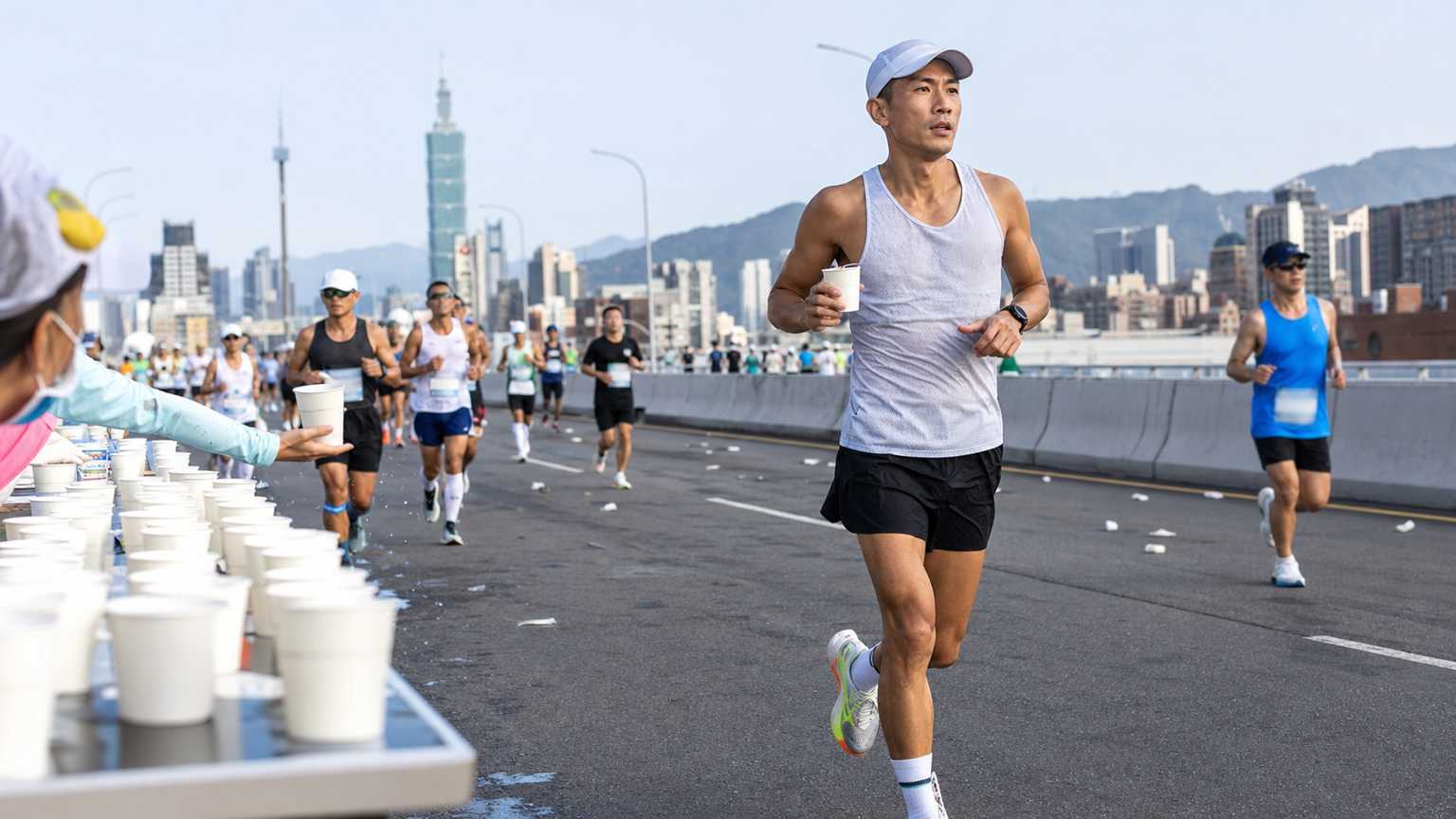
Introduction
Training is the foundation of a race; strategy is how that training pays off. At Taiwan’s major marathon events—whether it’s the Taipei Marathon looping around Taipei 101, the Wan Jin Shi Marathon along the Yehliu coast, or the sun-drenched Kaohsiung Marathon—countless well-prepared runners fall apart in the later stages every year because they started too fast or botched their fueling. A solid race-day strategy lets you cash in 100% of your 16 weeks of training, or even surpass it.
Pre-Race Preparation: 2 Hours Before the Start
The outcome of a race is often decided before the gun goes off. In the 2–2.5 hours before the start, you should complete:
- Final meal: 200–350 kcal, high-carb, low-fiber, low-fat (white rice, white toast, and bananas are the easiest options to find in Taiwan); avoid high-fiber foods like sweet potatoes and oatmeal
- Hydration: Finish 400–600ml of water 2 hours before the start, then top up in small amounts according to thirst
- Dynamic warm-up: 20–30 minutes before the start, complete 5–10 minutes of easy jogging plus dynamic stretching (ankle circles, forward/backward leg swings, lateral lunges)
- Toilet break: Bathroom lines at Taiwan marathon start areas are long; queue at least 45 minutes in advance to avoid pre-race urgency
Starting Pace Control: The Golden First 10K
Starting too fast is the most common marathon mistake, and it’s especially pronounced at Taiwan races—the crowd energy is high, the announcers are fired up, and the race atmosphere sends adrenaline soaring, causing many runners to go 30–60 seconds faster than planned pace in the first 5K.
The science: If you run the first 10K 10 seconds/km faster than your target MP, the probability of your pace collapsing in the final 10K exceeds 60% (research shows glycogen depletion rates increase non-linearly).
Pace execution strategy:
| Segment | Suggested pace offset (relative to MP) | Mental cue |
|---|---|---|
| 0–5K | MP +15"–+20" | “Deliberately hold back; it’s fine if people pass me” |
| 5–15K | MP +5"–+10" | “Rhythm is steady, start relaxing into the zone” |
| 15–25K | MP ±5" | “This is my pace, hold it” |
| 25–35K | MP ±0" | “The hardest stretch—rely on the memory of training” |
| 35–42K | MP –5"––15" | “Every step from here is a gain” |
Aid Station Strategy: Water, Electrolytes, and Energy Gels
Aid stations at Taiwan’s major marathons are typically set up every 2.5–3K, offering water and sports drinks. Here’s the optimal fueling execution:
Energy Gel Timing
- First gel: 30–40 minutes after the start (around 5–7K), while stomach digestion capacity is at its best
- Second gel: Around 75–80 minutes (around 13–14K)
- Third gel: Around 110–115 minutes (around 20–21K, near the half-marathon point)
- Fourth gel: Around 30K–33K (the most critical fueling, to prevent hitting the wall after 32K)
Take each gel with 100–150ml of water (not sports drink) to avoid stomach discomfort from mixing high sugar concentrations.
Aid Station Technique
- Start moving toward the aid tables 50 meters in advance to avoid the crowd crush
- Don’t come to a full stop when grabbing a cup—just ease off the pace slightly
- Master the “pinch-the-cup” method: pinch the cup opening flat so you don’t choke when drinking
- If the temperature exceeds 20°C on race day, pouring water over your head or the back of your neck at stations cools you down more effectively than drinking it
Picking Up the Pace in the Second Half: The Final Surge After 35K
A negative split is the most elegant way to run a marathon and the go-to strategy for elite runners. If you’ve managed your pace well in the first half, your body should theoretically be in better shape than most runners at the same pace, allowing you to gradually accelerate after 35K.
- 35K marker: If you’re feeling good at this point, try speeding up 5–10 seconds per kilometer
- 38K marker: Full-power mode—the remaining distance can be covered on willpower
- Mental weapon: On the final stretch of the Taipei Marathon, the straight section back onto Zhongshan North Road, the cheers from spectators and support groups are natural fuel for acceleration
Practical Tips
- Set watch alerts: Program per-kilometer pace range alerts on your GPS watch so you’re immediately warned if you go too fast
- Check the weather before the race: Taiwan’s winter marathons occasionally bring strong winds and cold snaps; adjust your pace 5–10 seconds slower accordingly to maintain energy efficiency
- Know your personal breaking point: If you’ve hit the wall at 30K or 35K in past marathons, take a gel 3K before that point and deliberately slow down 5 seconds per kilometer through the danger zone
- Mindset framework for the late race: When your legs start burning after 35K, replace the anxiety of “how much farther” with the thought that “every step shortens the distance”
Conclusion
Marathon race day is an art form of executing a plan flawlessly. Pace is the sheet music, fueling is the rhythm, and the second-half surge is the climax. When you cross the finish line, that feeling of “having completely controlled the entire race” is the ultimate reward for all the hard work of marathon training. On Taiwan’s winter racecourses, let’s all run our own personal bests.
Related Reading
- Marathon Race Day Strategy: A Scientific Pacing and Fueling Plan
- Road Race Starting Strategy: How Pace Control in the First 10% of the Distance Affects Finish Time
- Marathon Fueling Strategy: Water and Energy Intake During a Race
- Road Race Course Strategy: Speed Management on Straights, Curves, and Aid Stations
Live) 備戰2019彰化經典百K 賽前攻略 (已完賽請看新影片
7 年前
一日北高/長距離團騎 常見問題補充篇 / 組團或跟團的眉角 / 壯車友容易被瘦車友慢性拉爆 / 原來屁股痛可能是這個原因...? / 風場配速法 / 公路車 / CT Yeh
2 年前
一日北高前的高裝檢 | 北高 360 | 挑戰11小時的裝備 | 一日雙塔 | 補給
6 年前
西進武嶺 免費訓練分析服務 Intervals | 練不夠還是練過頭?你哪一種類型選手?AI模型告訴你! | 備戰神器 | 公路車 訓練 | CT Yeh
4 年前
西進武嶺 自製新版AI配速表產生器 x 賽前攻略 抱佛腳! 沒有功率計也可以產生配速表嗎?有什麼其他眉角賽前要注意的呢? | 西進武嶺 / 東進武嶺 KOM 攻略 | 公路車 | CT Yeh
4 年前
2019 夏季KOM 5小 完賽心得 準備攻略 東進武嶺 夏季登山王之路 Taiwan KOM Challenge
7 年前
#公路車 #西進武嶺 配速配瓦實驗 坡度分析 四小時內攻略 建大盃 NeverStop #西進武嶺攻略
6 年前
單車 一日北高 ( 雙城 ) 肥宅雙人瘋狂行 紀錄片 REACTO
10 年前