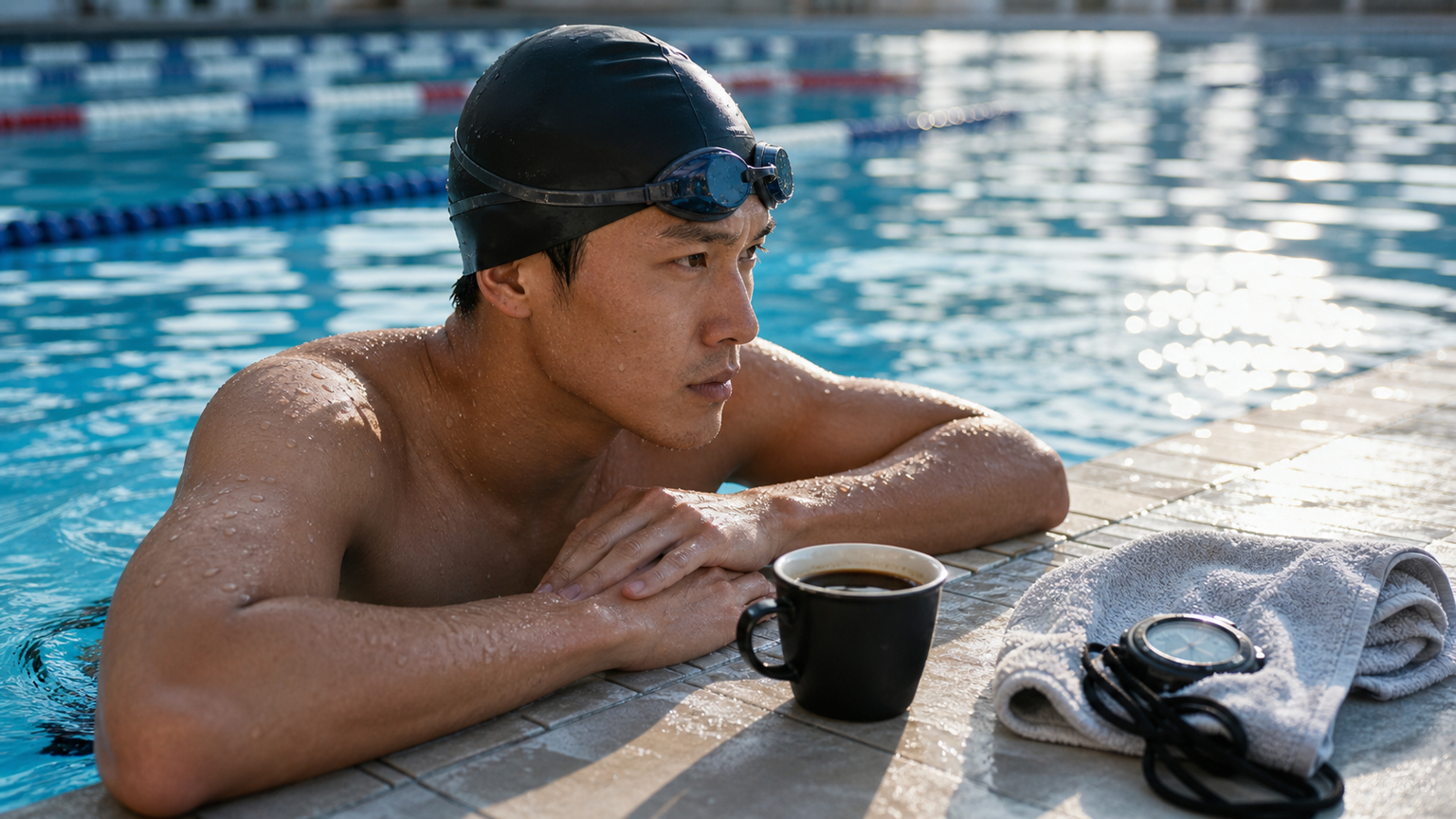
Introduction
Caffeine is one of the most well-supported ergogenic aids in sports science research today — so effective that it was listed as a controlled substance by the World Anti-Doping Agency (WADA) prior to 1984. Modern research shows that moderate caffeine supplementation can meaningfully boost both endurance and explosive power, and swimming is no exception. However, caffeine’s benefits depend heavily on precise timing and dosage — getting it wrong can fail to improve performance and may even cause anxiety, elevated heart rate, or gastrointestinal discomfort.
How Does Caffeine Improve Swimming Performance?
Caffeine’s performance-enhancing effects work through several mechanisms:
- Blocking adenosine receptors: Adenosine is a neurotransmitter associated with the perception of fatigue. Caffeine blocks its receptors, reducing the brain’s sense of tiredness
- Promoting adrenaline release: Increases cardiac output and boosts blood flow and oxygen delivery to working muscles
- Lowering rate of perceived exertion (RPE): Swimming at the same intensity feels “less tiring,” helping swimmers sustain higher speeds
- Improving muscle contraction efficiency: Studies show caffeine can slightly enhance fast-twitch fiber contraction force, benefiting short-distance explosive efforts
Research indicates caffeine can improve swimming performance by roughly 1–3%. That may sound small, but at the competitive level it’s often the margin between a podium finish and missing it.
Optimal Timing and Dosage
| Supplementation Timing | Notes |
|---|---|
| 45–75 minutes before the race | Blood caffeine concentration peaks 30–90 minutes after ingestion, making this the most commonly recommended window |
| 60 minutes before competition | The standard timing used in most research studies |
| Special considerations for early-morning races | Habitual caffeine users who abstain for more than 24 hours beforehand may see a more pronounced benefit |
Recommended dosage: 3–6mg per kg of body weight
| Body Weight | Low Dose (3mg/kg) | Medium Dose (5mg/kg) | High Dose (6mg/kg) |
|---|---|---|---|
| 50 kg | 150mg | 250mg | 300mg |
| 60 kg | 180mg | 300mg | 360mg |
| 70 kg | 210mg | 350mg | 420mg |
Meaningful benefits appear at around 3mg/kg. Doses above 9mg/kg produce no additional performance gain and instead raise the risk of side effects.
Caffeine Content of Common Foods and Drinks in Taiwan
- Freshly brewed Americano (240ml): approx. 80–150mg
- FamilyMart/7-Eleven Americano (240ml): approx. 80–120mg
- Latte (240ml): approx. 60–100mg
- Black tea (240ml): approx. 40–70mg
- GU Energy Gel (caffeinated version): approx. 20–40mg per packet
- Dark chocolate (30g): approx. 15–25mg
- Pre-workout supplements: 100–300mg per serving (use with caution)
Important Considerations for Caffeine Use
- Diminished effect for habitual users: Daily coffee drinkers develop reduced sensitivity to caffeine. Consider a 5–7 day “withdrawal period” before an important race to restore sensitivity
- Individual variation: Genetic variation (the CYP1A2 gene) affects caffeine metabolism rate — “fast metabolizers” see strong effects, while “slow metabolizers” may be more prone to side effects
- Avoid gastrointestinal irritation: Taking a large caffeine dose on an empty stomach can cause stomach discomfort; pair it with a small amount of food
- Avoid caffeine within 6 hours of bedtime: To prevent disrupting sleep quality and recovery
- Caution for younger athletes: Daily caffeine intake should not exceed 2.5mg per kg of body weight
Practical Recommendations
- Test your personal response to caffeine supplementation during non-critical training sessions to find the dose and timing that works for you
- Freshly brewed coffee or caffeinated energy gels make convenient, dose-controllable options for pre-race supplementation
- If you plan to abstain from caffeine before an important race, start at least 5 days ahead to avoid withdrawal headaches disrupting training
- Don’t treat caffeine as a substitute for sleep and recovery — it’s a bonus on top of a solid foundation, not a replacement for one
Conclusion
Caffeine is one of the few natural performance enhancers backed by robust scientific evidence. For Taiwanese swimmers, making smart use of an already-familiar daily coffee habit — by adjusting timing and dosage appropriately before competition — can yield a meaningful performance boost. The key is building a personalized strategy: understand your own sensitivity to caffeine, find your optimal supplementation window, and verify it repeatedly through training so that caffeine becomes a reliable ally on race day.
Related Reading
西進武嶺 自製新版AI配速表產生器 x 賽前攻略 抱佛腳! 沒有功率計也可以產生配速表嗎?有什麼其他眉角賽前要注意的呢? | 西進武嶺 / 東進武嶺 KOM 攻略 | 公路車 | CT Yeh
4 年前
西進武嶺 免費訓練分析服務 Intervals | 練不夠還是練過頭?你哪一種類型選手?AI模型告訴你! | 備戰神器 | 公路車 訓練 | CT Yeh
4 年前
CT暗黑廚房) 車友必備 宇宙無敵鮮蚵湯 幫助訓練恢復 天然食補 好市多 超肥鮮蚵 破PR
7 年前
[教學] Premiere 影片 手震 修正 教學 防抖 單眼 影像 GoPro 穩定 Video Stabilization
8 年前
#KOM 夏季登山王之路 比賽實況 #東進武嶺
7 年前
一日北高/長距離團騎 常見問題補充篇 / 組團或跟團的眉角 / 壯車友容易被瘦車友慢性拉爆 / 原來屁股痛可能是這個原因...? / 風場配速法 / 公路車 / CT Yeh
2 年前
2021 96聯賽 桃園市長盃 4K多視角實況 當天選手瓦數/推力比/均速/時間 即時數據分析 | 公路車 | CT Yeh
5 年前
靠單車減肥35公斤 心得分享與整理
7 年前