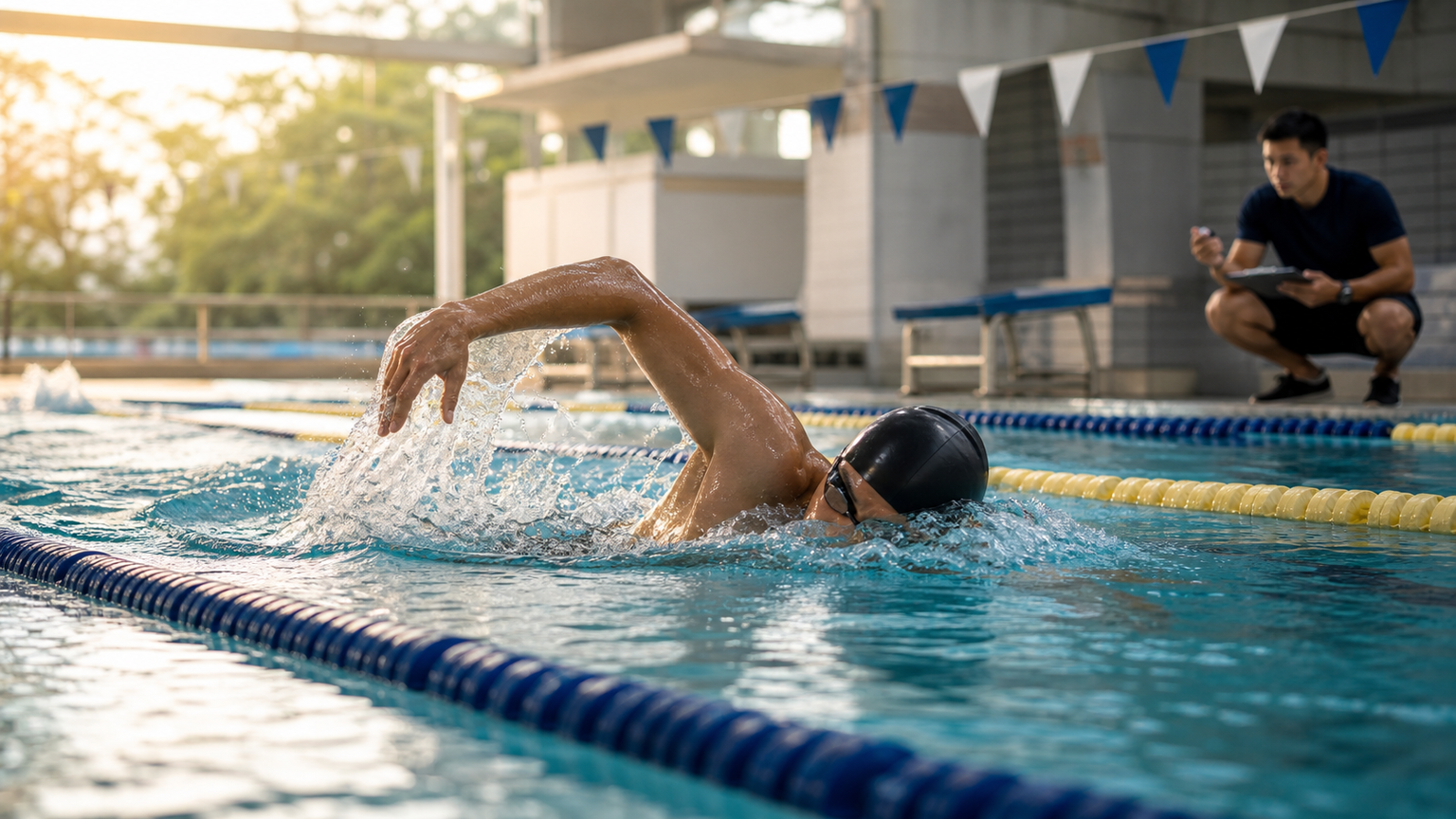
Introduction
Among swim fitness assessment tools, besides the CSS test and the 1500m timed swim, there is another assessment method that is highly practical for amateur athletes: the 4×100m Step Test. This test can simultaneously evaluate aerobic capacity, anaerobic threshold speed, and high-intensity endurance in a single session, making it an excellent source of data for designing training zones. This article will provide a complete introduction to the test method, data interpretation, and subsequent applications.
The Design Logic Behind the 4×100m Step Test
The concept of the Step Test originates from the “Graded Exercise Test” in sports science: progressively increasing exercise intensity at fixed increments while observing the body’s responses at each intensity level, thereby identifying key physiological thresholds.
Design principles of the 4×100m Step Test:
- 4 × 100m swims, with pace progressively increasing each repetition
- Uniform increments (approximately 5–10 seconds faster per 100m each repetition)
- Starting from easy aerobic effort, with the final repetition near maximal effort
- Fixed rest intervals between repetitions (typically 60–90 seconds)
Pre-Test Preparation
Equipment requirements:
- Waterproof timer or swim watch (with split/lap recording function recommended)
- Heart rate monitoring (optical heart rate on swim watch or heart rate strap; not mandatory but recommended)
- Recording sheet or phone notes
Preparation:
- Easy swim or complete rest the day before the test
- Thorough warm-up: 600m easy swim + 4×50m progressive pace swim
- Choose your usual pool to ensure accurate timing for each repetition
Test Protocol
Setting Target Pace for the 4 Repetitions (using CSS = 120 sec/100m as an example)
| Repetition | Target Pace (sec/100m) | Corresponding Intensity | Rest Interval |
|---|---|---|---|
| 1st | CSS + 20 sec = 140 sec | Easy aerobic (Zone E) | 90 sec |
| 2nd | CSS + 10 sec = 130 sec | Lower end of aerobic threshold (Zone A) | 90 sec |
| 3rd | CSS = 120 sec | Critical speed (Zone T) | 90 sec |
| 4th | CSS - 8 sec = 112 sec | High intensity (Zone I) | — |
If you are unsure of your CSS, you can estimate it first: set 4 speed targets intuitively using easy pace (E), moderate pace (A), fast pace (T), and near-maximal pace (I).
Recording Data
Immediately after each repetition, record:
- Actual time (seconds): Whether the target pace was achieved
- Heart rate (bpm): If using a swim watch, record the immediate heart rate after each repetition
- RPE (1–10): Subjective rating of perceived exertion
- Technical assessment: Whether stroke rhythm remained stable, or if technique began to break down
Data Interpretation
After completing the test, compile the 4 sets of data into a simple table:
Example results (based on actual test data):
| Repetition | Target | Actual Time | Heart Rate (bpm) | RPE |
|---|---|---|---|---|
| 1 | 140 sec | 141 sec | 118 | 3 |
| 2 | 130 sec | 131 sec | 138 | 5 |
| 3 | 120 sec | 122 sec | 158 | 7 |
| 4 | 112 sec | 109 sec | 176 | 9 |
Key interpretation points:
-
Relationship between heart rate and pace: If heart rate jumps sharply on the 3rd repetition (e.g., from 138 to 158, an increase > 15bpm), this pace is approaching the anaerobic threshold—the “aerobic-anaerobic transition point.”
-
RPE curve: RPE should increase linearly; if RPE spikes suddenly on a particular repetition, the intensity exceeded expectations and pace targets need recalibration.
-
Deviation between actual time vs. target: If the 4th repetition is significantly faster than the target (e.g., target 112 sec, actual 109 sec), the target pace was set too conservatively, and the settings can be raised for the next test.
-
Verifying CSS accuracy: If the 3rd repetition (CSS pace) feels like RPE 5–6, the CSS estimate is conservative, and the true critical speed may be faster.
How to Apply Test Results to Adjust Your Training Plan
Based on the test results, you can recalibrate the pace for each training zone:
- Zone E (aerobic recovery): 1st repetition time + 15 sec/100m or more
- Zone A (aerobic base): between the 1st and 2nd repetition times
- Zone T (threshold): between the 2nd and 3rd repetition times (around the anaerobic transition)
- Zone I (VO2max): between the 3rd and 4th repetition times
- Zone R (sprint): faster than the 4th repetition time (maximal explosive effort)
Practical Recommendations
- Repeat the test every 6–8 weeks to track whether heart rate responses at each intensity improve (lower heart rate at the same pace = improved aerobic capacity).
- Do not schedule other high-intensity training on test day to ensure test results reflect true fitness rather than fatigue.
- Don’t only focus on the last repetition: Many swimmers only pay attention to the 4th (fastest) repetition’s time, but improvements in the aerobic threshold are the core indicator of long-term progress.
- Invite a swim buddy to time you: When training at pools in Taiwan, having a partner who can time and record your results greatly improves test accuracy.
- Record environmental conditions: Water temperature and pool length (25m vs. 50m) both affect performance; keeping conditions consistent across tests is essential for meaningful comparisons.
Conclusion
The 4×100m Step Test is one of the most comprehensive fitness assessment tools that amateur swimmers can perform independently. In just about 20 minutes of testing time, you can simultaneously understand your current aerobic, threshold, and anaerobic capacities. For swimmers accustomed to training in Taiwan’s pools, regularly performing this test and dynamically adjusting training zones based on the results is the best way to ensure every session in the water is backed by clear scientific evidence.
Related Reading
- Swimming CSS Critical Swim Speed Test and Training Applications: Finding Your Aerobic Threshold Pace
- Swimming CSS (Critical Swimming Speed) Test: Calculation Methods Using 400m and 200m
- Swim Pace Training: Using 100m Baseline Pace to Design Training Targets for Each Intensity
- Long-Term Swim Fitness Development: A 2-Year Progression Roadmap for Amateur Athletes
西進武嶺 免費訓練分析服務 Intervals | 練不夠還是練過頭?你哪一種類型選手?AI模型告訴你! | 備戰神器 | 公路車 訓練 | CT Yeh
4 年前
單車 一日北高 ( 雙城 ) 肥宅雙人瘋狂行 紀錄片 REACTO
10 年前
Live) 備戰2019彰化經典百K 賽前攻略 (已完賽請看新影片
7 年前
#公路車 #Vo2Max #最大攝氧量 測驗 體驗 | 心肺測試
6 年前
實景訓練台) 彰化經典百K 高強度喵團 90分鐘 跟著一起練功 2019 Indoor workout Changhua Classic 100 Taiwan
7 年前
西進武嶺 自製新版AI配速表產生器 x 賽前攻略 抱佛腳! 沒有功率計也可以產生配速表嗎?有什麼其他眉角賽前要注意的呢? | 西進武嶺 / 東進武嶺 KOM 攻略 | 公路車 | CT Yeh
4 年前
單車AI教練!全新 ChatGPT4o 幫你分析訓練成果!排武嶺課表,分析騎車姿勢! 太神了! / 公路車 / CT Yeh / feat. 緯緯
2 年前
2019 夏季KOM 5小 完賽心得 準備攻略 東進武嶺 夏季登山王之路 Taiwan KOM Challenge
7 年前