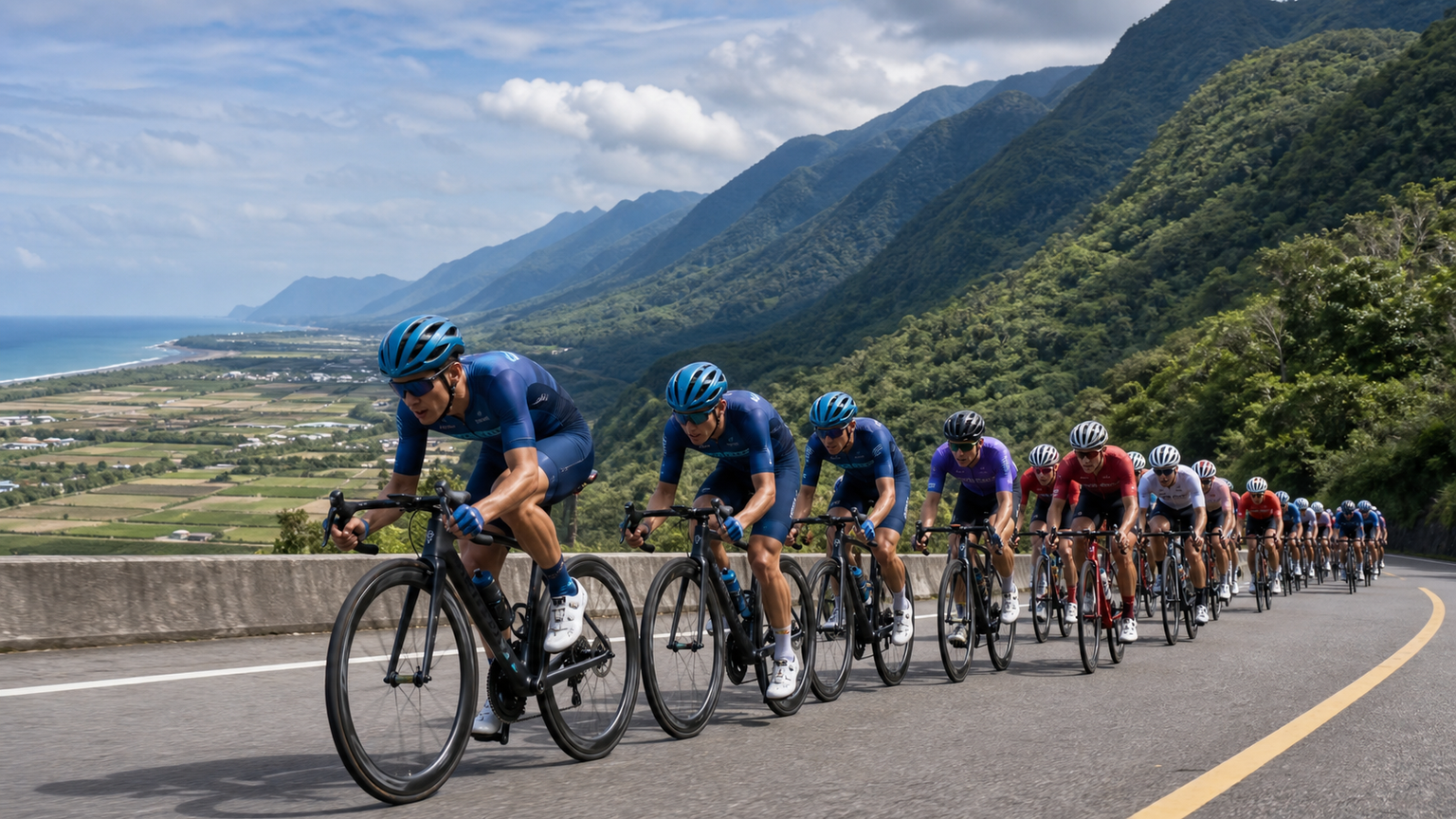
Introduction
The Tour de Taiwan has been held annually from March to April since 2005, making it one of the most representative UCI 2.Pro road races in the Asia-Pacific region. The race lasts six to seven days, with stage designs that combine the western plains, central mountain roads, and the eastern Huadong Rift Valley, offering distinctly different battlegrounds for various types of riders. Based on recent race routes, this article breaks down the tactical logic behind flat sprint stages and climbing decider stages.
Analysis of Typical Stage Types
| Stage Type | Representative Route | Total Elevation Gain | Who Benefits |
|---|---|---|---|
| Flat Sprint | Tainan → Chiayi | < 500 m | Sprinters |
| Hilly Mixed | Miaoli → Taichung | 800–1,200 m | Puncheurs |
| Mountain Climb | Wuling Summit Finish | 2,000 m+ | Climbers |
| Individual Time Trial | Flat TT | < 300 m | Time Trial Specialists |
Flat Stages: The Sprinter’s Arena
The western plains of Taiwan (Chianan Plain, Changhua Plain) are flat, with wind direction being the biggest variable. Flat stages of the Tour de Taiwan often see crosswind attacks near the finish, with strong teams actively splitting the peloton to drop heavier sprinters or those with weaker crosswind handling.
Key preparation points for sprinters:
- Save energy in the first 20 km, hiding in the middle-to-back of the peloton
- From the final 30 km, pay attention to wind direction and identify the formation of crosswind echelons
- Move into the top 10 positions in the final 3 km, relying on the leadout train for protection
- Launch a full sprint in the final 200 meters, sustaining at least 1,400 W (professional standard)
Climbing Stages: Tactical Rhythm on the Wuling Ascent
Wuling (elevation 3,275 m) is the most challenging summit finish in Tour de Taiwan history. The 2023 stage started from Puli with a cumulative elevation gain exceeding 2,400 meters. On such a long climb, sprinters are typically dropped within the first 30 km, and the battle for victory focuses on riders with a power-to-weight ratio (W/kg) of 6.2 or higher.
Key preparation points for climbers:
- Reserve anaerobic capacity for the “decisive steep section” in the final 5 km
- When rivals accelerate, respond with a steady tempo rather than impulsive reactions
- Control heart rate on descents to avoid excessive expenditure while chasing time
- Complete nutrition before the climb to reduce operational complexity on the ascent
Special Impact of Taiwan’s Terrain on Race Dynamics
- Taroko Gorge Section: Numerous sharp corners and significant wind tunnel effects make technical descending ability a decisive factor
- Huadong Rift Valley: Long north-south straight roads; headwinds from the south significantly slow the peloton, creating natural split points
- Coastal Highways: Persistent crosswinds require riders to precisely position themselves in the wind shadow; otherwise, energy expenditure is 1.3 times that of normal sections
Practical Advice
- When watching the Tour de Taiwan live, pay attention to the final 15 km on the elevation profile—this is where tactics are most intense.
- Amateur riders can use the official Tour de Taiwan Road Book to plan their own training routes.
- Climbing-oriented amateur riders can target Wuling, planning segmented climbing training to simulate race-day fatigue accumulation.
Conclusion
The stage design of the Tour de Taiwan reflects the diversity of Taiwan’s terrain, giving different types of riders the opportunity to compete for victory on this land. Whether you are enjoying professional racing or planning your own training, a deep understanding of stage types and tactical logic will make every ride more purposeful.
Related Reading
2019 夏季KOM 5小 完賽心得 準備攻略 東進武嶺 夏季登山王之路 Taiwan KOM Challenge
7 年前
2023桃園團體繞圈賽/環台賽等級拍攝/賽事精華/ 10人一隊缺一不可!50隊廝殺大場面 / 第三屆 海鷗繞圈賽 /公路車/CT Yeh
2 年前
單車 梅山36灣 坡度介紹 路段介紹 空拍 (相關遊記影片,請參考說明或我的頻道喔,歡迎訂閱)
6 年前
2025 海鷗團體繞圈賽 / 前八強賽事精華!/ 環台賽等級拍攝 / 國手菁英隊伍較勁 / CT Yeh #公路車
8 個月前
2025 崇越盃「西進武嶺」CT挑戰直播測試 / 公路車 / CT Yeh
1 年前
2023桃園團體繞圈賽 / 海鷗繞圈賽 | 全程空拍數據版 | 公路車 | CT Yeh
2 年前
Live) 備戰2019彰化經典百K 賽前攻略 (已完賽請看新影片
7 年前
2022 環花東挑戰賽 Day2 搭到特快車 高速真空吸引! 台東一路逆風殺回花蓮! 總排 ??| Feiyu Pocket 2s | 公路車 | CT Yeh
4 年前