Introduction
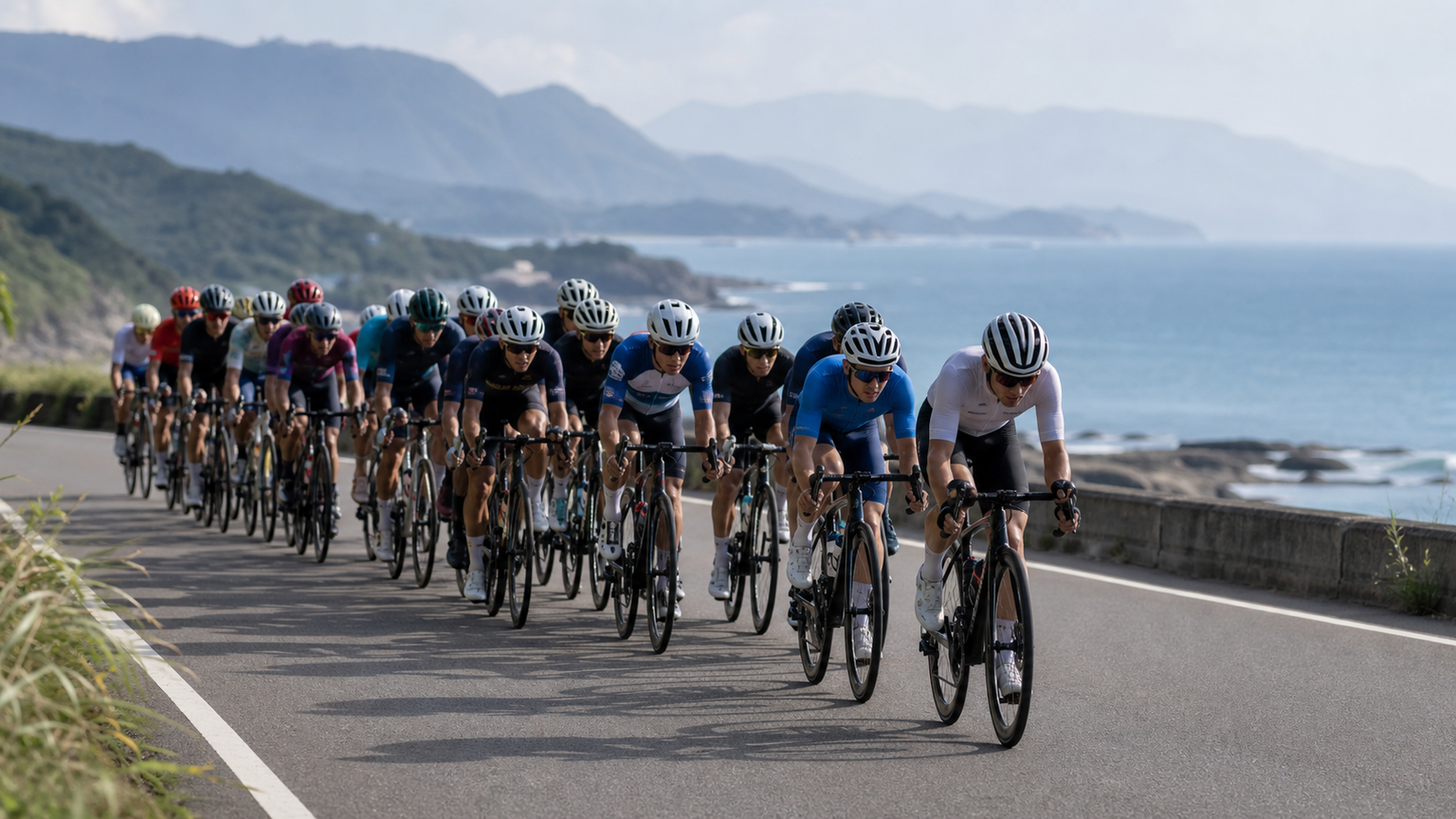
“Saving energy for the final sprint” is every road racer’s instinct, but in reality, where and how much energy you save depends on the art of position management within the peloton. Research shows that riding 0.5 meters behind the rider in front of you reduces drag by approximately 28–35%; however, the savings vary drastically depending on whether you are on the side or at the very back. This article starts with the fundamentals of aerodynamics and teaches you how to manage your position smartly in Taiwan’s road races.
Aerodynamic Benefits of Peloton Position
| Position | Relative Drag (Compared to Riding Solo) | Notes |
|---|---|---|
| Front of the peloton | 100% | Taking the wind, highest energy cost |
| 0.5 m directly behind the rider ahead | 65–70% | Most energy-efficient |
| Middle of the peloton | 50–60% | Multi-layer protection |
| Very back of the peloton | 70–80% | Requires active chasing |
| Side (crosswind) | 85–95% | Energy-saving when in an echelon |
Three Principles for Choosing Your Position
Principle 1: Stay Within the First Three Rows
The “Accordion Effect” is the issue beginners most often overlook. When the rider at the front of the peloton accelerates slightly, the shockwave amplifies layer by layer toward the back, and riders in the last five positions often need 30–50 extra watts just to match the same changes in pace. Therefore, on critical sections, you should try to stay within the first three rows.
Principle 2: Avoid Getting Cut Off by Crosswinds
Taiwan’s coastal highways (such as Provincial Highway 61 and the East Coast Highway in Hualien–Taitung) are the most severe crosswind sections. When crosswinds reach 20 km/h or more, the peloton often automatically forms an “echelon,” lining up diagonally to share the burden of the wind. If you fail to notice this change and continue following directly behind the rider ahead, you are effectively riding solo.
- Identify the direction of the crosswind (from the left or the right)
- Position yourself at the front on the windward side of the peloton, rather than at the back
- An echelon typically holds about 8–10 riders; beyond that, it splits into a “double echelon,” so move up to the front half as quickly as possible
Principle 3: Move Up Early Before Climbs
On climbs, the peloton slows down, the drafting effect weakens, and riders with weaker climbing ability are more easily dropped. One to two kilometers before an anticipated climb, push your way up to the top 10 positions to give yourself “buffer room,” so that even if you fall slightly behind when an attack comes, you still have enough distance to bridge back on.
Common Positioning Mistakes
- Following too far back: More than 1.5 meters behind the rider ahead, the energy-saving effect drops significantly, reaction time increases, and you are more likely to get caught in a pile-up
- Sticking too close to a wheel: Being too close (less than 0.3 meters) risks a rear-end collision in emergencies; adjust based on road conditions and speed
- Staying at the very back the whole time: It may seem energy-saving, but every acceleration costs you more, leaving you with worse legs later on
- Not watching the front of the peloton: Only staring at the bike directly ahead means you miss the signals of speed changes up front
Practical Advice
- Deliberately practice “peloton feel” in training: find three to five riders to practice drafting with, keeping a following distance of around 0.5 meters.
- When watching professional race broadcasts, pay attention to how commentators describe the formation of echelons—this is the most intuitive learning material.
- Familiarize yourself with the course before the race, mark the “crosswind sections” and “straight sections before climbs,” and plan your position changes in advance.
- Don’t give up observation entirely just to save energy: regularly glance at the movement of the 4–5 riders ahead of you to be ready to respond to sudden accelerations.
Conclusion
Peloton position management is not just a physical issue; it is a racing intelligence that requires constantly reading the wind, terrain, and opponents’ intentions. In Taiwan’s diverse terrain, riders who can flexibly switch positions often retain the most energy at the finish line—and that is what gives them the capital to fight for the final victory.
Related Reading
- Road Race Peloton Riding: Complete Guide to Position Selection and Energy-Saving Strategies
- Road Race Peloton Riding: How to Find a Safe Position in a 150-Rider Group
- Road Bike Peloton Riding Technique: Safe and Energy-Efficient Wheel-Sucking Skills
- Climbing in Races: Timing the Decision Between Staying in the Group and Going Solo
戰略) Zwift Race 如何咬在第一集團 如何評估自己要開多少推力 (請開1.5倍速看)
7 年前
CT 喇低賽) 武嶺牽車 才是王道 西進牽車四小時內秘訣 攝手位置 如何判斷 防抽筋小秘訣
7 年前
風櫃嘴 | 全台最多大砲的單車路線 | 尋寶網攝影師告訴你怎麼擺拍起來才好看 | 熱門攝影地點巡禮
6 年前
風櫃嘴時間 預測西進武嶺時間?13000名車友統計數據分析告訴你 !
5 年前
2025 海鷗團體繞圈賽 / 前八強賽事精華!/ 環台賽等級拍攝 / 國手菁英隊伍較勁 / CT Yeh #公路車
8 個月前
新屋團體繞圈賽 | 眾多菁英好手賽道奔馳 | 千瓦女子軍團 | 無敵交管狂獲好評 明年你一定不能錯過 | #公路車
5 年前
#公路車 #西進武嶺 配速配瓦實驗 坡度分析 四小時內攻略 建大盃 NeverStop #西進武嶺攻略
6 年前
西進武嶺 自製新版AI配速表產生器 x 賽前攻略 抱佛腳! 沒有功率計也可以產生配速表嗎?有什麼其他眉角賽前要注意的呢? | 西進武嶺 / 東進武嶺 KOM 攻略 | 公路車 | CT Yeh
4 年前