Aerodynamic Performance of Bike Wheelsets: Stability Analysis of Deep-Section Wheels in Crosswinds
Introduction
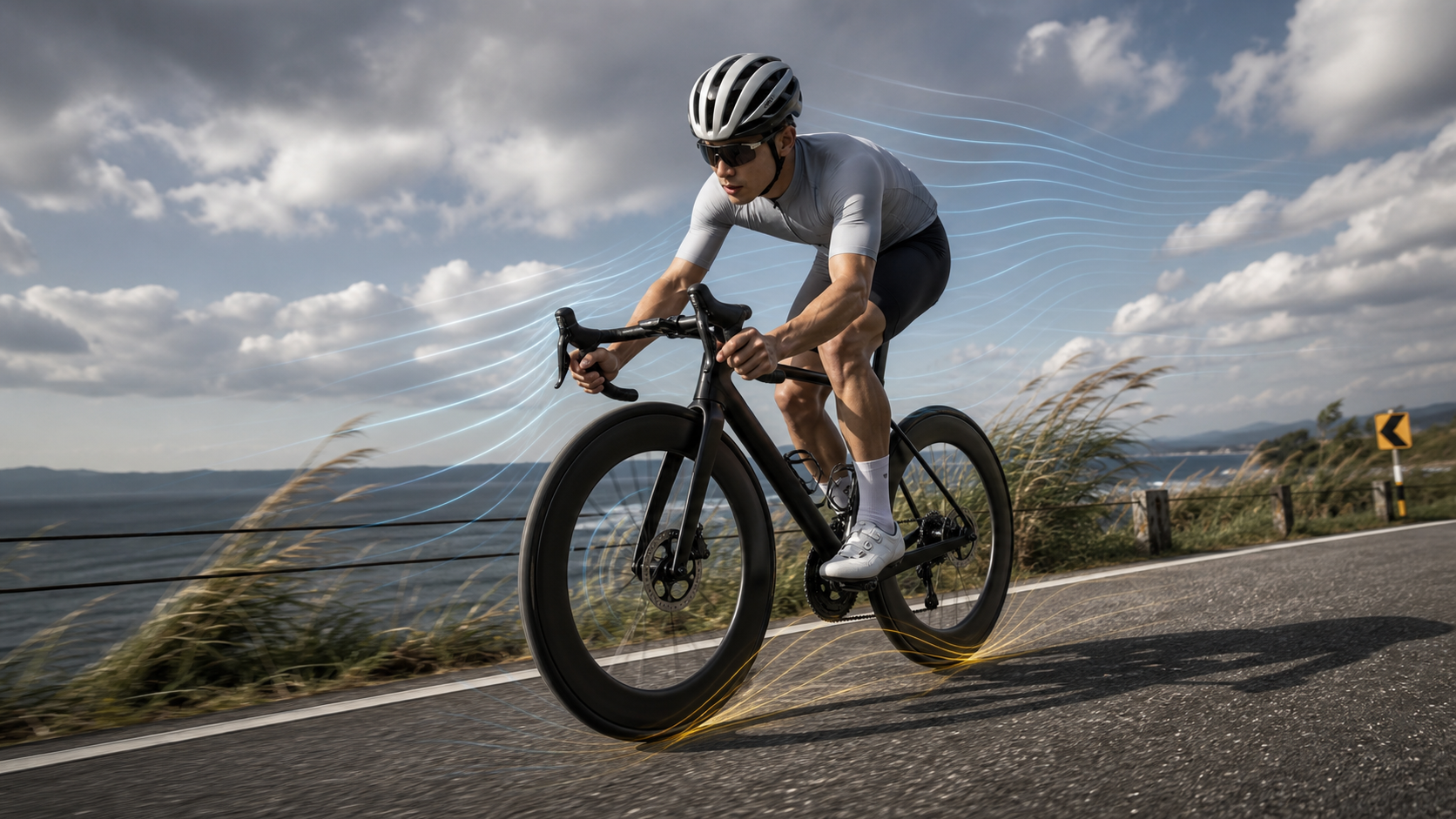
Standing at the Wuling Pass parking lot looking down, every Taiwanese cyclist dreams of descending the winding Central Cross-Island Highway at top speed. But when you consider upgrading to deep-section wheels for more speed, have you ever wondered how a 60mm deep-section wheel would react in the strong crosswinds at Hehuanshan Pass? Wheel selection is not just about aesthetics—it’s a discipline involving fluid dynamics, materials science, and handling safety.
Basic Principles of Wheel Aerodynamic Drag
A wheel’s contribution to the overall bike’s CdA accounts for approximately 10–15%. The aerodynamic efficiency of a rim shape depends on the following key factors:
Rim Cross-Section Design:
Traditional “Box Section” rims generate noticeable turbulence as air flows past. Modern aero wheels use an “Airfoil Section” design, allowing airflow to pass around the rim more smoothly and significantly reducing drag.
Effective Rim Depth:
The taller the rim, the more pronounced the airfoil effect and the greater the aerodynamic benefit. However, increased height also means a larger side profile, making the wheel more sensitive to crosswinds.
| Rim Depth | Aerodynamic Advantage | Crosswind Sensitivity | Best Use Case |
|---|---|---|---|
| 25–35mm (Shallow) | Low | Low | Mountain climbs, severe weather |
| 40–50mm (Mid) | Medium | Medium | Western Taiwan plains, mixed routes |
| 55–65mm (Deep) | High | High | Flat time trials, low-crosswind conditions |
| 80mm+ (Super Deep) | Highest | Very High | Time trials in calm conditions |
| Full Disc | Best on flats | Extremely High | Time trials (requires crosswind assessment) |
Crosswind Effects: The Importance of Yaw Angle
The degree to which a wheel is affected by crosswinds can be quantified using the “Yaw Angle”—the angle between the wind direction and the direction of travel.
Key Insights:
- In most riding conditions, the yaw angle falls between 0–15 degrees
- Within this range, deep-section wheels can actually generate a wing-like “lift” due to the airfoil effect, which reduces effective drag
- When the yaw angle exceeds 20 degrees (strong crosswinds), the side profile of deep-section wheels creates a massive “sail effect,” causing the handlebars to be pushed off course and making handling significantly more difficult
Typical Crosswind Sections in Taiwan:
- West Coast Expressway (Provincial Highway 61): Strong sea winds from the west—southwesterly in summer, northeasterly monsoon in winter; wheels deeper than 50mm are not recommended
- Valley openings crossing the Central Mountain Range (e.g., Wuling Pass, Taroko entrance): Valley effects cause sudden, gusty winds
- Tainan and Kaohsiung urban areas: Flat terrain but strong seasonal winds; careful assessment is required
Material Differences: Carbon vs. Aluminum Wheels
Beyond shape, materials also affect aerodynamic performance:
Carbon Wheels:
- Allow for more precise airfoil cross-section designs
- Lightweight, offering an advantage on climbs
- Braking (with rim brakes) generates heat buildup in wet conditions—a concern during Taiwan’s rainy season (recent hook-less disc brake wheels have improved this)
Aluminum Wheels:
- Stable braking performance, offering high safety in Taiwan’s rainy environment
- Limited cross-section design options; less aerodynamic than carbon
- Durable; the top choice for everyday training wheels
Practical Recommendations
- Long-distance flat touring around Taiwan: Choose 40–50mm mid-section carbon disc brake wheels, balancing aerodynamics with crosswind stability
- Mountain climbs in Taiwan (e.g., Wuling Pass, Hehuanshan): Choose 25–35mm shallow-section or even full-carbon climbing wheels, prioritizing weight
- Check the weather forecast: Confirm wind speeds before departure; avoid deep-section wheels over 60mm when winds exceed Force 4 (approximately 6m/s)
- First feel it out on low-speed sections: When first using deep-section wheels, familiarize yourself with the sensation of crosswind push on quiet, flat roads before heading onto major routes
- Tire pairing: Wide tires (25–28mm) paired with deep-section rims at appropriate pressures can further improve aerodynamic efficiency
Conclusion
The aerodynamic advantages of deep-section wheels are real, but they can only be realized in the right conditions. Understanding yaw angle and crosswind characteristics, combined with the wind patterns of Taiwan’s various road sections, will help you get the most out of your wheel investment. Choose your wheels scientifically, so speed and safety go hand in hand.
Related Reading
- In-Depth Analysis of Road Bike Wheels: Rim Depth, Tire Width, and Aerodynamics
- Wheel Aerodynamics: Why Rim Depth, Rim Width, and Tire Pairing Matter So Much
- Race Wheels and Aero Setup: Trade-offs Between 60mm, Disc Wheels, and Crosswinds
- How to Choose Rim Depth: Crosswind Stability Trade-offs and Real-World Differences Across Speed and Terrain
再一組! 全碳幅條 碟煞/無內胎輪組 開箱! 到底好騎嗎? UNAAS X40 | 公路車 | CT Yeh
4 年前
鉅齒紋輪組!? ControlTech MEG-T50 EVO 碳纖維幅條輪組/ 功率對比實驗 / 公路車 / CT Yeh
2 年前
Unaas X50 全碳纖幅條輪 數據實測對比PK | Lun Hyper 的高階版 | 板輪爬坡也可以很厲害? ! 武嶺2小時大師一起親測! CP值超高 | 公路車 | CT Yeh
4 年前
首發!LUN HYPER 第五代 2025最新版 碳幅條x鈦合金 輪組 D40 開箱 / 居然開始捲高端輪組了 / 公路車 / CT Yeh
11 個月前
Nepest NOVA 碳條輪組:輕量、空力、舒適一次滿足!/ 公路車 / CT Yeh
7 個月前
Vision Metron RS 37碳幅條輪組 (非SL)官網沒有的 低調開箱 / 這重量太銷魂了 / 公路車 / CT Yeh
6 個月前
一日北高/長距離團騎 常見問題補充篇 / 組團或跟團的眉角 / 壯車友容易被瘦車友慢性拉爆 / 原來屁股痛可能是這個原因...? / 風場配速法 / 公路車 / CT Yeh
2 年前
一日北高前的西濱集訓 | 跟著11小時軍團 | 300W踩不動的大逆風 | 輪車破風差幾瓦?
6 年前