Introduction
Wuling (3275m) is the holy mountain for Taiwanese cyclists, attracting thousands of challengers every year. Many people’s ultimate question is: “How much power do I need to climb it within a specific time?” This question has a precise physics answer. This article will build a complete mathematical model of climbing, giving your training goals a scientific basis.
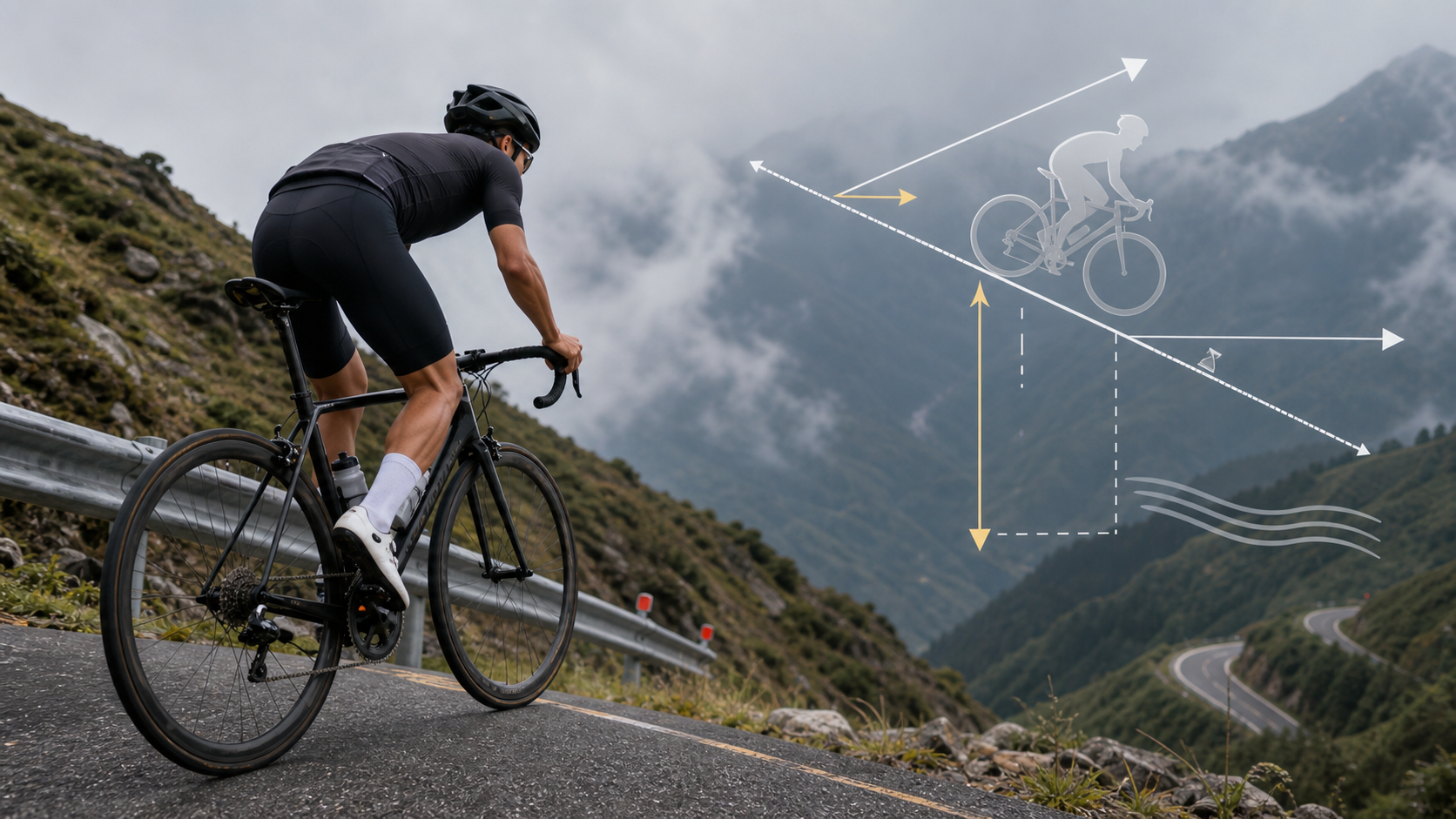
The Complete Equation for Climbing Resistance
The total resistance that needs to be overcome while riding can be broken down into the following components:
F_total = F_gravity + F_rolling + F_aero + F_bearing
- F_gravity (gravitational component): (m_rider + m_bike) × g × sin(θ)
- m_rider: rider weight; m_bike: bike weight; g: 9.81 m/s²; θ: gradient angle
- F_rolling (rolling resistance): Crr × (m_rider + m_bike) × g × cos(θ)
- F_aero (aerodynamic drag): ½ × ρ × v² × CdA
- F_bearing (mechanical friction): usually 1–2% of total resistance, often neglected
On steep gradients (gradient > 5%), gravity dominates (> 80%), and aerodynamic drag can be approximately ignored.
The Power-to-Speed Model
Required power (P) = F_total × v (speed)
Calculations for a 70kg rider + 8kg bike (78kg total) on a 10% gradient:
| Target speed | Gravitational resistance | Rolling resistance | Aerodynamic drag | Required power | Required W/kg |
|---|---|---|---|---|---|
| 8 km/h (2.22 m/s) | 767W… | Calculated value | Very low | ~185W | ~2.6 |
| 10 km/h (2.78 m/s) | — | — | — | ~232W | ~3.3 |
| 12 km/h (3.33 m/s) | — | — | — | ~278W | ~3.97 |
| 15 km/h (4.17 m/s) | — | — | — | ~348W | ~4.97 |
| 18 km/h (5.0 m/s) | — | — | — | ~418W | ~5.97 |
(These are approximate values, based on Crr=0.004, CdA=0.35, ρ=1.2 kg/m³)
W/kg: The Golden Metric for Climbing
Because gravity accounts for the vast majority of climbing resistance, climbing speed depends almost solely on W/kg (power-to-weight ratio), rather than absolute power:
A 60kg rider producing 240W = 4.0 W/kg
An 80kg rider producing 240W = 3.0 W/kg
With the same power output, the 60kg rider climbs significantly faster.
Climbing ability corresponding to each W/kg level:
- 2.0–2.5 W/kg: Beginner, Wuling challenge suggested at 240+ minutes
- 2.5–3.0 W/kg: Amateur entry-level, Wuling around 200–240 minutes
- 3.0–3.5 W/kg: Amateur intermediate, Wuling around 160–200 minutes
- 3.5–4.0 W/kg: Amateur advanced, Wuling around 130–160 minutes
- 4.0–4.5 W/kg: Elite amateur, Wuling around 110–130 minutes
- 4.5+ W/kg: Near-professional, Wuling possibly under 110 minutes
The Science of Pacing Strategy
The Wuling climb, from Lishan to Yuanfeng and then to Dayuling, has varying gradients. A proper pacing strategy should be based on:
- Maintaining a steady W/kg rather than a fixed speed: It is normal for speed to naturally vary with changes in gradient
- Avoiding “starting fast and blowing up”: Ride at a sustainable power output (about 90–95% of FTP), conserving energy for the final section
- Weight management: For every 1kg of body weight lost, you theoretically save about 10–15 minutes over the entire Wuling climb (approximately 1000m of elevation gain)
Practical Advice
- Test your FTP first: Use a 20-minute test or Ramp Test to determine your functional threshold power, then use 95% as your target power for long climbs
- Online calculation tools: Use Strava’s Power Estimator or BestBikeSplit to estimate a Wuling pacing plan
- Train weight management alongside: Losing 1–2 kg of body weight within a healthy range is equivalent to improving your FTP by about 5–8% for climbing performance
- Simulation training: On climbing routes such as Yangmingshan or Jiaoxi in Yilan, perform long-distance simulation rides at your target W/kg
- Equipment weight reduction: The bike accounts for about 10% of total weight; reducing a lightweight frame from 8kg to 7kg improves climbing speed by about 1–1.5%
Conclusion
The physics of climbing is clear and unforgiving: gravity does not lie, and W/kg determines everything. But this is also what makes it hopeful—power can be improved through training, weight can be reduced through dietary management, and every improvement in these numbers is directly reflected in your challenge time at Wuling. Let physics be the compass for your training plan.
Related Reading
- Power and Body Weight: A Complete Analysis of the Physics of Cycling Climbing Performance
- Power Strategies for Different Terrains: Principles of Power Distribution on Flats, Climbs, and Descents
- Power Training and Weight Loss: Calorie Expenditure Estimation and W/kg Body Weight Management Strategies
- Specialized Road Bike Climbing Training: Scientific Preparation for the Wuling Challenge
如果Pogačar騎西進武嶺可以多快?會破2嗎?各種情況深度推估探討 / 公路車 / CT Yeh
2 年前
西進武嶺 8000名單車友數據分析 PART1 | 從新手到高手數量/瓦數/推力比/FTP推力比/功率計使用率 大解析 | 公路車 | CTYeh
5 年前
#公路車 #西進武嶺 配速配瓦實驗 坡度分析 四小時內攻略 建大盃 NeverStop #西進武嶺攻略
6 年前
風櫃嘴時間 預測西進武嶺時間?13000名車友統計數據分析告訴你 !
5 年前
2019 夏季KOM 5小 完賽心得 準備攻略 東進武嶺 夏季登山王之路 Taiwan KOM Challenge
7 年前
大武山後門26%歡樂陡坡!JJSC南台灣單車行Day2 / 被颱風追著跑 / 公路車 / CT Yeh
2 年前
西進武嶺各路段 前8000名 大數據分析 配速攻略/功率/心律/推力比/維持率/踏頻/踏瓦比/牽車率 大公開 | 建大盃 NeverStop 可參考 | 公路車 | CT Yeh
5 年前
ThinkRider 智騎 XXPRO 訓練台,高階機種功能 只要 1/3價格!? 實測功率對比、噪音實測 / 公路車 / CT Yeh
1 年前