The Science and Buying Guide of Carbon-Plate Running Shoes: Which Runners Are Suited for Speed Shoes
Introduction
In 2019, the Nike Next% helped Eliud Kipchoge achieve his breakthrough 1:59 performance at the Berlin Marathon, and carbon-plate running shoes have been the hottest topic in road running ever since. Today, every major brand has released its own carbon-plate model, and at the start lines of Taiwan’s Taipei Marathon and Taichung Marathon, you can spot a pair of carbon-plate shoes almost every few steps. But who is this remarkable shoe actually suited for?
The Science Behind the Carbon Plate
The speed of carbon-plate running shoes comes from the combined effect of three key design elements:
1. Carbon Fiber Plate
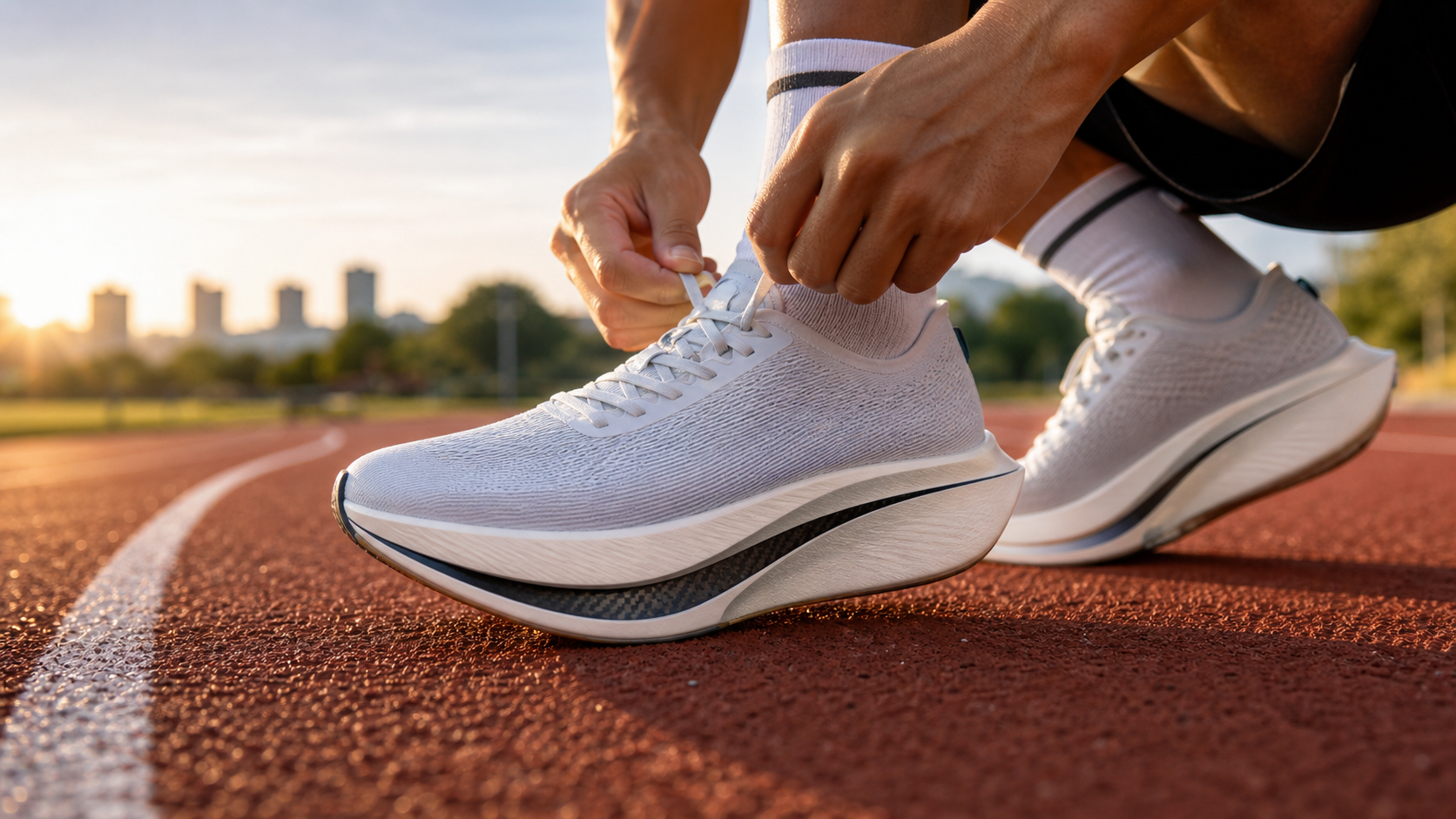
The carbon plate is embedded within the midsole and functions like a “spring board.” When the foot strikes the ground, the plate bends and stores energy; as the foot leaves the ground, the plate springs back and releases that energy, propelling the runner forward. Research shows this can reduce metabolic energy cost by about 4%.
2. High-Rebound Midsole Material
The carbon plate must be paired with a high-rebound foam to achieve its maximum effect, such as Nike’s ZoomX (made of PEBA) or ASICS’s FF Turbo used in the MetaSpeed line, both of which offer rebound rates above 85%.
3. Rocker Geometry Outsole
The outsole is shaped in an overall curve that guides the foot to roll forward quickly, shortening ground contact time and improving cadence efficiency.
Comparison of Popular Carbon-Plate Shoes
| Model | Brand | Weight (Men’s 27cm) | Stack Height | Characteristics |
|---|---|---|---|---|
| Vaporfly 3 | Nike | Approx. 198g | 40mm front / 32mm rear | Ultralight, exceptional rebound |
| Adizero Adios Pro 3 | Adidas | Approx. 215g | 39mm | Multiple carbon rods, slightly better stability |
| MetaSpeed Sky+ | ASICS | Approx. 215g | 40mm | Suited to high-cadence runners |
| Endorphin Pro 4 | Saucony | Approx. 210g | 39.5mm | Great value, a good first carbon-plate shoe |
| X3 | COROS Pace (OEM) | Approx. 190g | 40mm | A version commonly seen at races in Taiwan |
Which Runners Are Suited to Carbon-Plate Shoes
Carbon-plate shoes are not suitable for everyone. Here are the criteria to consider:
Runners suited to carbon-plate shoes:
- Full marathon finish time under 4 hours (pace of roughly 5:40/km or faster)
- Already have an established, stable forefoot or midfoot strike pattern
- Weekly mileage of 40–50km or more, with tendons and Achilles already having sufficient strength
- Have an important race goal and are willing to accept the high wear rate of carbon-plate shoes
Runners who should avoid carbon-plate shoes:
- Beginners or those with a full marathon time over 5 hours (running form not yet well established)
- History of Achilles tendinitis or plantar fasciitis (the leverage effect of the carbon plate increases the load on the Achilles tendon)
- Primarily using shoes for daily training (carbon-plate shoes have a lifespan of about 300–500km, making them poor value for this purpose)
Injury Risks of Carbon-Plate Shoes
Running in carbon-plate shoes is not without cost:
- Increased Achilles tendon load: The spring action of the carbon plate increases the eccentric contraction stress on the Achilles tendon, which may trigger Achilles tendinitis in runners with weaker tendons
- Transition-period injuries: Switching abruptly from cushioned training shoes to carbon-plate shoes, before the calf muscles have adapted, can easily lead to strains
- Over-reliance: Long-term dependence on the propulsive assistance of the carbon plate may weaken the active engagement of the glutes and core
Recommended approach: use carbon-plate shoes only on race day or during high-intensity training (such as tempo runs or interval training), while sticking to regular training shoes for daily easy runs.
Practical Tips
- Before wearing carbon-plate shoes for the first time, warm up on a treadmill for 5–10 minutes to get a feel for them — never go straight into a full-speed run
- Carbon-plate shoes and training shoes may fit differently in size; it’s best to try them out with an actual run rather than just standing in them
- Taiwan’s hot summer temperatures can slightly reduce the rebound of PEBA-based midsoles in carbon-plate shoes; avoid leaving your shoes exposed to prolonged sun before a race
- If your budget is limited, the Saucony Endorphin Pro and New Balance SC Elite series are relatively affordable in Taiwan and make a good entry point into carbon-plate shoes
Conclusion
Carbon-plate running shoes are a milestone in sports technology, but in the end they are an “assistive tool,” not a cure-all. What truly makes you faster is solid training, good running form, and adequate rest. Save your carbon-plate shoes for the races that matter most, and let them help you break your personal best exactly when you need it.
Related Reading
Nepest NOVA 碳條輪組:輕量、空力、舒適一次滿足!/ 公路車 / CT Yeh
7 個月前
Unaas X50 全碳纖幅條輪 數據實測對比PK | Lun Hyper 的高階版 | 板輪爬坡也可以很厲害? ! 武嶺2小時大師一起親測! CP值超高 | 公路車 | CT Yeh
4 年前
再快都跟的上!? 單車跟隨攝影機之王 HOVERAir X1 PROMAX 全面實測 / 唯一!8K畫質&自行車專用模式和跟蹤信標&前後避障 / DJI Neo 可參考/ 公路車 / CT Yeh
1 年前
#公路車 #Fitting 靠人工智慧APP 幫你調整單車
6 年前
單車 一日北高 ( 雙城 ) 肥宅雙人瘋狂行 紀錄片 REACTO
10 年前
高雄綠園道鐵路自行車道 / 外地人能輕鬆駕馭 還是整路崩潰? / 2025 全線開通 春節實地探索一次!(附GPS連結)/ 公路車 / CT Yeh
1 年前
全台首發!邁金P715踏板功率計!市場價格撼動者再出招 / 功率對比實測 / FAVERO ASSIOMA 可參考! / 公路車 / CT Yeh
1 年前
Vision Metron RS 37碳幅條輪組 (非SL)官網沒有的 低調開箱 / 這重量太銷魂了 / 公路車 / CT Yeh
6 個月前