Introduction
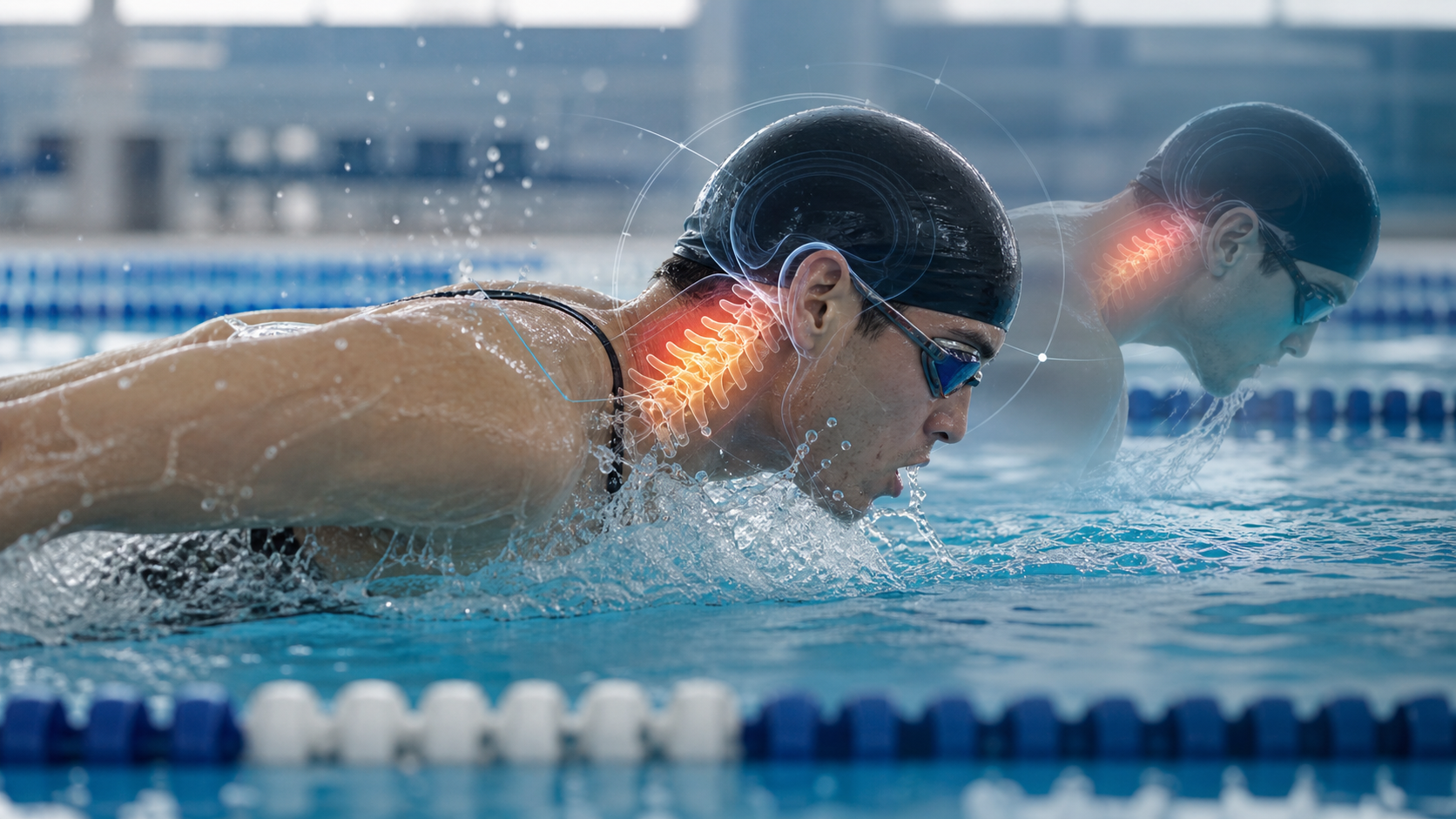
In Taiwan’s swimming classes, breaststroke is often the first stroke students learn, as it is relatively intuitive and easier to breathe; butterfly is the stroke with the highest technical threshold and the greatest physical load, usually a challenge goal for advanced swimmers. However, these two strokes share a hidden risk: repeated hyperextension of the cervical spine.
Long-term incorrect head-lifting breathing habits, combined with the widespread “prolonged sitting and forward head posture” issue among Taiwanese swimmers, put far more pressure on the cervical spine in the water than it should bear. Over time, this can easily trigger cervical disc degeneration, chronic fatigue of the neck muscles, and even symptoms of nerve compression.
Biomechanical Analysis of the Cervical Spine in the Two Strokes
Breaststroke
When breathing during breaststroke, the swimmer must quickly lift the head out of the water, pushing the chin forward and extending the cervical spine. At this moment, the cervical facet joints and intervertebral discs bear the greatest compressive force.
Typical incorrect postures:
- Lifting the head too high, looking forward instead of down at the water surface directly below
- Pushing the chin too far forward, causing local curvature of the cervical spine to exceed 30°
- Breathing too late, requiring the head to be lifted to a higher degree
Butterfly
When breathing during butterfly, the entire upper body rises with the dolphin undulation, and the neck must coordinate the “forward head-down breathing” motion. However, those with poor technique often mistakenly use active neck extension instead of relying on the hips and lower back to drive the body upward, causing excessive contraction of the neck muscles.
Typical incorrect postures:
- Leading with the head instead of using hip undulation to drive the whole body
- Excessive neck extension angle during breathing (> 45°)
- Chin lifted too high, causing overwork of the posterior neck muscles (semispinalis capitis, splenius capitis)
Cervical Spine Pressure Comparison
| Stroke | Cervical Spine Extension Motion | High-Risk Area | Relative Risk |
|---|---|---|---|
| Freestyle (correct) | Head rotates to the side, minimal extension | Cervical rotator muscles | Low |
| Breaststroke (correct) | Moderate head lift, chin slightly tucked | C4–C6 intervertebral discs | Medium |
| Breaststroke (poor) | High extension, chin pushed forward | C3–C5 posterior joints | High |
| Butterfly (correct) | Head-down breathing, neutral neck | Cervicothoracic junction | Medium |
| Butterfly (poor) | Neck replacing lower back, excessive extension | Entire cervical spine | Very High |
Posture Correction Key Points
Breaststroke Breathing Correction
- During breathing, the eyes should look level at the water surface (slightly below the horizon), not forward; at this point the chin naturally tucks slightly, greatly reducing the cervical spine extension angle
- Use the overall rise of the “head—shoulders—torso” rather than lifting the head alone
- Inhale as soon as the mouth leaves the water; do not wait until the entire face is out of the water, to shorten the head-lifting time
Butterfly Breathing Correction
- The driving force for breathing comes from the undulation of the hips and lower back pushing upward; the head is brought up by the body, not actively lifted
- Use the mental image of “chin close to the water surface, as if about to touch the water” during breathing practice
- You can first practice side-lying flutter board butterfly (dolphin kick only), focusing on feeling the hips driving the body’s undulation, then add the arm stroke and breathing
Neck Strengthening and Mobility Training
The following dry-land exercises are suitable for breaststroke and butterfly swimmers to perform 3 times per week:
- Neck isometric resistance: Press with the palm forward/backward/sideways while keeping the neck neutral and still, hold each direction for 10 seconds × 5 reps, to strengthen deep stabilizer muscles
- Prone head lift (neck extensor strengthening): Lie prone with the forehead lightly on the floor, slowly lift the head to horizontal, hold for 5 seconds, then slowly lower; 10 reps × 3 sets
- Cervical flexion/extension mobility: Slowly nod (chin to chest) → slowly extend backward, repeat 10 times each within a pain-free range
- Thoracic spine extension: Use a yoga block or foam roller under T4–T8, gently extend, to improve the overall spinal kinetic chain
Practical Recommendations
- If you have existing cervical disc herniation or cervical degeneration issues, consult an orthopedic doctor or physical therapist before starting butterfly or actively practicing breaststroke
- Perform gentle neck rotation and flexion/extension warm-ups before swimming, especially important for early morning swim training
- You can use a snorkel in the water for technique practice, temporarily removing the breathing requirement to focus on body posture and force transfer
- If neck pain persists for more than a week, or if arm numbness or radiating pain occurs, immediately stop the relevant stroke and seek medical attention
- Many swimming coaches in Taiwan are capable of in-water posture correction; if the budget allows, coached instruction is far more effective for posture correction than self-learning
Conclusion
The cervical spine is the most easily overlooked area in swimming injuries, because pain often only erupts after repeated accumulation. Understanding the cervical spine pressure characteristics of the stroke you regularly swim, combined with proper technique correction and dry-land strengthening training, can make swimming a protector of the cervical spine rather than a destroyer. Correct swimming posture is always the best rehabilitation prescription.
Related Reading
- Cervical Spine Issues and Swimming Breathing: Does Your Breathing Posture Hurt Your Neck?
- Neck Pain in Swimming: Injuries and Corrections from Improper Breathing Posture
- Excessive Head-Lifting Breathing in Swimming: Relaxation Exercises for Neck Stiffness
- Swimming for the Prevention and Improvement of Shoulder and Neck Soreness
一日北高/長距離團騎 常見問題補充篇 / 組團或跟團的眉角 / 壯車友容易被瘦車友慢性拉爆 / 原來屁股痛可能是這個原因...? / 風場配速法 / 公路車 / CT Yeh
2 年前
抖肩舞 台灣x日本交流版 (台灣 vs 前橋) 赤城山登山賽 coincidance
8 年前
一日北高常見問題大集合 | 攻略 | 路線 | 訓練 | 補給 | 自行車 單車 | 一日雙城 | 雙塔 | TWB北高360 | 屁股痛
6 年前
一起升級!海鷗盃LSD團練...JJSC Zone2招待 騎到手抖 / 公路車 / CT Yeh
2 天前
[教學] Premiere 影片 手震 修正 教學 防抖 單眼 影像 GoPro 穩定 Video Stabilization
8 年前
[防寒衣體驗] 鐵人魂 三鐵 防寒衣試穿會 於松運 深水游泳池 鯨魚池
8 年前
滑雪新手們慘摔學習全紀錄(請開字幕),滑雪好好玩 | Snowboard + Ski | 岩原 スキー場 | 滑雪APP使用 | GoPro Max
6 年前
Nepest NOVA 碳條輪組:輕量、空力、舒適一次滿足!/ 公路車 / CT Yeh
7 個月前